Mold Remediation in New Brunswick
24/7 mold remediation in New Brunswick, NJ. IICRC-certified, insurance billing accepted. Call (855) 650-7422.
Our IICRC-certified technicians are dispatched from our Fair Lawn, NJ headquarters and are typically on-site in New Brunswick within 60 minutes of your call.
New Brunswick’s combination of century-old rowhouses, dense student rentals near Rutgers University, and a riverfront that saw serious flooding during Ida in 2021 creates some of the most persistent mold conditions in Middlesex County. When a cast-iron drain backs up in a Robeson Village apartment or a basement wall wicks moisture after a Raritan River event, mold can begin colonizing porous materials in as little as 24 to 48 hours, often behind drywall or under flooring where it goes unnoticed until the smell becomes impossible to ignore.
Why New Brunswick Properties See Mold Issues
The housing stock in ZIP code 08901 tells a lot of the story. Blocks of early-1900s multifamily buildings near the Rutgers campus were built before modern vapor barriers existed, and many still rely on aging galvanized or cast-iron supply lines that develop pinhole leaks inside wall cavities. When those leaks go undetected, sometimes for weeks in a rental unit between tenants, moisture saturates wood framing, plaster lath, and the kraft-faced insulation common in mid-century construction. That combination feeds mold colonies that standard surface cleaning cannot reach.
The Raritan River corridor adds a second layer of risk. Low-lying areas near Boyd Park and the riverfront saw groundwater intrusion during Tropical Storm Ida that left crawl spaces and unfinished basements damp for days after the surface water receded. Elevated ambient humidity in those spaces, combined with limited ventilation in older foundation designs, creates conditions where mold returns even after a single remediation if the underlying moisture source is not fully addressed.
Downtown’s George Street corridor and the blocks surrounding Robert Wood Johnson University Hospital present a different pattern: commercial and institutional buildings with large HVAC systems, flat or low-slope roofs, and overnight occupancy gaps. A slow roof drain or a failed condensate line in a rooftop unit can saturate ceiling tiles and ductwork insulation before anyone arrives in the morning.
Our Mold Remediation Process in New Brunswick
Every job starts with a thorough moisture mapping inspection, thermal imaging and calibrated moisture meters to locate saturation behind walls and under flooring before any demolition begins. In New Brunswick’s older multifamily buildings, that step matters more than in newer construction because plaster walls and tongue-and-groove subfloors can hold water in places a visual check will miss entirely.
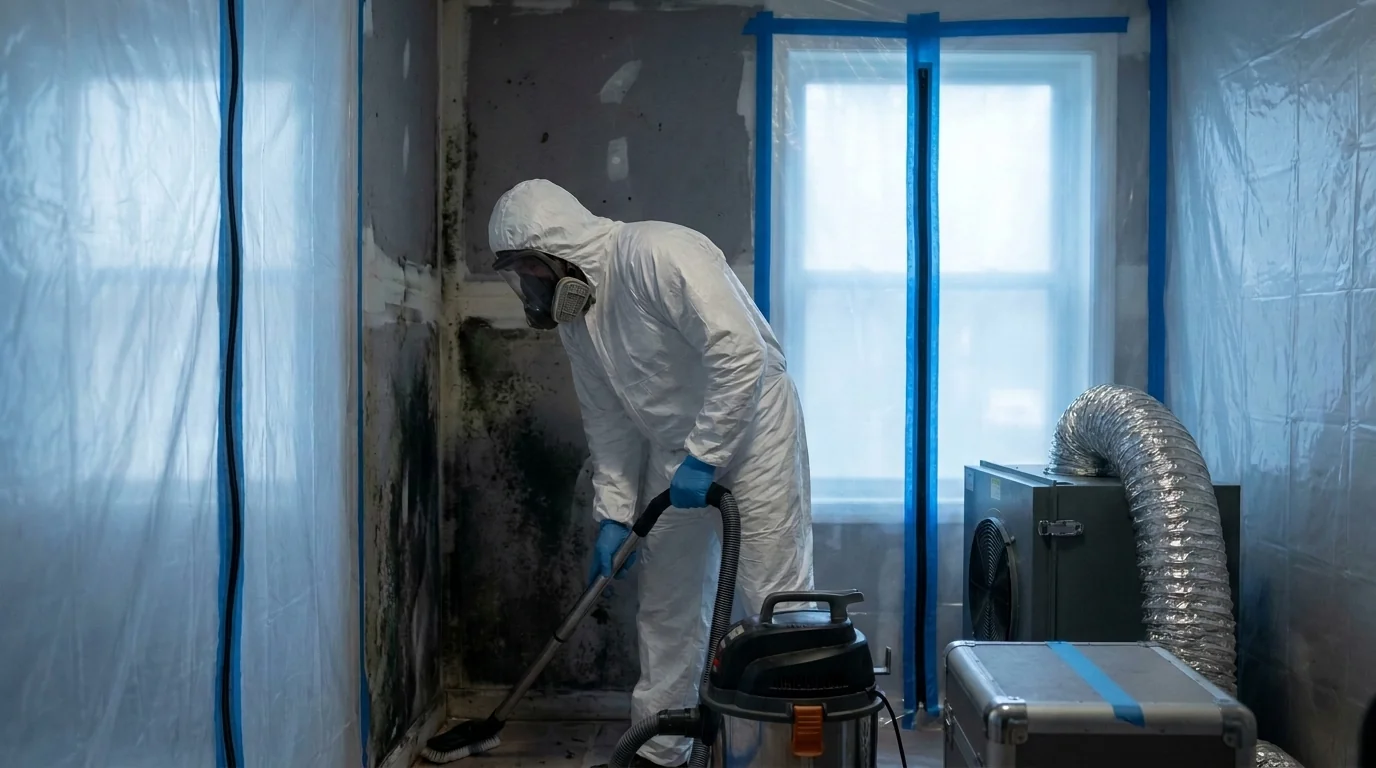
Once the affected area is defined, we establish negative-air containment using 6-mil poly barriers and HEPA-filtered air scrubbers running at negative pressure relative to adjacent living spaces. This is especially important in attached rowhouses and multi-unit buildings, the kind common in the Fifth Ward and Edgebrook, where spores can migrate through shared wall cavities to unaffected units if containment is not airtight.
Contaminated materials are removed, bagged, and disposed of per New Jersey DEP guidelines. Remaining structural surfaces are HEPA-vacuumed, treated with an EPA-registered antimicrobial, and dried to IICRC S520 standard moisture thresholds before any rebuild begins. As an IICRC Certified Firm (#210213), our protocols follow the industry’s published standard for mold remediation, not a shortcut version of it.
Reaching New Brunswick from Kenilworth
The Restoration Group operates 24/7 out of Kenilworth, roughly 12 miles northwest of New Brunswick via the Garden State Parkway to Route 1. That route keeps response times consistent regardless of whether the call comes from a Rutgers Village apartment, a downtown commercial property, or a single-family home near the Highland Park border. For calls originating in the 08901 or 08903 ZIP codes, our dispatch team confirms the fastest access point before the crew loads out, Route 18 and Route 27 are both viable depending on traffic and the specific block.
New Brunswick Insurance Coordination
Most mold losses in New Brunswick trace back to a covered water event, a burst pipe, appliance overflow, or storm-related intrusion, and the mold remediation is often a covered extension of that claim. We document affected areas with detailed photo logs, moisture readings, and scope narratives formatted for adjuster review. We work with most major carriers and can communicate directly with your adjuster to reduce back-and-forth delays. Landlords managing student rentals near Rutgers should be aware that some commercial landlord policies carry mold sublimits; reviewing that language before filing can prevent surprises at settlement.
Local Note
In New Brunswick’s older multifamily stock, particularly the attached brick rowhouses common in the Fifth Ward and blocks just off George Street, interior wythe walls (the inner layer of a double-brick exterior wall) frequently trap condensation during New Jersey’s humid summers. When a plumbing event adds liquid moisture to a wall cavity that is already running at high relative humidity, mold can establish on the back face of drywall or plaster lath within days. Crews unfamiliar with this construction type sometimes clear surface mold and close out the job without checking the cavity side of the wall. We probe and instrument those cavities before signing off, because a missed colony in a shared wall becomes someone else’s problem within a season.
If you are dealing with a mold situation anywhere in New Brunswick, whether it is a visible patch in a basement near Boyd Park or a musty smell you cannot locate in a Rutgers-area rental, call The Restoration Group at (855) 650-7422. We respond around the clock, assess the full scope before recommending demolition, and carry NJ Licensed Home Improvement Contractor status through the NJ Division of Consumer Affairs.
Serving New Brunswick from our Fair Lawn headquarters — ★ 4.8 · 166 Google reviews
“Prompt, knowledgeable, skillful and honest. Highly recommend. They remediated within 24 hours. Total peace of mind restored. Worth every penny.” - Anne, October 2026Read our reviews on Google →
Mold Remediation in New Brunswick: Service Coverage
Frequently Asked Questions
How fast can you arrive for mold remediation in New Brunswick?
Are homes near the Raritan River in New Brunswick at higher risk for recurring mold after flooding?
How does New Brunswick's older housing stock affect the mold remediation process?
Can mold spread between units in New Brunswick's attached rowhouses and multifamily buildings?
Does a mold remediation job in New Brunswick require a clearance test before the space can be reoccupied?
My New Brunswick rental property has a mold complaint from a tenant — what should I document before your crew arrives?
Will my homeowners insurance cover mold remediation in New Brunswick?
Mold Remediation response in New Brunswick
Most New Brunswick calls see a technician on-site within 60 minutes from our Fair Lawn headquarters.