24/7 Emergency Water Damage Restoration in New Brunswick
24/7 emergency water damage restoration in New Brunswick, NJ. IICRC-certified, insurance billing accepted. Call (855) 650-7422.
Our IICRC-certified technicians are dispatched from our Fair Lawn, NJ headquarters and are typically on-site in New Brunswick within 60 minutes of your call.
The Raritan River has flooded George Street-area basements before, Ida in 2021 pushed water into low-lying riverfront blocks near Boyd Park in ways that caught even longtime New Brunswick property owners off guard. But most water damage in the city never involves a named storm. It starts with a corroded cast-iron drain stack in a century-old rowhouse off Robeson Village, a burst supply line behind a Rutgers Village apartment wall, or a sprinkler head that trips overnight in a George Street restaurant and soaks a finished basement by morning. The Restoration Group responds 24/7 from Kenilworth, bringing certified structural drying and water extraction to New Brunswick properties before secondary damage compounds the loss.
Why New Brunswick Properties See More Water Damage Events
New Brunswick’s housing stock is unusually varied for a mid-size city, and that variety creates layered risk. The Fifth Ward and blocks near Rutgers University are dense with early-1900s rowhouses and multifamily buildings where original galvanized supply lines and cast-iron drain stacks are well past their service life. These pipes don’t fail dramatically, they weep, they seep, they drip inside wall cavities for weeks before a ceiling gives way. Edgebrook and postwar neighborhoods carry a different problem: slab-on-grade construction and aging sump systems that struggle during heavy rain events when the water table rises.
Downtown and the George Street corridor add commercial exposure. Restaurants, retail spaces, and office buildings with aging sprinkler infrastructure generate overnight losses that can saturate multiple floors before anyone arrives in the morning. Robert Wood Johnson University Hospital and university buildings represent continuous institutional risk, large square footage, complex mechanical systems, and occupancy requirements that compress the drying timeline. ZIP code 08901 alone covers a cross-section of all of these building types.
Our Water Damage Restoration Process in New Brunswick
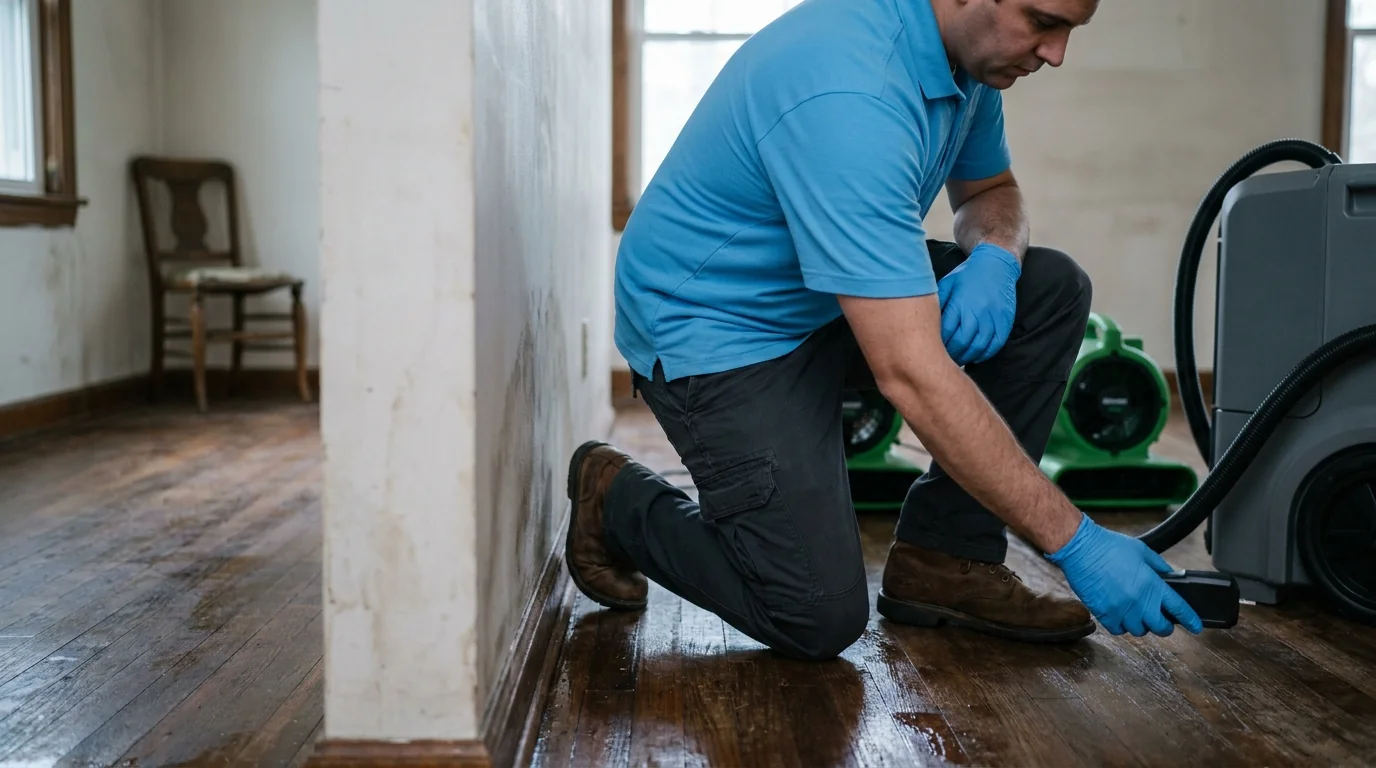
When we arrive, the first priority is stopping the source and containing the spread, not writing an estimate. We use thermal imaging and moisture meters to map hidden saturation inside walls, under flooring, and above drop ceilings before a single piece of equipment is placed. In New Brunswick’s older rowhouses, that mapping step is especially important: plaster-and-lath construction common near the Highland Park border absorbs water differently than modern drywall, holding moisture deeper and releasing it more slowly during the drying phase.
After extraction, we establish a drying system calibrated to the specific materials and square footage, commercial-grade desiccant or refrigerant dehumidifiers, air movers positioned to create directional airflow, and daily moisture readings logged against the IICRC S500 drying standard. We document every reading, every affected material, and every piece of removed content in a format that works directly with insurance adjusters. For multi-unit buildings near Rutgers, we coordinate floor-by-floor access with building managers to keep unaffected units clear of equipment staging.
Reaching New Brunswick from Kenilworth
Kenilworth sits roughly 12 miles northwest of downtown New Brunswick via the Garden State Parkway to Route 1, a route that stays accessible even during off-peak hours. For addresses in the Fifth Ward or near Robeson Village, we typically route through Route 27 south, which feeds directly into the city’s residential grid. Downtown and hospital-adjacent calls near Robert Wood Johnson are straightforward from either approach. Because we operate 24/7, we can dispatch for burst pipes, appliance failures, and storm-driven flooding at any hour, the kind of events that don’t wait for business hours in a city with this density of rental housing and commercial property.
New Brunswick Insurance Coordination
Most homeowner and commercial property policies cover sudden and accidental water losses, a burst pipe qualifies; long-term seepage typically does not. In New Brunswick’s rental-heavy market, the coverage picture gets more complicated: a tenant’s renters policy, a landlord’s dwelling policy, and a building owner’s commercial policy can all be in play simultaneously for a single event in a multifamily building. We document the loss with photographs, moisture logs, and itemized scope from the first visit, and we bill major carriers directly so property owners aren’t fronting the full cost out of pocket. If a loss involves a common area in a building with a condo association or property management company, we can coordinate scope documentation with their adjuster as well.
Local Note
In New Brunswick’s older rowhouses, particularly blocks in the Fifth Ward and near the Rutgers campus, original plaster walls sit over wood lath rather than paper-faced drywall. When these walls get wet, they don’t buckle and crumble the way modern drywall does; instead, they hold moisture for an extended period, sometimes reading dry at the surface while the lath and framing behind remain saturated. We’ve learned to extend drying timelines and increase monitoring frequency on these structures rather than calling a job complete based on surface readings alone. Closing out too early in this building stock is one of the most common causes of mold growth appearing weeks after a restoration is supposedly finished.
Serving New Brunswick from our Fair Lawn headquarters — ★ 4.8 · 166 Google reviews
“Prompt, knowledgeable, skillful and honest. Highly recommend. They remediated within 24 hours. Total peace of mind restored. Worth every penny.” - Anne, October 2026Read our reviews on Google →
Water Damage Restoration in New Brunswick: Service Coverage
Frequently Asked Questions
How fast can you arrive for water damage restoration in New Brunswick?
How quickly can The Restoration Group reach a water emergency in the Fifth Ward or near Rutgers Village?
Are the older rowhouses near Robeson Village and the Rutgers campus harder to dry out after a water loss?
New Brunswick has a lot of multifamily rentals — how do you handle water damage in a building where a tenant's unit and a landlord's policy are both involved?
What does structural drying actually involve, and how long does it typically take in a New Brunswick property?
Does flooding from the Raritan River near Boyd Park create a different kind of water damage claim than an indoor pipe burst?
Will my homeowners insurance cover water damage restoration in New Brunswick?
Water Damage Restoration response in New Brunswick
Most New Brunswick calls see a technician on-site within 60 minutes from our Fair Lawn headquarters.
Nearby & Related
- 24/7 Emergency Water Damage Restoration in Kenilworth
- Restoration Services in New Brunswick
- 24/7 Emergency Fire Damage Restoration in New Brunswick
- Mold Remediation in New Brunswick
- 24/7 Emergency Water Damage Restoration in Bayonne
- 24/7 Emergency Water Damage Restoration in Bloomfield
- Contact The Restoration Group