Water Cleanup in Newark
24/7 water cleanup in Newark, NJ. IICRC-certified, insurance billing accepted. Call (855) 650-7422.
Our IICRC-certified technicians are dispatched from our Fair Lawn, NJ headquarters and are typically on-site in Newark within 60 minutes of your call.
When a pipe bursts in a Ironbound row house or a combined sewer backs up into a Weequahic basement during a nor’easter, the water doesn’t wait for business hours — and neither do the consequences. Newark’s dense pre-war housing stock, aging municipal infrastructure, and proximity to the Passaic River create a water damage environment that’s more complicated than a typical suburban leak, and cleanup that ignores those conditions will leave moisture behind long after the fans are gone. The Restoration Group responds 24/7 from Kenilworth to address water emergencies across the city before secondary damage sets in.
Why Newark Properties See Water Cleanup Issues
Newark’s vulnerability to water intrusion is structural, not accidental. The city’s combined sewer system — one shared pipe for stormwater and sanitary waste — was built for a different era’s rainfall. When heavy storms push beyond the system’s capacity, the overflow has nowhere to go but up through floor drains and basement toilets. This is a citywide pattern, but it hits lowest-lying neighborhoods hardest. The Ironbound district, tucked along the Passaic River near ZIP code 07105, flooded severely during Tropical Storm Ida and remains one of the most flood-exposed urban neighborhoods in New Jersey.
The housing stock compounds the problem. Newark’s brick multifamily buildings and frame two- and three-families — many built before World War II — have plaster walls, older cast-iron plumbing, and foundations that weren’t designed with modern waterproofing expectations. When a single riser fails in a three-story building, water travels through floor assemblies and wall cavities across multiple units before anyone notices a ceiling stain. Forest Hill’s grand colonials present a different challenge: larger square footage, finished basements, and older copper or galvanized supply lines that can fail without warning.
Our Water Cleanup Process in Newark
Effective water cleanup in Newark starts with understanding what’s behind the walls, not just what’s visible on the floor. The process follows the IICRC S500 standard for water damage restoration, adapted to the realities of Newark’s building types.
Assessment and containment come first. Moisture meters and thermal imaging cameras identify saturation in plaster, brick cavities, and subfloor assemblies that look dry at the surface. In multifamily buildings, this step also determines whether adjacent units are affected — a critical question for landlords and property managers who need to know their exposure before calling their carrier.
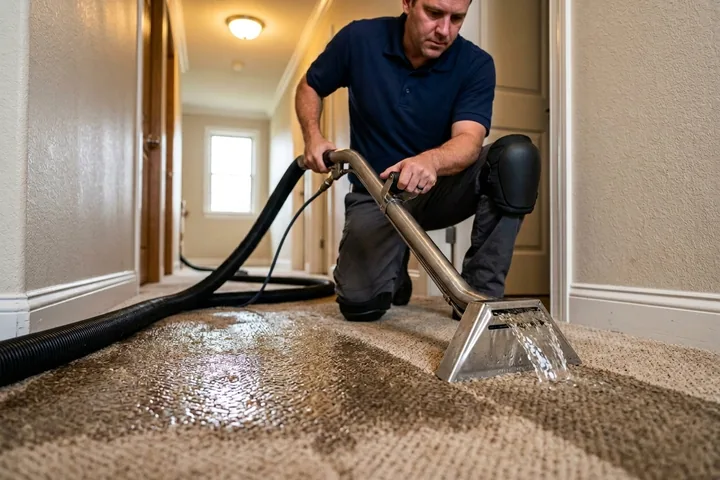
Standing water removal uses truck-mounted and portable extraction equipment sized to the space. Basement flooding from sewer backup requires both water extraction and antimicrobial treatment, since combined sewer overflow is classified as Category 3 (grossly contaminated) water under industry standards.
Structural drying in Newark’s older buildings takes longer than in newer construction. Plaster releases moisture slowly and can hold saturation even when the surface reads dry. Drying chambers, desiccant dehumidifiers, and directed airflow are calibrated to actual moisture readings — not to a standard number of days — and documented throughout for insurance purposes.
Debris removal and documentation close out the mitigation phase. Every affected material is photographed, measured, and logged in a format that insurance adjusters can work with directly.
Reaching Newark from Kenilworth
Kenilworth sits just off the Garden State Parkway, and McCarter Highway (Route 21) runs directly into Newark from the south, making the Ironbound, Downtown Newark, and University Heights reachable without navigating surface-street congestion. For neighborhoods further north — Forest Hill, Vailsburg, or areas near Branch Brook Park — Route 21 north or I-280 west provides a direct corridor. Because The Restoration Group operates 24/7, dispatch goes out the moment you call (855) 650-7422, regardless of the hour.
For property managers overseeing multiple buildings across Newark’s ZIP codes, a single call initiates response across all affected addresses — no need to coordinate separate vendors for a multi-unit loss.
Newark Insurance Coordination
Newark’s density means water losses frequently involve multiple parties: a building owner, tenants, a property management company, and sometimes a commercial carrier alongside a residential policy. The Restoration Group documents losses in a format designed for insurance submission — moisture logs, photo evidence, scope of work, and material inventories — so the claim file is complete from day one.
Landlords and institutions near the arena district and Newark Penn Station corridor often carry commercial policies with different documentation requirements than standard homeowner’s policies. The team is familiar with both and can coordinate directly with adjusters to keep the process moving.
Local Note
In Newark’s Ironbound and other neighborhoods with combined sewer infrastructure, basement flooding after heavy rain almost always involves sewer backup rather than clean groundwater intrusion — even when it doesn’t smell like it immediately. As Category 3 contaminated water dries, odor compounds can become more concentrated, not less. Treating this class of loss as a simple water extraction without proper antimicrobial protocol and material removal is a common mistake that leads to odor callbacks weeks later. Any basement flood following a storm in ZIP codes like 07105 or 07106 should be evaluated for contamination before drying equipment is placed.
If you’re dealing with standing water anywhere in Newark — a flooded basement in the Ironbound, a soaked ceiling in a Forest Hill colonial, or a commercial space near Prudential Center — call (855) 650-7422. The Restoration Group, an IICRC Certified Firm (#210213) and NJ Licensed Home Improvement Contractor, is available around the clock to assess the damage, extract the water, and document everything your insurance carrier needs.
Water Cleanup in Newark: Service Coverage
Frequently Asked Questions
How fast can you arrive for water cleanup in Newark?
The Ironbound flooded during a storm and the water smells — is that a sewage backup?
How does water damage in Newark's older brick and plaster buildings differ from newer construction?
Can you respond to water emergencies in Newark at night or on weekends?
I'm a landlord with units in ZIP code 07105 — how do you handle water losses that affect multiple tenants?
What does the water cleanup process look like from start to finish, and how long does it typically take?
Will my homeowners insurance cover water cleanup in Newark?
Water Cleanup response in Newark
Most Newark calls see a technician on-site within 60 minutes from our Fair Lawn headquarters.