Mold Inspection and Testing in North Bergen
24/7 mold inspection and testing in North Bergen, NJ. IICRC-certified, insurance billing accepted. Call (855) 650-7422.
Our IICRC-certified technicians are dispatched from our Fair Lawn, NJ headquarters and are typically on-site in North Bergen within 60 minutes of your call.
The dense hillside blocks of North Bergen, packed with early 20th-century two- and three-family homes, aging cast-iron plumbing, and basement apartments that sat under several inches of water during Ida in 2021, create conditions where mold can colonize a wall cavity within 48 to 72 hours of a moisture event. A mold inspection here isn’t a formality; it’s a diagnostic tool that tells you exactly what’s growing, where it started, and whether the air your family is breathing meets safe thresholds before any remediation work begins.
Why North Bergen Properties See Elevated Mold Risk
North Bergen sits on a geological split that matters for moisture: the Palisades ridge drops sharply toward the low-lying western flats near Tonnelle Avenue and the Meadowlands, where storm drains routinely back up during heavy rain events. Basements in that corridor, particularly in older rental stock along and west of Bergenline Avenue, took on water repeatedly in recent years, and water that isn’t fully extracted and dried within the first day or two leaves behind residual moisture that feeds mold long after the puddles disappear.
The housing stock compounds the problem. Pre-1940 brick and frame multi-family buildings dominate much of 07047, and they share several traits that accelerate mold growth: plaster walls that absorb and hold moisture longer than modern drywall, minimal vapor barriers in crawl spaces and basement slabs, and mechanical systems, boilers, cast-iron radiators, older HVAC ducts, that can harbor spore colonies undetected for years. Overcrowded units also mean higher interior humidity year-round, which keeps relative humidity levels in the range where Cladosporium, Penicillium, and Stachybotrys thrive.
Commercial properties along the Tonnelle Avenue corridor face a different but related pattern: roof-deck leaks and sprinkler activations that saturate drop ceilings and insulation, often going unnoticed until a tenant complaint or a routine HVAC inspection surfaces visible growth.
Our Mold Inspection and Testing Process in North Bergen
A thorough mold assessment here follows a structured sequence calibrated to the building types we encounter most often in this area.
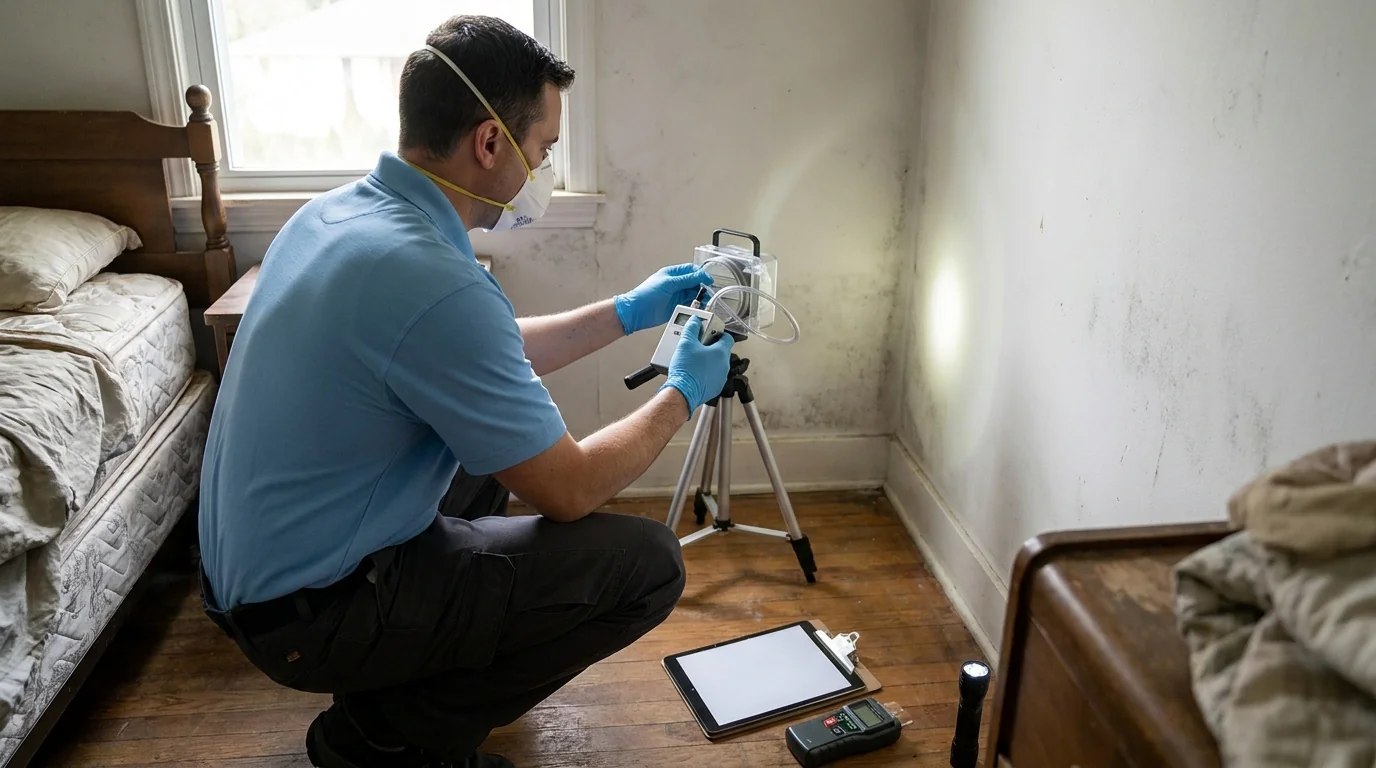
Visual survey and moisture mapping. We begin with a room-by-room walkthrough, using thermal imaging cameras and calibrated moisture meters to locate elevated readings behind walls, under flooring, and in ceiling cavities, areas where visible mold is absent but conditions are already right for growth. In multi-family walkups, we pay particular attention to shared walls between units and the areas directly above and below reported leak points, since water travels unpredictably through old masonry.
Air sampling. We collect indoor air samples from the affected areas and an outdoor baseline using calibrated spore-trap cassettes. Those samples go to an accredited third-party laboratory. Results typically return within 24 to 48 hours and identify the genera and concentration of spores present, giving you a defensible, documented picture of indoor air quality that insurance adjusters and landlords both recognize.
Surface and bulk sampling. Where visible growth or staining is present, we take tape-lift or swab samples to confirm the species and concentration. In older plaster walls common to the Woodcliff area and hillside blocks near James J. Braddock North Hudson Park, we may also collect bulk samples from wall material to determine how deeply growth has penetrated.
Written assessment report. Every inspection closes with a written report that maps affected areas, lists lab findings, and outlines recommended remediation scope, specific enough to serve as a remediation work plan or to support an insurance claim.
Reaching North Bergen from Kenilworth
From our Kenilworth headquarters, the fastest route to North Bergen runs up the NJ Turnpike to Route 3 east and connects to the Lincoln Tunnel approach roads, or alternatively north on Route 9W through Hudson County. We serve all of North Bergen, from the Guttenberg border in the east to the Fairview border in the north and the Tonnelle Avenue commercial corridor in the west, and because we operate 24/7, scheduling an inspection doesn’t have to wait until Monday morning after a weekend basement flood.
Local Note
One pattern we’ve learned working in North Bergen’s older multi-family stock: plaster walls in pre-war buildings absorb moisture slowly but release it even more slowly, which means a moisture meter reading that looks borderline on day three may still reflect active wetting inside the wall assembly. We’ve found that buildings near the Hudson River waterfront, where ambient humidity stays elevated through the summer, can show persistently high wall moisture readings weeks after a visible leak is repaired. That’s why our assessments here include a second moisture scan of any plaster walls flagged in the initial survey, rather than relying on a single-day reading, before we finalize the remediation scope.
If you’re dealing with a musty smell, visible discoloration, or a recent water event in a North Bergen property, the right first step is a documented inspection, not a guess. Call The Restoration Group at (855) 650-7422 to schedule mold inspection and testing in North Bergen and get lab-backed answers you can act on.
Serving North Bergen from our Fair Lawn headquarters — ★ 4.8 · 166 Google reviews
“Prompt, knowledgeable, skillful and honest. Highly recommend. They remediated within 24 hours. Total peace of mind restored. Worth every penny.” - Anne, October 2026Read our reviews on Google →
Mold Inspection and Testing in North Bergen: Service Coverage
Frequently Asked Questions
How fast can you arrive for mold inspection and testing in North Bergen?
Are basement apartments in North Bergen's older multi-family buildings more likely to test positive for mold?
How does North Bergen's older plaster-wall construction affect the mold inspection process?
Can a mold inspection report be used in a landlord-tenant dispute in North Bergen?
What does indoor air quality testing actually measure, and how long does it take to get results?
Does homeowner's or renter's insurance typically cover mold inspection costs for North Bergen properties that flooded during a storm event?
Mold Inspection and Testing response in North Bergen
Most North Bergen calls see a technician on-site within 60 minutes from our Fair Lawn headquarters.