Water Cleanup in North Bergen
24/7 water cleanup in North Bergen, NJ. IICRC-certified, insurance billing accepted. Call (855) 650-7422.
Our IICRC-certified technicians are dispatched from our Fair Lawn, NJ headquarters and are typically on-site in North Bergen within 60 minutes of your call.
When a storm drain backs up along Tonnelle Avenue or a cast-iron supply line finally gives out in one of North Bergen’s century-old three-family walkups, water doesn’t wait for business hours. It moves through plaster, under tile, and into the framing before most homeowners realize the floor is wet. The Restoration Group responds 24/7 to water cleanup calls across North Bergen’s 07047 ZIP code, extracting standing water, drying structural materials, and documenting everything your insurance carrier needs from the first hour on-site.
Why North Bergen Properties See Water Cleanup Issues
North Bergen’s geography sets up two distinct flood profiles. On the Palisades ridge, hillside lots shed water fast, but that runoff has to go somewhere, and it often finds the basement of the downhill neighbor. In the low-lying western flats near the Meadowlands and the Tonnelle Avenue corridor, the problem reverses: heavy rain overwhelms the municipal storm system and water backs up through floor drains and sump pits. Tropical Storm Ida in 2021 made that pattern impossible to ignore, pushing water into dozens of below-grade units across the area.
The building stock amplifies the risk. Most of North Bergen is made up of brick and frame two- and three-family homes built before World War II, with original cast-iron drain stacks, galvanized supply lines, and plaster-over-lath interior walls. Pipes corrode from the inside out and can fail without warning. Landlords managing multi-unit buildings near the Bergenline Avenue business district deal with tenant-reported leaks that have often been seeping for days before anyone calls. Commercial properties along Tonnelle Avenue face their own version, roof membrane failures, sprinkler activations, and HVAC condensate overflows that can saturate drop ceilings and concrete slab floors.
Our Water Cleanup Process in North Bergen
The first thing we do on arrival is locate the water source and stop the loss if it hasn’t been stopped already. From there, the process follows a defined sequence calibrated to what we actually find in North Bergen’s older housing stock.
Inspection and moisture mapping. We use thermal imaging cameras and calibrated moisture meters to trace water migration behind plaster walls and under hardwood subfloors. In pre-war construction, water can travel several feet from the visible wet area before the surface reads damp.
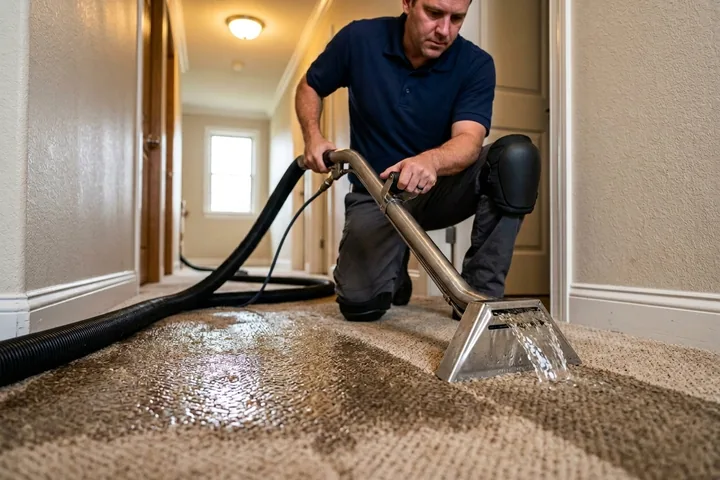
Extraction. Truck-mounted and portable extraction units pull standing water from finished basements, crawl spaces, and ground-floor units. In multi-family buildings, we coordinate access floor by floor to confirm water hasn’t migrated to adjacent units.
Structural drying. Industrial air movers and low-grain refrigerant dehumidifiers run continuously until moisture readings return to acceptable baselines. Drying logs are maintained daily, these records matter when your adjuster reviews the claim.
Content handling. Furniture, personal property, and tenant belongings are documented, moved to a dry area, or flagged for pack-out depending on the scope of saturation.
All drying is performed to the IICRC S500 standard, and The Restoration Group holds IICRC Certified Firm status (#210213).
Reaching North Bergen from Kenilworth
The Restoration Group is based in Kenilworth, NJ. The most direct route to North Bergen runs via the New Jersey Turnpike to Route 3 east and NJ-495 toward the Lincoln Tunnel approach, then north on local roads into the Woodcliff area or down toward the Bergenline corridor. Traffic on the Turnpike and the Tonnelle Avenue interchange can add time during peak hours, which is why our dispatch team tracks conditions in real time and routes crews accordingly. We’re available around the clock, if you’re calling at 2 a.m. because a pipe let go in your Bergenline-area rental, someone answers.
North Bergen Insurance Coordination
Most standard homeowner and landlord policies cover sudden and accidental water damage, a burst pipe qualifies; long-term seepage typically does not. We document the loss thoroughly from the moment we arrive: timestamped photos of affected materials, moisture readings at each measurement point, and a written scope of work that maps to the line items your carrier’s adjuster will review. For multi-unit properties, we can separate documentation by unit to simplify claims that involve more than one tenant’s space. We bill major carriers directly and work with you on the deductible conversation upfront.
Local Note
North Bergen’s pre-war plaster walls behave differently from the paper-faced drywall that dominates newer construction. Plaster is denser and more alkaline, which slows mold colonization slightly, but it also holds moisture deep in the lath cavity long after the surface feels dry to the touch. Moisture meters calibrated for drywall will underread in plaster assemblies if the operator doesn’t adjust the reference scale. We account for this on every job in older North Bergen housing stock, extending drying cycles and verifying readings at the lath layer before we call a wall dry. Pulling a wall open prematurely and finding wet lath two weeks later is an avoidable outcome.
If you’re dealing with water damage anywhere in North Bergen, a flooded basement near James J. Braddock North Hudson Park, a burst pipe in a Woodcliff two-family, or a commercial loss on Tonnelle Avenue, call The Restoration Group at (855) 650-7422. We’re available 24/7 and licensed through the NJ Division of Consumer Affairs as a Home Improvement Contractor.
Serving North Bergen from our Fair Lawn headquarters — ★ 4.8 · 160 Google reviews
“(Translated by Google) Excellent work. The staff were responsible, friendly, and above all, very clean. I was very satisfied and I recommend them 100%. (Original) Excelente trabajo.el personal responsables,amables y sobre todo muy limpios para trabajar .quedé satisfecha y lo recomiendo al 💯.” — Dessy, September 2026Read our reviews on Google →
Water Cleanup in North Bergen: Service Coverage
Frequently Asked Questions
How fast can you arrive for water cleanup in North Bergen?
Are basement floods near the Tonnelle Avenue corridor handled differently than other water cleanup jobs in North Bergen?
How does North Bergen's older housing stock affect the drying timeline for water cleanup?
Can you handle water cleanup in a multi-unit rental building near Bergenline Avenue, where multiple tenants are affected?
What's the difference between water extraction and structural drying, and do I need both after a flood in my North Bergen home?
Does my homeowner's or landlord's insurance typically cover emergency water cleanup in North Bergen, and how does the claims process work?
Water Cleanup response in North Bergen
Most North Bergen calls see a technician on-site within 60 minutes from our Fair Lawn headquarters.