Water Cleanup in Parsippany
24/7 water cleanup in Parsippany, NJ. IICRC-certified, insurance billing accepted. Call (855) 650-7422.
Our IICRC-certified technicians are dispatched from our Fair Lawn, NJ headquarters and are typically on-site in Parsippany within 60 minutes of your call.
When the Whippany River backs up after a heavy rain or a supply line lets go behind a finished basement wall in Lake Hiawatha, the clock starts immediately. Water moves fast through the split-levels and ranches that define so much of Parsippany-Troy Hills, soaking subfloor OSB, wicking into wall cavities, and reaching insulation before the smell even registers. The Restoration Group responds 24/7 from Kenilworth, and our IICRC Certified Firm (#210213) crews bring the extraction and drying equipment to stop that spread before it becomes a structural or mold problem.
Why Parsippany Properties See Water Damage So Often
Parsippany’s geography sets it up for recurring water events in ways that aren’t always obvious from the street. Troy Brook, the Rockaway River, and the Whippany River all drain through low-lying sections of the township, and the lake communities, Lake Hiawatha especially, sit in topographic bowls that collect runoff from surrounding development. During Ida in 2021, Lake Hiawatha saw some of the most severe residential flooding in Morris County, and the pattern repeated echoes of what Floyd and Irene left behind years earlier.
Beyond surface flooding, the housing stock itself creates vulnerability. The postwar capes, ranches, and split-levels that fill ZIP codes 07054 and 07005 were built when galvanized steel supply lines and cast-iron drains were standard. Those materials have a lifespan, and in finished basements, which are nearly universal in the older lake tracts, a pinhole in a 50-year-old supply line or a cracked cast-iron elbow can release hundreds of gallons before anyone notices. The tightly packed Victorian cottages in the Mount Tabor Historic District present a different challenge: original plank subflooring and plaster-on-lath construction absorb water at a different rate than modern materials, and drying timelines there typically run longer.
On the commercial side, the Waterview corridor and the dense hotel and office park belt along Route 46 generate their own category of loss, sprinkler-head discharges, overnight roof leaks, and HVAC condensate failures that can saturate large floor plates before the morning shift arrives.
Our Water Cleanup Process in Parsippany
Every job starts with a moisture assessment, not an assumption. We use thermal imaging cameras and penetrating moisture meters to map exactly where water has traveled, behind knee walls in split-levels, under floating laminate floors, inside the framing bays of finished basements. In older Parsippany homes, water often reads dry at the surface while the subfloor or lath beneath it is still saturated.
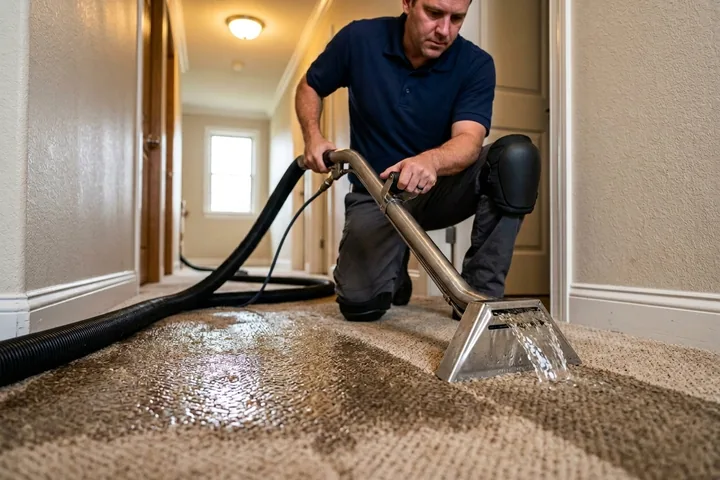
Once we know the scope, extraction comes first. Truck-mounted and portable extractors pull standing water and trapped moisture from carpet, pad, and hard flooring. Then we set a drying system calibrated to the structure: commercial-grade desiccant or refrigerant dehumidifiers, high-velocity air movers positioned to create directed airflow through wall cavities and under flooring, and in-wall drying panels where demo would otherwise be required. We monitor moisture readings daily and adjust equipment placement until structural materials reach their target drying goals per the IICRC S500 standard.
Documentation runs alongside every step, moisture logs, equipment placement records, and photographs of affected materials. That file becomes the foundation of your insurance claim.
Reaching Parsippany from Kenilworth
Kenilworth sits roughly 25 miles from central Parsippany via I-78 West to I-287 North, a straightforward highway run that keeps response times predictable even during off-peak hours. For addresses near the I-80/287 interchange or the Route 46 commercial corridor, access is direct. Lake Hiawatha and Rainbow Lakes neighborhoods are a few minutes further north off 287, and Mount Tabor is accessible from either the Tabor Road or Reynolds Avenue approach depending on where flooding or road closures redirect traffic. Because we run 24/7, a call at 2 a.m. after a pipe failure gets the same crew deployment as a call at noon.
Parsippany Insurance Coordination
Most standard homeowners policies cover sudden and accidental water discharge, a burst pipe, a failed appliance supply line, an ice-dam backup, but the documentation requirements matter. Carriers want moisture readings, not just photographs, and they want a drying log that shows the structure reached acceptable moisture content before materials were replaced. We build that file from day one. We communicate directly with adjusters, provide line-item scopes in the format most carriers use, and can coordinate with your public adjuster if you’ve retained one. For commercial losses in the Waterview district or along Route 46, we’re familiar with the additional documentation layers that property managers and building owners typically need for multi-tenant claims.
Local Note
In the older lake-tract neighborhoods, Lake Hiawatha, Lake Parsippany, Rainbow Lakes, many finished basements were built with the slab poured directly against the original soil grade, with little or no exterior waterproofing membrane. When the water table rises after a sustained rain event, hydrostatic pressure can push moisture through the slab itself rather than through any obvious breach. That kind of seepage looks minor at the surface but keeps the slab and lower wall framing perpetually damp. Standard extraction equipment won’t resolve it; the drying plan has to account for ongoing vapor drive from below, which changes both the equipment selection and the monitoring schedule. It’s a pattern we see repeatedly in this part of Morris County, and it’s worth knowing before you assume a basement dried out on its own.
If water has reached your floors, walls, or framing anywhere in Parsippany-Troy Hills, call The Restoration Group at (855) 650-7422. We’re available around the clock, and the sooner extraction begins, the more of the structure, and the contents, we can protect.
Serving Parsippany from our Fair Lawn headquarters — ★ 4.8 · 160 Google reviews
“They were very professional, and took care of all the water in my ceiling. It was alot of work, but they were very good at what they did.” — Lisa, September 2026Read our reviews on Google →
Water Cleanup in Parsippany: Service Coverage
Frequently Asked Questions
How fast can you arrive for water cleanup in Parsippany?
How quickly can The Restoration Group reach Lake Hiawatha or Rainbow Lakes after a flooding call?
Are the older split-levels and ranches in Parsippany's lake communities harder to dry out after water damage?
The Mount Tabor Historic District has older cottage construction — does that affect water cleanup and restoration options?
What does the water cleanup process actually involve once your crew arrives on site?
Will my homeowners insurance cover water cleanup after a pipe failure in Parsippany, and how does documentation work?
Water Cleanup response in Parsippany
Most Parsippany calls see a technician on-site within 60 minutes from our Fair Lawn headquarters.