Water Cleanup in Paterson
24/7 water cleanup in Paterson, NJ. IICRC-certified, insurance billing accepted. Call (855) 650-7422.
Our IICRC-certified technicians are dispatched from our Fair Lawn, NJ headquarters and are typically on-site in Paterson within 60 minutes of your call.
The Passaic River doesn’t forgive slowly. When it rises, as it did during Hurricane Irene in 2011 and again during Ida in 2021, the low-lying blocks near downtown Paterson and the Riverside section can take on water faster than any sump pump can handle. But flooding isn’t the only threat here. Burst pipes in century-old rowhomes, failed standpipes in converted silk-mill apartments, and backed-up cast-iron drains in unventilated rental basements generate water damage calls year-round across every ZIP code in the city. The Restoration Group responds 24/7, and our IICRC Certified Firm (#210213) team brings industrial drying equipment, not shop vacs and box fans, to every job.
Why Paterson Properties See Repeated Water Damage
Paterson’s housing stock is among the oldest in New Jersey. Dense 19th-century mill-worker rowhomes, brick three-family walkups, and aging frame houses with cast-iron drain lines dominate neighborhoods from the Eastside to South Paterson. These buildings were not designed with modern waterproofing in mind, and decades of deferred maintenance compound the risk.
Cast-iron drain stacks corrode from the inside out. By the time a homeowner notices a slow drain, the pipe may already be partially collapsed, and a single heavy rain event can push sewage back through floor drains into finished basement spaces. In multi-unit buildings, a leak on the second floor travels through plaster and lath to the unit below before anyone realizes there’s a problem. Brick exterior walls wick groundwater laterally into basement walls during sustained rain, a pattern especially common in the Sandy Hill and Lakeview sections where older masonry foundations sit close to grade.
Converted industrial buildings, former silk-era factories now operating as apartment complexes, carry their own risk profile. Sprinkler systems and standpipe risers in these structures can fail at fittings, releasing large volumes of water into spaces that were never designed as residential interiors. When that happens, the water migrates through concrete subfloors and into units below before the building super even locates the shutoff.
Our Water Cleanup Process in Paterson
Every water cleanup job starts with moisture mapping, not assumptions. We use thermal imaging cameras and calibrated moisture meters to trace where water has traveled, behind plaster walls, under original hardwood flooring, inside the cavities of brick exterior walls, before any drying equipment is placed. In Paterson’s older housing stock, surface readings are routinely misleading: a wall can read dry at the face while the lath behind it holds significant moisture.
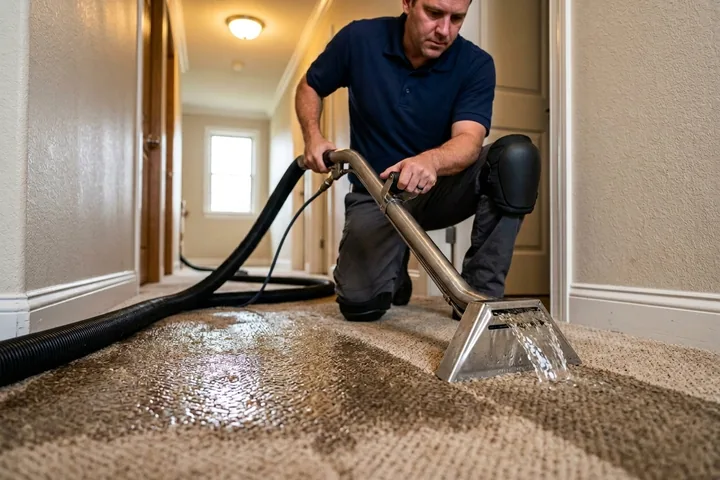
Once the affected area is fully mapped, we extract standing water with truck-mounted or portable extraction units, then position commercial-grade desiccant or refrigerant dehumidifiers and high-velocity air movers calibrated to the room’s cubic footage and material types. Drying targets follow the IICRC S500 standard. We monitor daily and adjust equipment placement as materials dry at different rates, plaster releases moisture more slowly than drywall, and brick releases it more slowly still.
For losses involving sewage backup or contaminated floodwater, common in basement units across the 07501 and 07503 ZIP codes, we follow Category 3 water protocols: affected porous materials are removed rather than dried in place, and all contacted surfaces are treated before reconstruction begins.
Reaching Paterson from Kenilworth
Our team dispatches from Kenilworth and reaches Paterson via I-78 East to Route 21 North, which runs directly along the Passaic River corridor into the heart of the city. The Hillcrest and Totowa Section neighborhoods on the western edge of Paterson are typically the fastest to reach via Route 46. For addresses near Great Falls National Historical Park or the dense blocks around Hinchliffe Stadium, we use McBride Avenue or Market Street depending on traffic. We operate 24/7, so we’re not waiting until morning to start.
Local Note: What Old Plaster Walls Mean for Drying Time
Paterson’s pre-1940 rowhomes and multi-family buildings were almost universally finished with three-coat plaster over wood lath, a combination that behaves very differently from the paper-faced drywall in newer construction. Plaster is denser and more alkaline, which slows microbial growth slightly, but it also holds moisture deep in the substrate long after the surface feels dry to the touch. In practice, this means drying timelines in these buildings run longer than industry averages, and equipment needs to stay in place until subsurface readings confirm the lath cavity has reached equilibrium, not just the plaster face. Pulling equipment too early is one of the most common reasons mold appears weeks after a water loss in Paterson’s older housing stock. We account for this on every job in the city.
If water has reached your home or building in Paterson, call The Restoration Group at (855) 650-7422. We’re available around the clock, and we’ll tell you exactly what we’re seeing and what it will take to dry it out, no pressure, no guesswork.
Serving Paterson from our Fair Lawn headquarters — ★ 4.8 · 160 Google reviews
“Teams were very prompt and respectful.. company responded quickly and kept in touch” — Peggy, August 2026Read our reviews on Google →
Water Cleanup in Paterson: Service Coverage
Frequently Asked Questions
How fast can you arrive for water cleanup in Paterson?
How quickly can The Restoration Group reach the Eastside or South Paterson for a water emergency?
Paterson has a lot of older rental buildings — does the cleanup process differ for a multi-unit building versus a single-family home?
Are homes near the Passaic River in Paterson at higher risk for contaminated floodwater?
What does water cleanup typically involve in Paterson's older plaster-and-lath homes?
Will my insurance cover water cleanup for a burst pipe or basement backup in Paterson, and can you help with the claim?
Water Cleanup response in Paterson
Most Paterson calls see a technician on-site within 60 minutes from our Fair Lawn headquarters.