Mold Inspection and Testing in Piscataway
24/7 mold inspection and testing in Piscataway, NJ. IICRC-certified, insurance billing accepted. Call (855) 650-7422.
Our IICRC-certified technicians are dispatched from our Fair Lawn, NJ headquarters and are typically on-site in Piscataway within 60 minutes of your call.
The stretch of Piscataway running along the Raritan River has been soaked repeatedly, Hurricane Floyd, Irene, and then Ida in 2021 left basements and crawl spaces in the River Road corridor and Johnson Park flatlands sitting in water long enough for mold colonies to establish well before the floodwaters fully receded. If you’re in a postwar split-level off Stelton Road or a Society Hill townhome that took on moisture and now smells faintly musty, a professional mold inspection and testing assessment tells you exactly what you’re dealing with, before you start tearing out walls or paying for remediation you may not need.
Why Piscataway Properties See Elevated Mold Risk
Piscataway’s housing stock is unusually varied, and that variety matters for mold risk. The postwar capes and split-levels concentrated in neighborhoods like Possumtown and Arbor were built before vapor barriers were standard practice. Many of those finished basements still run on original galvanized supply lines and cast-iron drain stacks, both known for slow, hidden leaks that saturate wall cavities for months before a homeowner notices a stain or odor. Mold can begin colonizing damp organic material within 24 to 48 hours of a moisture event, so a pinhole leak behind a utility wall can produce a significant hidden colony long before it’s visible.
The Society Hill condo and townhome developments present a different pattern: shared plumbing chases and stacked units mean one unit’s slow leak becomes a neighbor’s mold problem. HOA boards in those developments frequently require documented inspection results, not just a contractor’s verbal assessment, before authorizing remediation work or releasing reserve funds.
The Stelton commercial corridor and the warehouse and lab space near Centennial Avenue add a commercial dimension. Sprinkler-discharge events and roof leaks in those buildings often go undetected overnight, and the large square footage means spore counts can be elevated across a wide area before anyone arrives in the morning.
Our Mold Inspection and Testing Process in Piscataway
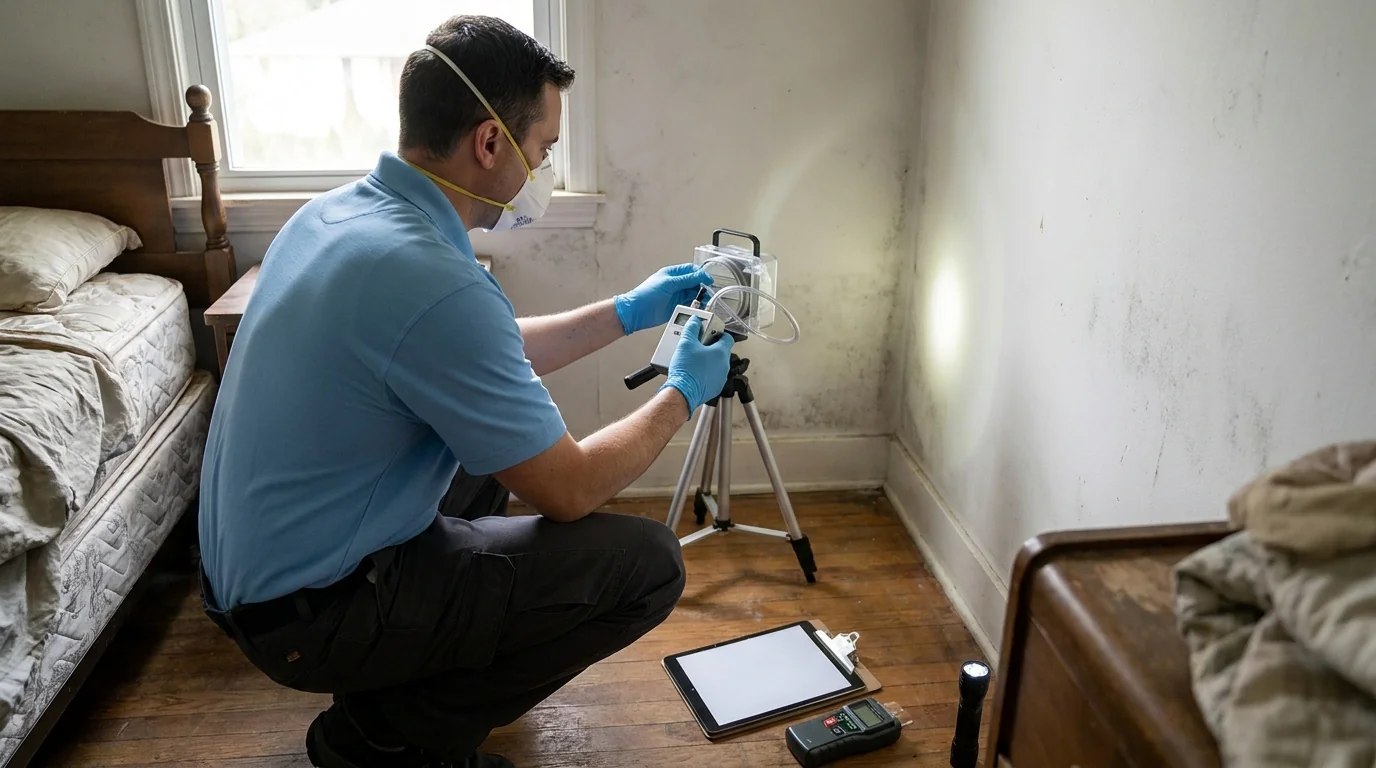
A mold inspection is not a visual walk-through with a flashlight. The process starts with a structured moisture mapping of the affected areas using thermal imaging and calibrated moisture meters, tools that locate elevated readings inside wall assemblies, under flooring, and above drop ceilings without opening anything unnecessarily. In older Piscataway homes with plaster walls over wood lath, moisture readings behave differently than in modern drywall construction; plaster holds and releases moisture slowly, which can mask an active problem or make a resolved one appear ongoing without careful interpretation.
Air sampling and surface sampling follow the moisture assessment. Air cassettes are collected in affected rooms and in an outdoor control location, the outdoor sample is the baseline against which indoor spore counts are compared. Surface samples (tape lifts or swabs) target visible suspect growth to identify genus and species. All samples are sent to an accredited third-party laboratory. The written report you receive identifies the species present, the relative concentration, and whether the indoor environment is elevated compared to the outdoor baseline. That report is the document your insurance adjuster, your HOA board, or your remediator needs to move forward.
Because The Restoration Group holds IICRC Firm Certification (#210213), the inspection protocol follows industry-standard methodology, which matters when an insurance carrier or an HOA management company scrutinizes the documentation.
Reaching Piscataway from Kenilworth
The Restoration Group operates out of Kenilworth, NJ, and reaches Piscataway via Route 1 or the Garden State Parkway to Route 287, a straightforward run that keeps response times reasonable across the township’s ZIP codes, including 08854. The team is available around the clock, so a homeowner who discovers standing water or a musty odor late on a Sunday night can reach a live person at (855) 650-7422 rather than waiting until Monday morning when mold has had additional hours to spread.
Local Note: What Repeat Flooding Leaves Behind
One thing that stands out in Piscataway properties that flooded during Ida, particularly those closest to the Johnson Park flatlands and the River Road corridor, is that some homeowners dried out the visible surfaces, assumed the problem was resolved, and then called 12 to 18 months later with a persistent musty odor and discoloration behind baseboards. Riverine flooding carries silt and organic debris into wall cavities and under subfloors; that organic load feeds mold growth even after the moisture content of the framing returns to normal ranges. An inspection in those homes needs to include sampling behind lower wall sections, not just air quality readings in the center of the room. If your home was in the flood zone during any of the major Raritan events and you haven’t had a professional assessment, the absence of visible mold is not a clean bill of health.
If you’re in Piscataway, whether you’re in a Possumtown split-level, a Society Hill condo, or a commercial space off the Stelton corridor, and you have a moisture history or an unexplained odor, call (855) 650-7422. The Restoration Group will schedule an inspection, deliver a lab-backed written report, and give you a clear picture of what’s actually in your air and walls.
Serving Piscataway from our Fair Lawn headquarters — ★ 4.8 · 166 Google reviews
“Well, the restoration group I would say they are always prompt in terms of arriving on time. they came and They did what they had to do. very friendly and they were able to explain to me the process what they were doing and what it was for. I did appreciate that. most importantly I needed to get a…” - Viergina, September 2026Read our reviews on Google →
Mold Inspection and Testing in Piscataway: Service Coverage
Frequently Asked Questions
How fast can you arrive for mold inspection and testing in Piscataway?
Are homes near the Raritan River in Piscataway at higher risk for hidden mold after flooding?
My Society Hill condo had a leak from the unit above. Does the HOA need a formal inspection report before remediation can start?
How does mold inspection work differently in Piscataway's older split-levels and capes compared to newer construction?
What does the lab report from mold testing actually tell me, and how long does it take to get results?
Can mold testing in Piscataway (ZIP code 08854) support an insurance claim for a water loss?
Mold Inspection and Testing response in Piscataway
Most Piscataway calls see a technician on-site within 60 minutes from our Fair Lawn headquarters.