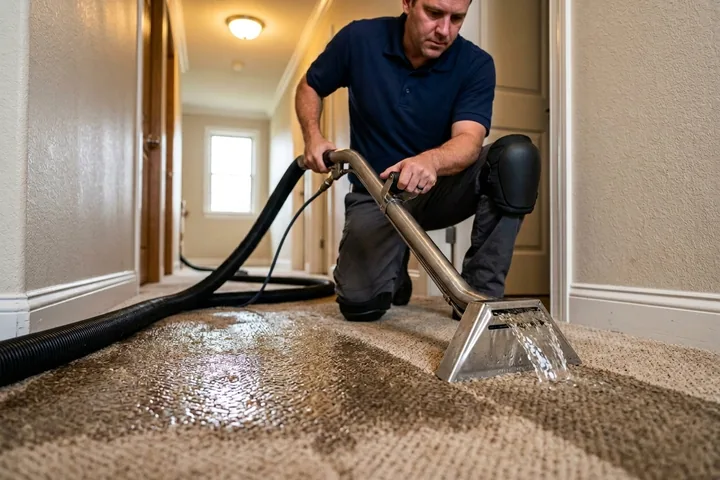
Water Cleanup in Piscataway
24/7 water cleanup in Piscataway, NJ. IICRC-certified, insurance billing accepted. Call (855) 650-7422.
Our IICRC-certified technicians are dispatched from our Fair Lawn, NJ headquarters and are typically on-site in Piscataway within 60 minutes of your call.
The Raritan River doesn’t forgive slowly. When Ida pushed through in 2021, the River Road corridor and the Johnson Park flatlands took on water faster than sump pumps could cycle, and many Piscataway homeowners were left pulling soaked carpet out of finished basements days after the storm passed. Whether the source is riverine flooding, a burst galvanized supply line in a postwar split-level, or a sprinkler discharge in a Stelton corridor warehouse, the clock starts the moment water contacts your structure, and every hour it sits, the damage compounds.
Why Piscataway Properties See Repeated Water Damage
Piscataway’s geography works against homeowners in a few specific ways. The township runs along a long stretch of the Raritan, and the flatlands near Johnson Park and River Road sit in a natural flood path that has filled repeatedly, not just during Ida, but during Floyd and Irene before it. Properties in those areas carry a real risk of riverine flooding that isn’t fully addressed by standard sump systems.
Beyond storm events, the housing stock creates its own vulnerabilities. The postwar capes and split-levels that dominate older tracts throughout neighborhoods like Possumtown and Stelton were built with galvanized steel supply lines and cast-iron drain stacks. Both materials degrade from the inside out. Galvanized pipe corrodes and narrows over decades until a pressure spike causes a pinhole leak or a full rupture, often inside a finished basement wall where it goes undetected for days. Cast-iron drains crack under root pressure and soil movement, backing up into finished lower levels. By the time water is visible, it has usually been migrating through framing and insulation for longer than the surface suggests.
Society Hill’s townhome and condo developments present a different challenge: shared wall assemblies mean one unit’s plumbing failure can saturate a neighbor’s unit before either resident notices. HOA involvement in the remediation scope adds a coordination layer that single-family claims don’t require.
Our Water Cleanup Process in Piscataway
When we arrive, 24 hours a day, any day of the week, the first priority is stopping active water intrusion if it hasn’t been stopped already. From there, the process follows a structured sequence calibrated to what we actually find in Piscataway homes.
Moisture mapping before extraction. Thermal imaging and calibrated moisture meters tell us where water has traveled, not just where it pooled. In older homes with plaster-over-lath walls, water wicks laterally through the lath and reads dry at the surface while the framing behind stays saturated. We map the full wet boundary before any drying equipment is placed.
Extraction and controlled demolition. Standing water comes out first with truck-mounted or portable extraction units. Saturated materials that cannot be dried in place, carpet padding, compromised drywall, wet insulation, are removed to allow airflow to the structural cavity. In finished basements common to Piscataway’s split-level stock, that often means opening the lower portion of drywall to expose the bottom plate and subfloor edge.
Structural drying to IICRC S500 standard. Industrial air movers and refrigerant or desiccant dehumidifiers run in a calculated configuration based on the cubic footage and material types in the affected space. Readings are logged daily until all monitored materials reach their dry standard. We don’t pull equipment on a calendar, we pull it on data.
Documentation throughout. Every moisture reading, every photo, every equipment placement is logged in a format your insurance adjuster can work from directly.
Reaching Piscataway from Kenilworth
Our team dispatches from Kenilworth, and Piscataway is a straightforward run, typically via Route 28 east or the Garden State Parkway to Route 287 south depending on traffic and the specific address. The Stelton Road and Centennial Avenue corridors are easy to reach from either approach. River Road addresses near Johnson Park are accessible from the New Brunswick side via Route 18 when the direct routes are congested. We’re available around the clock, so dispatch timing isn’t constrained by business hours.
Local Note: What Older Basements in Piscataway Actually Hide
In the split-levels and raised ranches built across Piscataway’s older tracts in the 1950s through 1970s, finished basements were often insulated with fiberglass batts tucked behind wood-paneled or drywall finishes, with no vapor barrier between the insulation and the concrete block foundation wall. When water enters, the insulation acts as a wick, holding moisture against the block and the bottom plate of the framing. The surface can feel dry to the touch within a day or two while the cavity behind it remains wet enough to support mold colonization within 48 to 72 hours. Moisture meters and thermal cameras are not optional in these structures, they’re the only way to know what’s actually happening behind the finish.
If you’re dealing with water damage in Piscataway, whether it’s a flooded basement off River Road, a pipe failure in a Society Hill unit, or a commercial loss on the Stelton corridor, call The Restoration Group at (855) 650-7422. We respond 24/7, document everything for your carrier, and don’t leave until the readings confirm the structure is dry.
Serving Piscataway from our Fair Lawn headquarters — ★ 4.8 · 160 Google reviews
“Prompt and professional work. Kept in contact thru out the process which was very important to me.” — F., July 2026Read our reviews on Google →
Water Cleanup in Piscataway: Service Coverage
Frequently Asked Questions
How fast can you arrive for water cleanup in Piscataway?
How quickly can The Restoration Group reach River Road or the Johnson Park area after a flooding call?
Are Possumtown and Stelton homes at higher risk for hidden water damage because of their age?
My Society Hill condo shares a wall with a neighboring unit — how does that affect the water cleanup scope?
What does the drying process actually look like inside a Piscataway basement, and how long does it take?
Will my insurance cover water cleanup in Piscataway, and does flood damage from the Raritan work differently?
Water Cleanup response in Piscataway
Most Piscataway calls see a technician on-site within 60 minutes from our Fair Lawn headquarters.