24/7 Emergency Flood Damage Restoration in Plainfield
24/7 emergency flood damage restoration in Plainfield, NJ. IICRC-certified, insurance billing accepted. Call (855) 650-7422.
Our IICRC-certified technicians are dispatched from our Fair Lawn, NJ headquarters and are typically on-site in Plainfield within 60 minutes of your call.
Flooding emergency in Plainfield? We answer 24/7. Call now and our crew can be on-site within 60 minutes to pump out the water and stop the damage from spreading.
When Tropical Storm Ida tore through Union County in September 2021, Cedar Brook and the Green Brook overflowed their banks and turned the streets near East Front Street into channels. Plainfield lost lives that night, and hundreds of homes, many of them century-old Victorians and Queen Annes with finished basements, took on water faster than any sump pump could handle. That kind of flooding doesn’t just wet a floor; it saturates original plaster, wicks into balloon-frame walls, and leaves behind a contamination and structural drying problem that can compound for weeks if the response is slow.
Why Plainfield Properties Are Especially Vulnerable to Flood Damage
Plainfield’s topography funnels trouble. Cedar Brook and the Green Brook run through the city’s low-lying corridors, and neighborhoods like Sleepy Hollow and the Crescent Area sit in the drainage paths that fill first during heavy rain events. The Front Street and Park Avenue commercial strips add their own exposure, flat roofs, aging sprinkler systems, and basement-level storage that turns a roof leak or a main break into a significant loss.
The housing stock amplifies every water event. A large share of Plainfield’s residential inventory, particularly in the Van Wyck Brooks Historic District and Netherwood, was built between 1880 and 1940. Those homes typically have cast-iron drain stacks prone to root intrusion and joint failure, original clay-tile sewer laterals that back up under hydrostatic pressure, and deep full basements that were finished decades later without modern waterproofing membranes. When a storm event backs up the municipal system, those basements don’t just flood, they flood fast, and the water is often Category 3 (sewage-contaminated), which changes the entire scope of cleanup and disposal.
Our Flood Damage Restoration Process in Plainfield
Every flood loss is different, but the sequence matters and the science doesn’t change. Here is how a typical residential flood job unfolds in Plainfield:
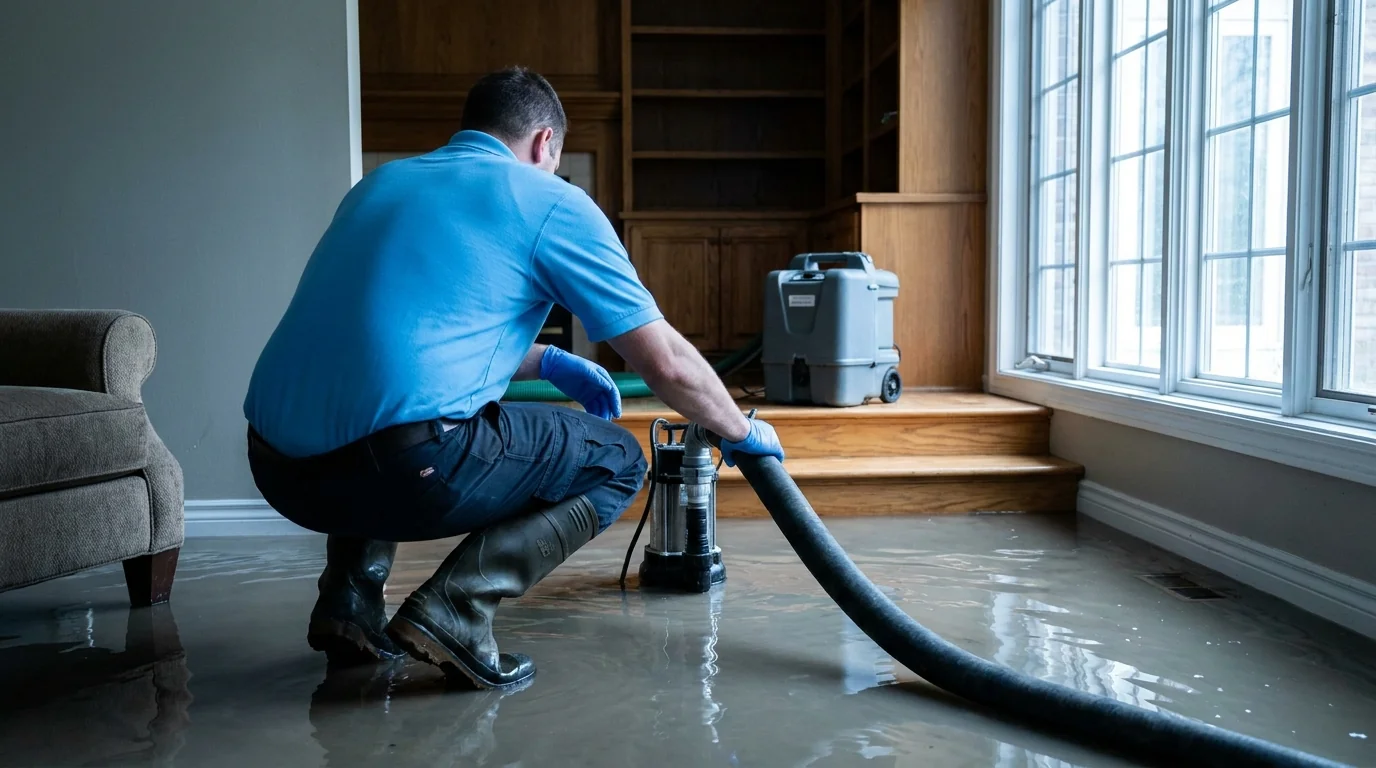
1. Emergency extraction and safety assessment. We arrive, assess structural safety, identify the water category (clean supply line vs. gray vs. black water), and deploy truck-mounted or portable extraction units to remove standing water. In finished basements with carpet over concrete, that extraction step alone can pull hundreds of gallons.
2. Controlled demolition of unsalvageable materials. Category 3 water, common in sewer-backup and brook-overflow events, requires removing saturated drywall, insulation, and flooring to defined flood cuts rather than attempting to dry materials in place. In Plainfield’s older homes, this sometimes means cutting through horsehair plaster or removing original hardwood that has cupped beyond refinishing.
3. Antimicrobial treatment and structural drying. After demo, we apply EPA-registered antimicrobial agents to framing and concrete, then deploy commercial-grade LGR dehumidifiers and high-velocity air movers calibrated to the room volume and ambient conditions. We monitor moisture readings in framing, subfloor, and wall cavities daily, not just surface readings, and adjust equipment placement until we reach documented dry standard per the IICRC S500.
4. Documentation and rebuild coordination. We photograph and log every affected material for your insurance claim, then coordinate the rebuild phase, framing, drywall, flooring, and finishing, so you are not managing two separate contractors.
Reaching Plainfield from Our Kenilworth HQ
Kenilworth sits roughly four miles from central Plainfield via Route 28, and our crews run that corridor regularly. Whether the call comes from a flooded basement near Cedar Brook Park or a commercial water loss on the Front Street business district, we dispatch around the clock, 24/7, and can stage equipment at the property while the water is still moving. ZIP codes 07060, 07062, and 07063 are all within our standard service area, and we carry the full equipment load on every emergency vehicle so we are not making a second trip for dehumidifiers.
Plainfield Insurance Coordination
Most flood losses in Plainfield involve at least one coverage question: standard homeowners policies typically exclude rising-water flood events (those require a separate NFIP or private flood policy), but sewer backup, burst pipe, and appliance failures are usually covered under the standard form. We have seen Plainfield homeowners lose weeks trying to sort this out on their own after an Ida-type event.
We document the loss thoroughly from the moment we arrive, moisture mapping, photos, written scope, and communicate directly with your adjuster in the format carriers expect. We are a licensed NJ Home Improvement Contractor and an IICRC Certified Firm (#210213), which matters when an adjuster is reviewing the scope of work for approval.
Local Note
One thing that surprises homeowners in the Van Wyck Brooks Historic District and similar pre-war Plainfield neighborhoods: plaster walls dry on a fundamentally different timeline than modern drywall. Plaster is dense and holds moisture deep in its substrate long after the surface reads dry on a pin meter. We use both pin and pinless meters at multiple depths and extend drying cycles accordingly, sometimes by several days compared to a comparable drywall home. Skipping that step is how mold colonizes behind a wall that “passed” a surface check. If a previous contractor told you the job was done in 48 hours on a plaster-wall Victorian, it is worth a second opinion.
If your Plainfield home or business has taken on water, whether from a brook overflow, a sewer backup, or a failed supply line, call The Restoration Group at (855) 650-7422. We are available 24/7, and we know what flood damage looks like in this city specifically.
Serving Plainfield from our Fair Lawn headquarters — ★ 4.8 · 166 Google reviews
“Hired the Restoration Group after mold and flood in our house. Their 24 hour line was always available. They came right away and were prompt completing the work. Everyone was friendly.” - Amanda, October 2026Read our reviews on Google →
Flood Damage Restoration in Plainfield: Service Coverage
Frequently Asked Questions
How fast can you arrive for flood damage restoration in Plainfield?
How quickly can The Restoration Group reach a flooded property in Plainfield from Kenilworth?
Are homes near Cedar Brook and the Green Brook at higher risk of Category 3 flood water?
Does Plainfield's older Victorian and Queen Anne housing stock change how flood drying is handled?
My Plainfield basement flooded during a storm — is that covered by my homeowners insurance?
How long does flood damage restoration typically take for a finished basement in Plainfield?
Flood Damage Restoration response in Plainfield
Most Plainfield calls see a technician on-site within 60 minutes from our Fair Lawn headquarters.
Nearby & Related
- 24/7 Emergency Flood Damage Restoration in Kenilworth
- Restoration Services in Plainfield
- 24/7 Emergency Fire Damage Restoration in Plainfield
- Mold Remediation in Plainfield
- 24/7 Emergency Flood Damage Restoration in Bayonne
- 24/7 Emergency Flood Damage Restoration in Bloomfield
- Contact The Restoration Group