Mold Remediation in Plainfield
24/7 mold remediation in Plainfield, NJ. IICRC-certified, insurance billing accepted. Call (855) 650-7422.
Our IICRC-certified technicians are dispatched from our Fair Lawn, NJ headquarters and are typically on-site in Plainfield within 60 minutes of your call.
Plainfield’s older housing stock and its history with flooding make mold remediation a different challenge here than in newer suburban towns. When Tropical Storm Ida tore through Union County in 2021, the Green Brook and Cedar Brook corridors, running right through Plainfield’s low-lying neighborhoods, pushed water into finished basements faster than sump pumps could respond. Mold can begin colonizing damp materials within 24 to 48 hours, which means homes that took on water during that storm, and never received professional drying, may still be harboring hidden growth behind drywall or under flooring today.
Why Plainfield Properties See More Mold Problems
The city’s celebrated Victorian and Queen Anne homes, concentrated in areas like the Van Wyck Brooks Historic District and Netherwood, were built with materials and construction methods that respond to moisture very differently than modern builds. Original horsehair plaster, old-growth wood framing, and cast-iron drain stacks that are now well past their service life all create conditions where a slow leak or a single wet season can quietly feed mold colonies for months before anyone notices a smell or a stain.
Deep, finished basements are common throughout Plainfield’s ZIP codes 07060 and 07062, and they amplify water losses in two ways: they hold humidity longer than above-grade spaces, and they’re often the last rooms inspected when a homeowner suspects a problem. Add the fact that knob-and-tube-era electrical systems in pre-1950 homes frequently run through wall cavities that are also the first places moisture collects, and you have a recipe for mold that’s both structurally hidden and slow to announce itself.
Along the Front Street and Park Avenue commercial corridors, aging flat roofs and older sprinkler systems introduce a different category of mold risk, water intrusion from above rather than below, often soaking insulation and ceiling assemblies before it’s visible at the surface.
Our Mold Remediation Process in Plainfield
Every job starts with a thorough inspection, not just the obvious wet area, but the adjacent wall cavities, subfloor, and HVAC returns. In Plainfield’s older homes, mold rarely stays where the leak was. It follows the framing.
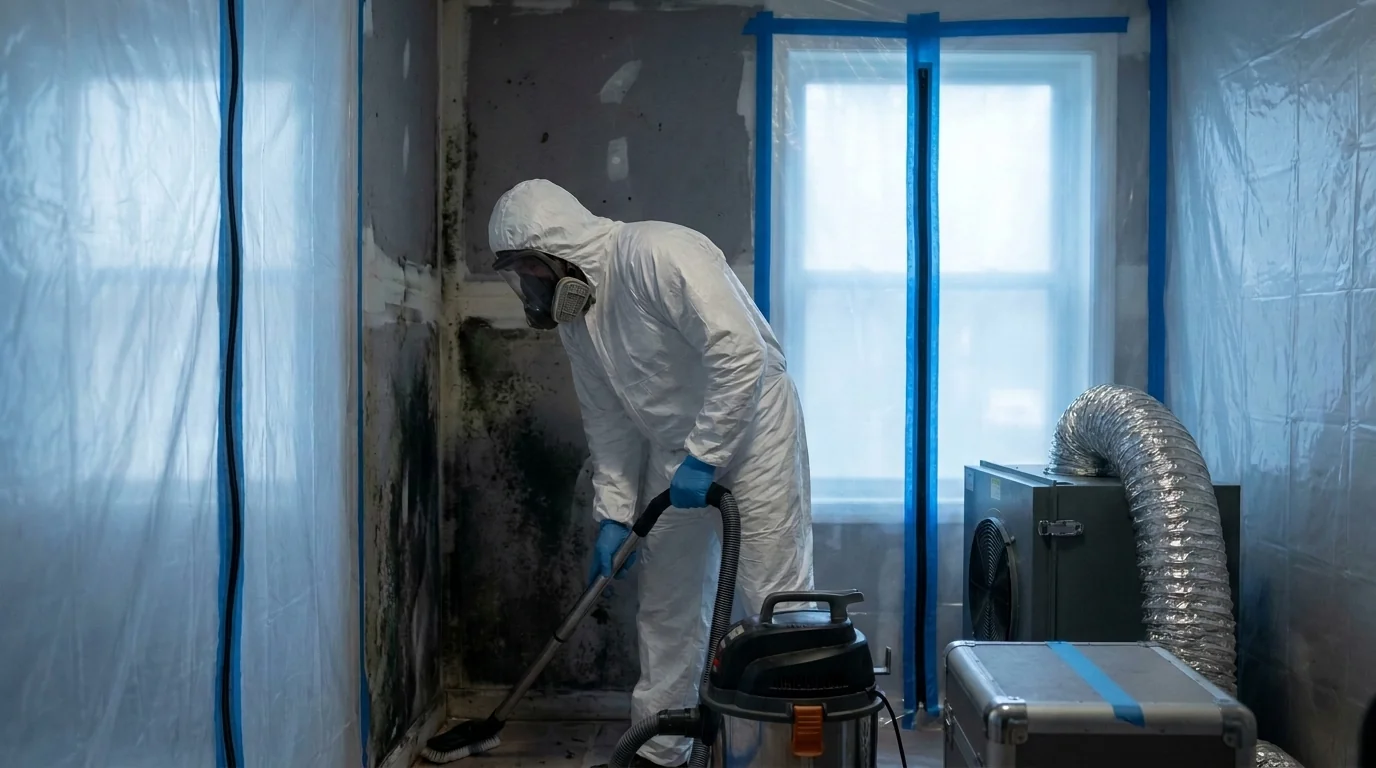
Once we’ve mapped the affected zone, we establish negative-air containment using 6-mil poly barriers and HEPA-filtered air scrubbers. This matters especially in homes where original plaster and lathe construction means disturbing one wall can send spores through gaps that simply don’t exist in modern drywall builds. Contaminated materials, drywall sections, insulation, affected framing, are bagged and removed per EPA guidelines before any surface treatment begins.
Drying and treatment follow IICRC S520 standard protocols. We use commercial-grade desiccant dehumidifiers and antimicrobial applications on affected structural surfaces, then re-test air quality before containment comes down. As an IICRC Certified Firm (#210213), our documentation throughout this process is formatted for insurance carriers, which simplifies the claim process considerably.
Reaching Plainfield from Kenilworth
The Restoration Group operates out of Kenilworth, which puts Plainfield well within our regular service area, a straightforward run west on surface roads or via Route 28. We’re available around the clock, every day of the year, so whether a homeowner in the Sleepy Hollow section discovers a musty crawl space on a Sunday morning or a property manager near the Plainfield Train Station gets a call about a ceiling collapse after a sprinkler fault, we can dispatch immediately.
For neighborhoods closer to the Green Brook flood plain, particularly the East Front Street corridor and the Crescent Area, we’re familiar with the access and staging constraints that come with dense residential blocks and narrow driveways. We coordinate arrival logistics before we show up, not after.
Local Note: What Plainfield’s Plaster Walls Mean for Mold Remediation
One thing that catches homeowners off guard in Plainfield’s Victorian-era homes is how mold behaves inside original plaster-and-lathe wall assemblies. Unlike paper-faced drywall, which shows visible staining relatively quickly, plaster can mask active mold growth in the wood lath behind it for a long time. By the time a musty odor is noticeable in a bedroom in the Van Wyck Brooks Historic District, the lath and the back of the plaster coat may already have significant colonization. This means our scoping process in these homes almost always involves thermal imaging and moisture mapping behind finished surfaces before we commit to a remediation boundary, because the visible damage is rarely the full picture.
If you’re dealing with a mold concern in Plainfield, whether it’s a damp basement near Cedar Brook, a post-Ida remediation that was never completed, or an unexplained smell in a pre-war home, call The Restoration Group at (855) 650-7422. We’ll assess the scope honestly, document everything for your insurer, and get the work done right.
Serving Plainfield from our Fair Lawn headquarters — ★ 4.8 · 166 Google reviews
“Hired the Restoration Group after mold and flood in our house. Their 24 hour line was always available. They came right away and were prompt completing the work. Everyone was friendly.” - Amanda, October 2026Read our reviews on Google →
Mold Remediation in Plainfield: Service Coverage
Frequently Asked Questions
How fast can you arrive for mold remediation in Plainfield?
Are homes in Plainfield's Van Wyck Brooks Historic District subject to any restrictions that affect mold remediation work?
Our basement flooded during Tropical Storm Ida and we had it dried out, but now there's a smell. Is mold still possible years later?
How quickly can you reach the Sleepy Hollow or Crescent Area neighborhoods from your Kenilworth location?
What does mold remediation actually involve in a pre-1950 Plainfield home with original plaster walls?
Will my homeowner's insurance cover mold remediation in Plainfield, and how does the claims process work?
Mold Remediation response in Plainfield
Most Plainfield calls see a technician on-site within 60 minutes from our Fair Lawn headquarters.