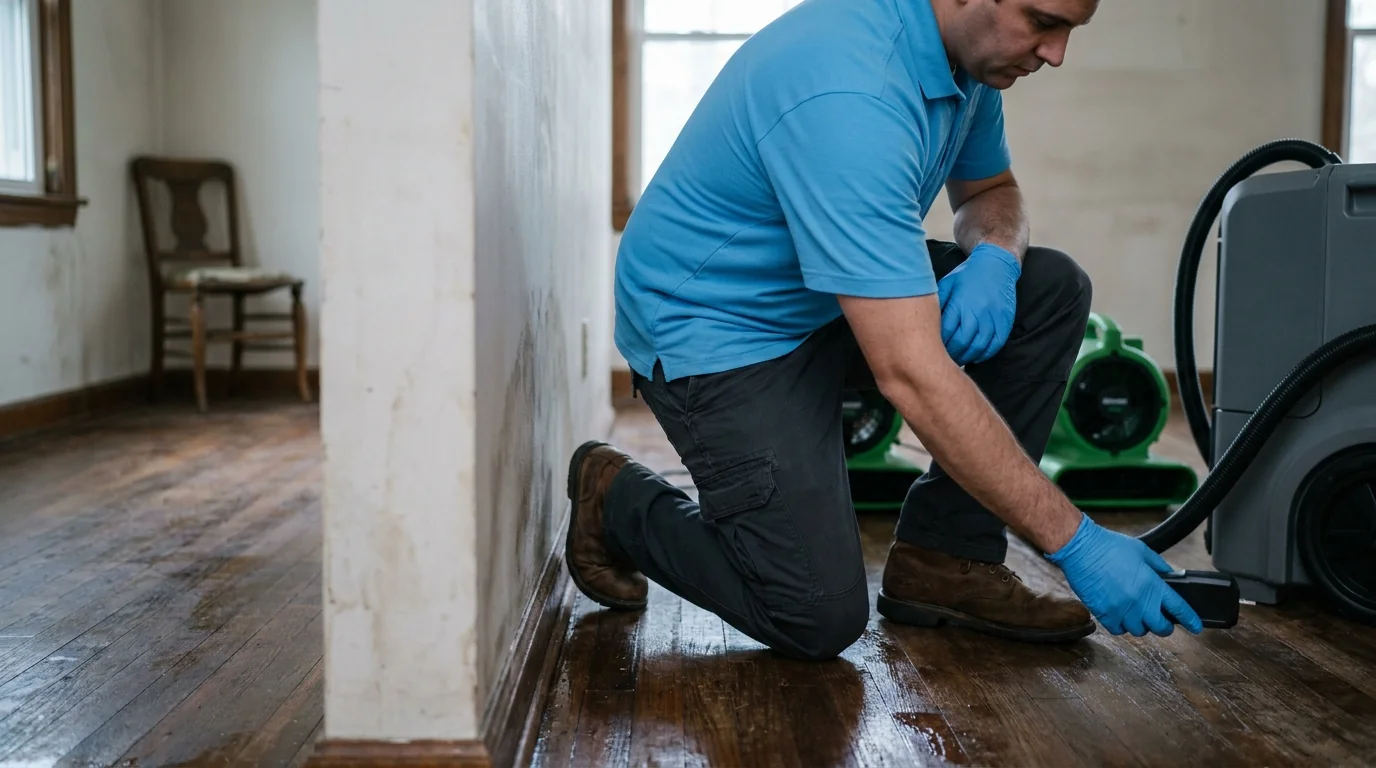
24/7 Emergency Water Damage Restoration in Plainfield
24/7 emergency water damage restoration in Plainfield, NJ. IICRC-certified, insurance billing accepted. Call (855) 650-7422.
Our IICRC-certified technicians are dispatched from our Fair Lawn, NJ headquarters and are typically on-site in Plainfield within 60 minutes of your call.
When Tropical Storm Ida tore through Union County in September 2021, the Green Brook and Cedar Brook overflowed into Plainfield’s lowest-lying streets, and the East Front Street corridor took some of the worst of it, homes with finished basements filled in hours, not days. That kind of loss doesn’t wait for business hours, and neither do we. The Restoration Group dispatches from Kenilworth around the clock, reaching Plainfield ZIP codes 07060, 07062, and 07063 with extraction equipment already loaded.
Why Plainfield Properties See Water Damage So Often
Plainfield’s topography works against its homeowners. Cedar Brook and the Green Brook run through the city’s lower elevations, and the neighborhoods that hug those corridors, including the Crescent Area and the blocks east of the Plainfield Train Station, sit in natural drainage paths. When heavy rain overwhelms the storm system, water finds its way into basements before residents realize what’s happening.
The housing stock compounds the risk. Plainfield is one of the most architecturally intact Victorian cities in New Jersey; the Van Wyck Brooks Historic District alone contains dozens of late-1800s Queen Anne and Italianate homes. Those properties were built with cast-iron drain lines that are now well over a century old, galvanized supply pipes prone to pinhole leaks, and deep full-height basements that were finished by subsequent owners, often without waterproofing membranes. When a cast-iron cleanout fails or a supply line sweats through a wall, a finished basement can take on several inches of water before the leak is even noticed. Postwar homes in Netherwood and the West End face similar plumbing vulnerabilities, just in a slightly younger form.
On the commercial side, the Front Street business corridor sees its own pattern: aging flat-roof assemblies, interior sprinkler systems that trip during minor electrical events, and ground-floor retail with slab-on-grade construction that holds moisture long after the visible water is gone.
Our Water Damage Restoration Process in Plainfield
Every job starts with a moisture survey before a single pump is placed. We use thermal imaging cameras and calibrated moisture meters to map how far water has traveled, because in a Victorian home with plaster-over-lath walls and original hardwood floors, water migrates horizontally through wall cavities in ways that aren’t obvious from the surface. Skipping this step leads to hidden pockets of moisture that feed mold growth within 48 to 72 hours.
Once we know the full extent of the loss, we begin water extraction using truck-mounted and portable extraction units, followed by targeted structural drying with industrial air movers and desiccant or refrigerant dehumidifiers sized to the affected area. Drying targets are set to IICRC S500 standard, not pulled from the air, but calculated from the material types and ambient conditions present in your specific home.
For Plainfield’s older homes, we pay particular attention to subfloor assemblies. Many properties in the Sleepy Hollow neighborhood and along the Cedar Brook corridor have original tongue-and-groove subfloor boards over floor joists, a construction style that traps water underneath finished flooring and requires directed airflow from below, not just above. We pull readings daily and adjust equipment until every monitored point reaches its dry standard.
Reaching Plainfield from Kenilworth
Our Kenilworth headquarters puts Plainfield within a short drive via Route 28 or the Garden State Parkway to local streets, a route our crews run regularly. Because we operate 24/7, a call at 2 a.m. after a pipe bursts in a Netherwood colonial gets the same dispatch as a midday call. When you reach us at (855) 650-7422, a live team member answers, not a voicemail.
For properties near Cedar Brook Park or in the lower West End, we’re familiar with the access patterns and the types of losses those addresses typically produce. That familiarity matters when every hour of standing water adds to structural damage and pushes the job closer to a mold remediation scope.
Working With Your Insurance Carrier After a Plainfield Water Loss
Most homeowner policies in New Jersey cover sudden and accidental water losses, a burst pipe, an appliance failure, a roof leak, but exclude gradual seepage or flood damage from rising water. After Ida, many Plainfield residents discovered that distinction the hard way. We document every loss with photographs, moisture readings, and a written scope before work begins, giving your adjuster a clear record of cause and extent.
We work directly with most major carriers and can communicate with your adjuster on your behalf throughout the claim. We are an NJ Licensed Home Improvement Contractor, which is a requirement for restoration work billed through homeowner insurance in this state.
Local Note
Plainfield’s Victorian and Edwardian homes frequently have plaster walls finished with horsehair-reinforced base coats, a material that behaves very differently from modern drywall during a water loss. Plaster is denser and absorbs moisture more slowly than drywall, but it also releases that moisture more slowly during drying. In our experience on jobs in the Van Wyck Brooks Historic District, plaster assemblies routinely require 30 to 50 percent more drying time than a comparable modern wall. We flag this upfront so homeowners aren’t surprised when the drying phase runs longer than a neighbor’s drywall repair did, and so the insurance scope reflects actual drying time rather than a generic estimate.
If you’re dealing with standing water, wet flooring, or a soaked basement anywhere in Plainfield, call (855) 650-7422 now. The longer water sits in contact with your framing, insulation, and finishes, the more the scope, and the cost, grows. We’ll assess the damage, start extraction, and walk you through every step from wet to dry.
Serving Plainfield from our Fair Lawn headquarters — ★ 4.8 · 166 Google reviews
“Hired the Restoration Group after mold and flood in our house. Their 24 hour line was always available. They came right away and were prompt completing the work. Everyone was friendly.” - Amanda, October 2026Read our reviews on Google →
Water Damage Restoration in Plainfield: Service Coverage
Frequently Asked Questions
How fast can you arrive for water damage restoration in Plainfield?
How quickly can The Restoration Group reach a home near Cedar Brook Park or the East Front Street area?
Are the older Victorian and Queen Anne homes in the Van Wyck Brooks Historic District harder to dry out after a water loss?
My Netherwood home has a finished basement that flooded — does that change the restoration process?
Will my homeowner's insurance cover a water loss in Plainfield, and how does the claims process work?
What does structural drying actually involve, and how do you know when a Plainfield home is truly dry?
Water Damage Restoration response in Plainfield
Most Plainfield calls see a technician on-site within 60 minutes from our Fair Lawn headquarters.
Nearby & Related
- 24/7 Emergency Water Damage Restoration in Kenilworth
- Restoration Services in Plainfield
- 24/7 Emergency Fire Damage Restoration in Plainfield
- Mold Remediation in Plainfield
- 24/7 Emergency Water Damage Restoration in Bayonne
- 24/7 Emergency Water Damage Restoration in Bloomfield
- Contact The Restoration Group