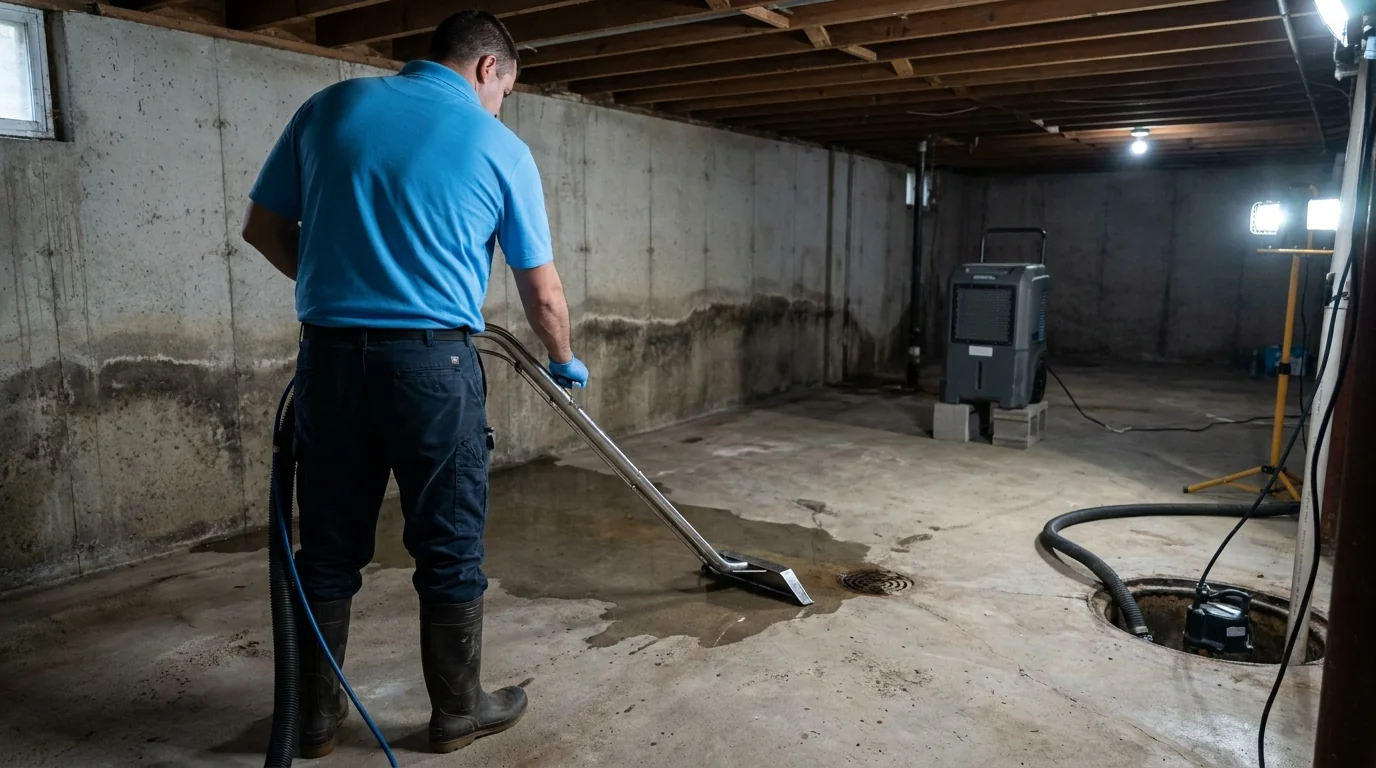
24/7 Emergency Basement Flooding Cleanup in Staten Island
24/7 emergency basement flooding cleanup in Staten Island, NY. IICRC-certified, insurance billing accepted. Call (855) 650-7422.
Our IICRC-certified technicians are dispatched from our Fair Lawn, NJ headquarters and are typically on-site in Staten Island within 60 minutes of your call.
Flooded basement in Staten Island? We answer 24/7. Call now and our crew can be on-site within 60 minutes to pump out the water and start drying.
Staten Island’s East Shore has never fully dried out from Hurricane Sandy’s memory, and when Ida dropped several inches of rain in a matter of hours in 2021, low-lying South Shore streets flooded again before most residents could move a single box. If you’re standing at the top of your basement stairs right now looking at a foot of brown water, the clock is already running: mold can begin colonizing wet framing within 24 to 48 hours, and the longer saturated water sits against a concrete block or poured-foundation wall, the deeper it wicks. The Restoration Group has crews based on the island and can be reached any hour at (855) 650-7422.
Why Staten Island Basements Flood, and Why It’s Complicated Here
The borough’s geography stacks several flood risks on top of each other in ways that don’t apply to most of the metro area. The East Shore communities, South Beach, Midland Beach, Oakwood Beach, sit on low-lying coastal fill that drains poorly even in moderate rain events. The South Shore’s newer townhome developments along the Hylan Boulevard corridor were built on former wetland, and their sump systems are often undersized for the water table they’re fighting. Meanwhile, the North Shore neighborhoods like St. George and Port Richmond are packed with early-1900s frame homes whose cast-iron drain stacks and galvanized supply lines are well past their service life, a single January cold snap can split a pipe inside a basement wall and dump hundreds of gallons before anyone notices.
Postwar Cape Cods and split-levels throughout Great Kills and New Dorp (ZIP 10306) present their own challenge: finished basements with drop ceilings, carpet over concrete slab, and fiberglass batt insulation tucked against rim joists. That layering traps moisture and hides it. A wet carpet pad can feel barely damp on the surface while the concrete beneath reads 90% relative humidity on a moisture meter.
Our Basement Flooding Cleanup Process in Staten Island
When a crew arrives, the first priority is safety, cutting power to the affected circuit if water is near any electrical panel or outlet, then assessing whether the water source is still active. Standing water is extracted with truck-mounted or portable submersible pumps depending on access; many Staten Island homes have narrow exterior basement entries or interior stairs that limit equipment size.
Once bulk water is out, the real work begins. Moisture mapping with thermal imaging and pin-type meters identifies exactly where water has traveled, under baseboards, into wall cavities, beneath any floating floor system. Wet materials are categorized: what can be dried in place (concrete block, solid wood framing, poured walls) versus what must come out (saturated drywall, carpet, insulation). Drying equipment, desiccant or refrigerant dehumidifiers, axial air movers, and in some cases drying mats for slabs, is positioned based on the moisture map, not guesswork. Readings are logged daily against the IICRC S500 standard until affected materials reach documented dry goals, typically three to five days depending on the extent of saturation.
If the loss involves sewage backup, common when a combined sewer system surcharges during a heavy rain event, which happens regularly in parts of Port Richmond and St. George, the cleanup protocol shifts to a Category 3 contaminated-water response, which requires personal protective equipment, antimicrobial treatment, and removal of any porous materials that contacted the water.
Reaching Staten Island from Our Kenilworth Base
The Restoration Group operates 24/7, and Staten Island is one of our active office locations, which means crews are already on the island rather than crossing from New Jersey for every call. For addresses in the 10301 corridor near St. George or the ferry terminal, response is straightforward. South Shore addresses near Tottenville or Great Kills may add travel time depending on traffic on the Staten Island Expressway or Hylan Boulevard, but dispatchers can give you a realistic arrival window when you call. We do not quote minute guarantees we can’t keep, you’ll get an honest estimate, not a marketing number.
Working With Your Insurance Carrier
Most homeowner policies cover sudden and accidental water losses, a burst pipe, an appliance failure, a sump pump overflow if you carry the rider. Flood damage from a storm surge or rising groundwater is a different category and typically requires a separate NFIP or private flood policy. Given Sandy’s history on the East Shore, a meaningful number of Staten Island homeowners do carry flood coverage, and we’re familiar with the documentation those claims require.
We photograph affected materials before anything is removed, generate moisture logs that adjusters accept, and can bill carriers directly on agreed-upon losses so you’re not advancing the full cost out of pocket.
Local Note
One thing that catches homeowners off guard in the postwar split-levels common throughout New Dorp and Great Kills: the half-level design means the “basement” floor is often only partially below grade, with one or two walls fully exposed above ground. That sounds like it would make drying easier, and it does for those walls, but the below-grade portion often has no vapor barrier between the slab and the soil, and the soil on the South Shore holds water for days after a rain event. We’ve seen slabs that read dry on the surface re-wet from below within 48 hours of equipment removal because the ground moisture was never addressed. On those jobs, we extend the drying cycle and verify slab readings at depth before pulling equipment.
If your basement flooded today, whether it’s a pipe break in a St. George brownstone or storm surge creeping under a South Beach back door, call (855) 650-7422. Crews are on the island and available around the clock.
Serving Staten Island from our Fair Lawn headquarters — ★ 4.8 · 166 Google reviews
“Prompt, knowledgeable, skillful and honest. Highly recommend. They remediated within 24 hours. Total peace of mind restored. Worth every penny.” - Anne, October 2026Read our reviews on Google →
Basement Flooding Cleanup in Staten Island: Service Coverage
Frequently Asked Questions
How fast can you arrive for basement flooding cleanup in Staten Island?
Are East Shore neighborhoods like South Beach at higher risk for basement flooding than the rest of Staten Island?
How does a sewage backup during a Staten Island storm event change the cleanup process?
My Great Kills home has a finished basement with carpet and drop ceiling — does that affect how long drying takes?
What's the difference between a water damage claim and a flood claim for Staten Island homeowners?
How long does basement drying typically take in Staten Island's older housing stock?
Will my homeowners insurance cover basement flooding cleanup in Staten Island?
Basement Flooding Cleanup response in Staten Island
Most Staten Island calls see a technician on-site within 60 minutes from our Fair Lawn headquarters.
Nearby & Related
- 24/7 Emergency Basement Flooding Cleanup in Kenilworth
- Restoration Services in Staten Island
- 24/7 Emergency Fire Damage Restoration in Staten Island
- Mold Remediation in Staten Island
- 24/7 Emergency Basement Flooding Cleanup in Bayonne
- 24/7 Emergency Basement Flooding Cleanup in Bloomfield
- Contact The Restoration Group