
Mold Inspection and Testing in Teaneck
24/7 mold inspection and testing in Teaneck, NJ. IICRC-certified, insurance billing accepted. Call (844) 808-8838.
Our IICRC-certified technicians are dispatched from our Fair Lawn, NJ headquarters and are typically on-site in Teaneck within 60 minutes of your call.
Noticing a musty smell in a finished basement near Teaneck Creek, or dark spotting on drywall after last spring’s rain? Mold inspection and testing is the step that turns a guess into a plan: it tells you what’s actually growing, where it’s hiding behind walls or under flooring, and whether the air itself needs attention before any remediation work begins. In a township where so many basements took on water during Ida, that distinction matters more than it does almost anywhere else in Bergen County.
Why Teaneck Properties See Mold Issues
Teaneck’s housing stock skews heavily toward 1920s-40s brick Tudors, colonials, and center-hall homes, many of them in West Englewood, The Grange, and the Whittier section, with finished basements added decades after original construction. Those basements sit close to the water table along the Hackensack River and Teaneck Creek, and the 2021 Ida flooding pushed water into crawl spaces and finished lower levels across the township that had never seen standing water before. Old cast-iron drain lines common to this housing era are also more prone to slow leaks at joints, which can feed hidden mold growth inside a wall cavity for months before anyone smells it. Add in the humidity swings of a North Jersey summer and a finished basement that wasn’t rebuilt with vapor barriers or dehumidification in mind, and you have conditions that favor mold colonization within 24 to 48 hours of any moisture intrusion, whether that’s a flooded sump pit or a slow leak around a Cedar Lane storefront’s rear utility wall.
Our Mold Inspection and Testing Process in Teaneck
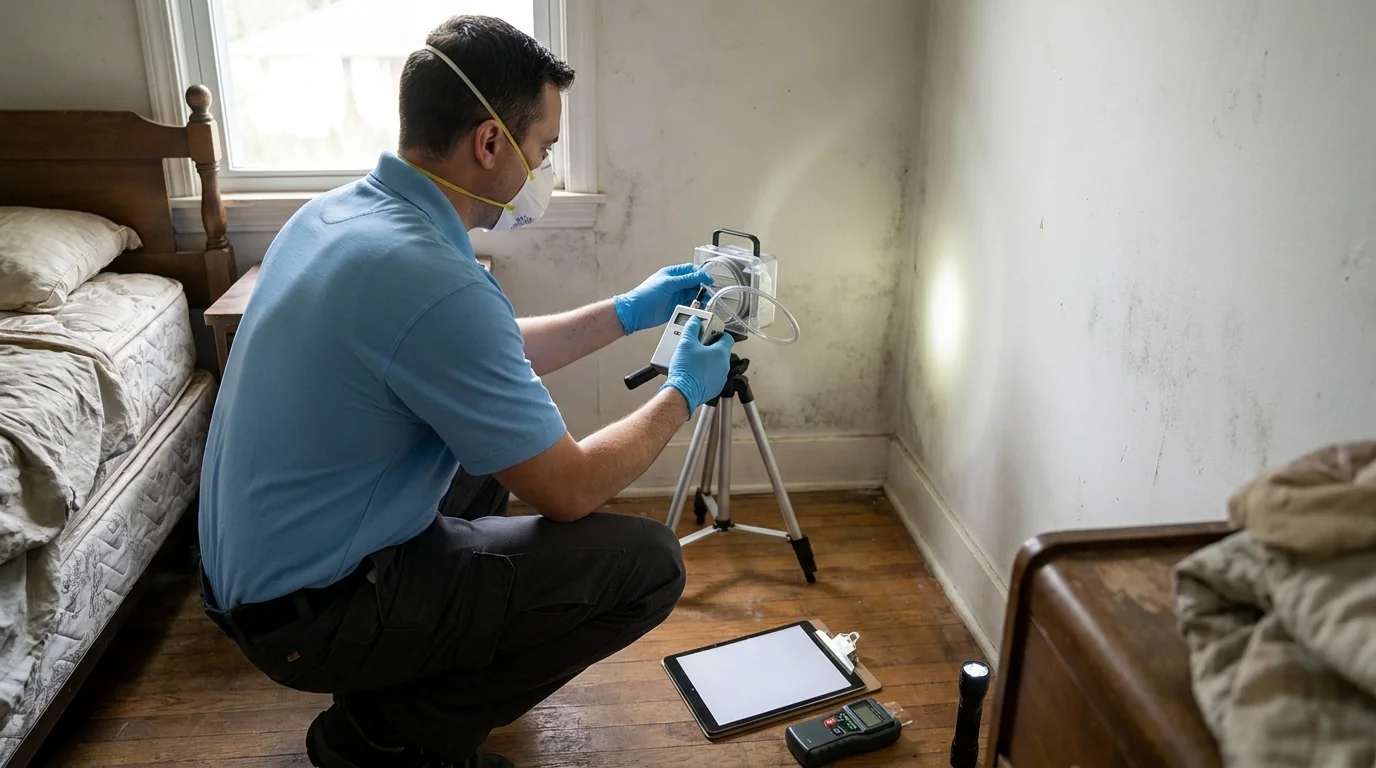
An inspection starts with a visual and moisture-mapping walkthrough, checking rim joists, below-grade walls, and HVAC returns, since these are the spots where Teaneck’s older homes tend to trap humidity. We use a moisture meter to find elevated readings behind baseboards and around foundation walls, which in pre-1950 construction often means checking both the finished surface and the original masonry behind it, since plaster and old block hold moisture differently than modern drywall. Where conditions suggest a problem, air samples are taken both inside the suspect area and from an unaffected reference point in the home, a comparison that’s especially useful in center-hall colonials near the Bryant School area where finished basements sit directly below living space. Surface swabs are collected from any visible growth for lab analysis. Results typically come back from the lab within a few business days, and we walk homeowners through what the spore counts and species findings actually mean before recommending next steps, including when mold remediation is warranted and when it isn’t.
Teaneck Insurance & HOA Coordination
Mold claims in Teaneck often trace back to a covered water event, a burst supply line, a sewage backup, or storm flooding, rather than mold itself, since most policies treat long-term moisture and humidity as a maintenance issue rather than a covered peril. That makes the documentation from an inspection valuable: clear photos, moisture readings, and lab results give an adjuster something concrete to tie back to the triggering event, particularly for finished basements that flooded during Ida and were only recently reopened or sold. We provide written reports that homeowners can hand directly to their carrier or share with a property manager handling a multi-unit building near the Cedar Lane commercial district.
Equipment & Methods We Use for Mold Inspection
Testing relies on calibrated moisture meters, thermal imaging to spot temperature differentials that indicate trapped moisture behind finished surfaces, and both air and surface sampling collected under controlled conditions. Samples go to an independent lab for species identification and spore count, keeping the testing separate from any remediation recommendation, which protects the homeowner from a conflict of interest between diagnosis and treatment.
Local note
Homes within a few blocks of Votee Park and the lower-lying streets near Teaneck Creek tend to show elevated subfloor moisture readings even in units that look dry on the surface, a pattern we’ve learned to check for specifically given how often the creek’s seasonal rise saturates the ground beneath older slab additions. It’s worth a look even if the basement itself seems fine.
If you’re dealing with a musty odor, visible spotting, or a basement that took on water and was never professionally tested afterward, mold inspection and testing gives you an answer instead of a guess. Call The Restoration Group at (844) 808-8838 to schedule testing for a Teaneck property, including homes near FDU, Cedar Lane, or anywhere in the 07666 area.
Serving Teaneck from our Fair Lawn headquarters — ★ 4.8 · 171 Google reviews
“Honest people, super quick and very professional! I recommend them entirely.” - Jennifer, November 2026Read our reviews on Google →
Mold Inspection and Testing in Teaneck: Service Coverage
Frequently Asked Questions
How fast can you arrive for mold inspection and testing in Teaneck?
How does mold inspection work for a finished basement near Teaneck Creek that flooded during Ida?
Are older colonials in West Englewood or The Grange more prone to hidden mold growth?
Do you test indoor air quality separately from surface mold testing in Teaneck homes?
How long does it take to get mold testing results for a Teaneck property?
Will my insurance cover mold testing for a basement near the Cedar Lane commercial district?
Mold Inspection and Testing response in Teaneck
Most Teaneck calls see a technician on-site within 60 minutes from our Fair Lawn headquarters.