Commercial Restoration in Wayne
24/7 commercial restoration in Wayne, NJ. IICRC-certified, insurance billing accepted. Call (855) 650-7422.
Our IICRC-certified technicians are dispatched from our Fair Lawn, NJ headquarters and are typically on-site in Wayne within 60 minutes of your call.
Wayne’s commercial corridors along Route 23 and Route 46 sit within one of the most flood-prone watersheds in Passaic County. When the Pompton River backs up or a sprinkler line ruptures inside a Willowbrook Mall anchor tenant’s stockroom, the clock starts immediately, standing water in a commercial space compounds fast, and every hour of downtime has a dollar figure attached to it. The Restoration Group responds 24/7 to commercial losses across Wayne’s 07470 and 07474 ZIP codes, from the Route 23 retail strip to office parks near William Paterson University.
Why Wayne Commercial Properties Face Elevated Risk
The geography here is unforgiving. The Passaic and Pompton Rivers converge just south of Wayne, and the Hoffman Grove and Mountain View sections have flooded repeatedly, most severely during Irene in 2011 and again during Ida in 2021, when river levels overwhelmed sump systems and inundated ground-floor commercial spaces. Businesses along the lower-lying corridors near those neighborhoods know the pattern: a heavy rain event upstream means water at the threshold within hours.
Beyond riverine flooding, the commercial building stock along the Route 23/46 corridor includes retail centers and strip plazas built in the 1970s and 1980s. Aging wet-pipe sprinkler systems in these structures are prone to freeze-induced pipe bursts during hard New Jersey winters, and flat or low-slope roofs accumulate ice dams that drive water into ceiling assemblies. A single failed sprinkler head in a retail bay can discharge hundreds of gallons before the system is isolated, saturating inventory, subfloor assemblies, and adjacent tenant spaces simultaneously.
Our Commercial Restoration Process in Wayne
Commercial losses are operationally different from residential ones. Tenants need partial access maintained, inventory must be documented before it moves, and building owners often have lease obligations that affect how quickly a space must be returned to service. The process is structured around those constraints.
The first step on arrival is containment and documentation, moisture mapping with thermal imaging across the full affected footprint, photographic inventory of damaged materials, and identification of any secondary systems (HVAC ducts, electrical panels, elevator shafts) that may have been compromised. For multi-tenant retail or office buildings, we isolate the loss area without cutting off adjacent tenants where structurally possible.
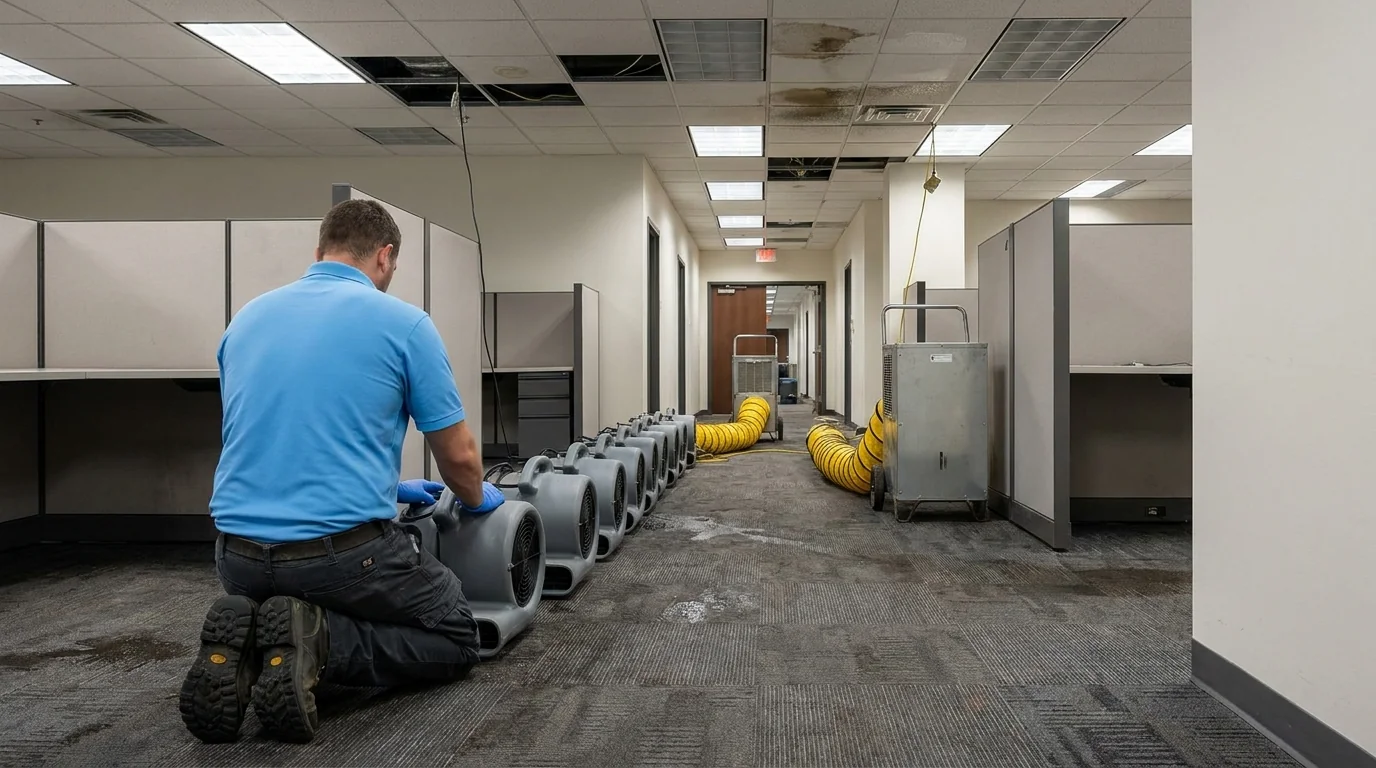
Drying in commercial spaces requires industrial-scale equipment: large-capacity desiccant or refrigerant dehumidifiers, high-velocity axial air movers, and in some cases negative air pressure containment to prevent cross-contamination during mold-risk situations. Drying timelines are validated against the IICRC S500 standard for water damage and documented daily, that documentation matters when a property manager is reporting to an insurance adjuster or a commercial landlord is tracking a tenant’s business interruption claim.
For fire and smoke losses, common in restaurant and kitchen-adjacent commercial spaces, odor neutralization and structural cleaning follow a separate protocol. Smoke residue in HVAC ductwork can redistribute odor throughout an entire building long after visible soot is cleaned; duct cleaning and sealing is part of the scope, not an afterthought.
Reaching Wayne from Kenilworth
The Restoration Group is headquartered in Kenilworth, NJ, and Wayne is accessible via I-287 West to Route 23 North, a route that keeps response times practical even during peak hours. For properties near William Paterson University or the Wayne Towne Center, Route 23 provides direct access. Businesses closer to the Packanack Lake or Pines Lake communities, where midcentury commercial-adjacent properties and homeowner associations sometimes share infrastructure, may require coordination on access routes, particularly if a loss event coincides with a community-wide flooding situation that has local roads partially closed. We account for that when dispatching.
Because hours are 24/7, a pipe burst at 2 a.m. inside a Route 46 restaurant or a sprinkler discharge in an office building over a holiday weekend gets the same response as a weekday call.
Wayne Insurance and Commercial Claim Coordination
Most commercial losses in Wayne flow through commercial property policies, and many retail tenants carry separate business interruption coverage. The documentation we produce, moisture logs, thermal images, material inventories, drying validation reports, is formatted to support both the property owner’s carrier and the tenant’s carrier simultaneously, which matters when two adjusters are working the same loss from different angles.
Wayne commercial properties in flood-prone zones near the Passaic River corridor may also carry NFIP (National Flood Insurance Program) policies in addition to standard commercial property coverage. NFIP claims have specific documentation requirements and scope limitations; we work within those parameters and flag scope items that fall outside NFIP coverage so the property owner can address them with their primary carrier without delays.
Local Note
One pattern that catches Wayne commercial property managers off guard: buildings in the Mountain View section that back up to drainage easements along the river tributaries often have below-grade mechanical rooms that are not reflected accurately in older as-built drawings. When water enters those spaces, the actual affected square footage, and the location of electrical panels and data infrastructure, can differ significantly from what the lease plans show. We’ve learned to walk the full mechanical footprint before scoping a loss in that part of town, rather than relying on floor plans alone.
If your Wayne business or commercial property has taken on water, smoke, or structural damage, call (855) 650-7422. The Restoration Group handles the documentation, the drying, and the carrier coordination so you can focus on getting your operation back open.
Serving Wayne from our Fair Lawn headquarters — ★ 4.8 · 166 Google reviews
“Prompt, knowledgeable, skillful and honest. Highly recommend. They remediated within 24 hours. Total peace of mind restored. Worth every penny.” - Anne, October 2026Read our reviews on Google →
Commercial Restoration in Wayne: Service Coverage
Frequently Asked Questions
How fast can you arrive for commercial restoration in Wayne?
How quickly can The Restoration Group reach a commercial property in the Willowbrook Mall corridor or along Route 46 in Wayne?
The Hoffman Grove and Mountain View sections of Wayne flood repeatedly — does that affect how you scope a commercial loss there differently than elsewhere in town?
Are commercial buildings near William Paterson University or Wayne Towne Center more likely to have specific code requirements that affect restoration work?
How long does commercial water damage drying typically take for a mid-size retail or office space in Wayne?
Wayne's older strip plazas along Route 23 often have multiple tenants — how do you handle a water or fire loss that crosses tenant lines?
Will my homeowners insurance cover commercial restoration in Wayne?
Commercial Restoration response in Wayne
Most Wayne calls see a technician on-site within 60 minutes from our Fair Lawn headquarters.