Mold Inspection and Testing in Clark
24/7 mold inspection and testing in Clark, NJ. IICRC-certified, insurance billing accepted. Call (855) 650-7422.
Our IICRC-certified technicians are dispatched from our Fair Lawn, NJ headquarters and are typically on-site in Clark within 60 minutes of your call.
Clark’s postwar housing stock, the split-levels off Valley Road, the capes tucked near Brant Lake, the finished basements that absorbed Rahway River backflow during Ida in 2021, creates exactly the conditions where mold takes hold quietly and spreads fast. A musty smell in a basement that flooded two seasons ago, a persistent cough that clears up when you leave the house, discoloration behind a water heater that’s been dripping for months: these are the signals that warrant a professional mold inspection and testing visit before a small colony becomes a structural problem.
Why Clark Properties See Elevated Mold Risk
Clark’s geography does a lot of the work for mold. Robinson’s Branch, the tributary that threads through low ground near Lake Avenue, keeps the water table close to the surface in a wide swath of the township. When sump pumps fail during a summer downpour, and in Clark’s clay-heavy soil, they fail more often than homeowners expect, that moisture doesn’t just drain away. It lingers in wall cavities, under subfloor sheathing, and behind the drywall that was used to finish basements in the 1970s and 1980s renovation wave.
The aging infrastructure compounds the problem. Many of the ranches and split-levels built in the 1950s and 1960s still run original cast-iron drain lines and copper supply lines. Cast iron corrodes at joints; copper develops pinhole leaks at fittings. Either failure can feed a slow, hidden moisture source for months before it’s visible, and mold can begin colonizing a wet surface in as little as 24 to 48 hours. By the time a homeowner notices staining or odor, the colony is often well established behind finished surfaces.
The Raritan Road business district and the Westfield Avenue corridor add a commercial dimension. Restaurant kitchens, retail storage rooms, and office suites in those strips share the same moisture vulnerability as residential properties, with the added complication of food odors masking early mold indicators.
Our Mold Inspection and Testing Process in Clark
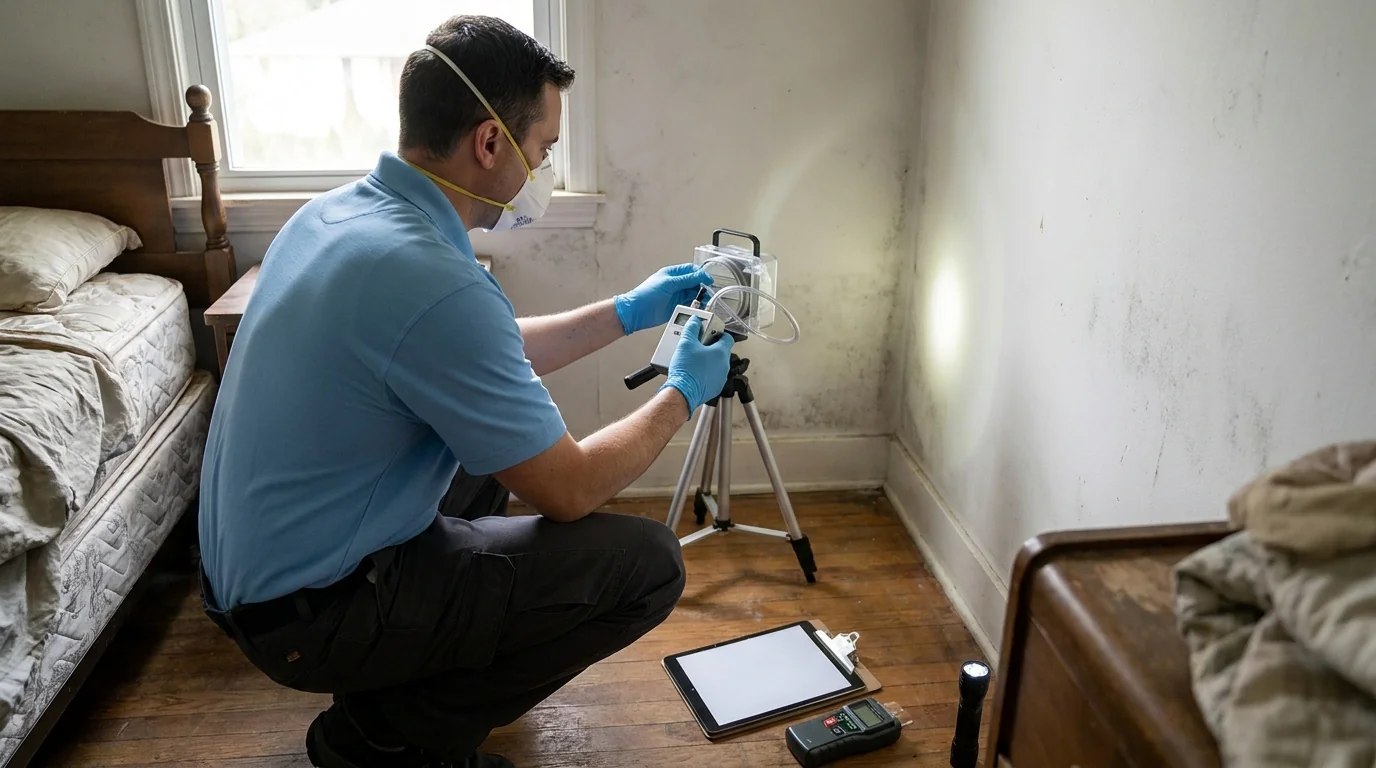
A mold assessment isn’t a single swab and a phone call. The process starts with a thorough visual inspection of the areas most likely to harbor growth in a Clark home: the basement perimeter, the rim joist cavity, under-sink cabinets, and any wall or ceiling surface that was wet during a past flood or leak event. We use thermal imaging to identify temperature differentials that indicate moisture behind finished surfaces, a critical step in homes where the original 1960s framing is now buried under decades of renovation layers.
Air sampling for mold spores is collected at multiple points: typically one outdoor baseline sample and two or more indoor samples in areas of concern. Tape-lift or swab samples are taken from any visible growth to identify the genus and species present. All samples are submitted to an accredited third-party laboratory. The written report we provide includes spore counts by species, a comparison to outdoor baseline levels, and a clear statement of whether remediation is warranted, language that holds up with insurance adjusters and real estate attorneys alike.
For indoor air quality testing beyond mold, we can extend sampling to include VOCs and other particulates, which is relevant for properties near the Raritan Road commercial corridor where prior tenant activities may have left residual contamination.
Reaching Clark from Kenilworth
The Restoration Group operates out of Kenilworth, which sits directly adjacent to Clark’s northern boundary. From our location, we can reach most Clark addresses, including neighborhoods off Valley Road and the Lake Avenue corridor, without navigating significant traffic delays. Because we operate 24/7, an overnight call about a flooded basement or a sudden sewage backup doesn’t wait until morning. We schedule inspections around your availability and aim to get eyes on the problem the same day you call.
Clark Insurance Coordination
Mold inspection findings in Clark most commonly enter the insurance process through one of two paths: a homeowner’s policy claim tied to a covered water loss (burst pipe, appliance failure, storm-driven flooding) or a real estate transaction where the buyer’s inspector flagged a suspect area. We document findings with photographs, moisture readings, and lab-certified spore counts, the format carriers and real estate attorneys expect. We work directly with adjusters on covered claims so you’re not translating technical reports under pressure.
Note that standard homeowner’s policies in New Jersey typically exclude mold that results from long-term neglect or gradual leaks, so the documentation of a specific loss event matters. Our report is structured to support that distinction clearly.
Local Note
One pattern that comes up repeatedly in Clark’s finished basements: the 1970s-era drywall used to panel basement walls in this housing stock is paperless on neither face, and paper-faced gypsum is among the most hospitable substrates mold can colonize. When we inspect a split-level or ranch in the 07066 ZIP code that had any water intrusion during Tropical Storm Ida or a subsequent sump failure, we probe the lower 18 inches of those basement walls carefully, even when the surface looks dry. Mold behind intact paint is common, and a visual-only inspection misses it routinely. Air sampling alone won’t locate the source; the physical inspection has to go deeper than the surface.
If you’re seeing signs of a moisture problem, or just want confirmation before listing your home or closing on one, call The Restoration Group at (855) 650-7422. We’ll assess the situation honestly, give you a written report you can actually use, and tell you plainly whether remediation is necessary.
Serving Clark from our Fair Lawn headquarters — ★ 4.8 · 166 Google reviews
“The company was very prepared and professional. They were prompt with coming out to inspect the water damage that occurred and had the team come out the next day. They even wore booties in the house. They cut out all areas of damage, sprayed and use numerous fans and humidifiers in the wet area. I…” - Melanie, October 2026Read our reviews on Google →
Mold Inspection and Testing in Clark: Service Coverage
Frequently Asked Questions
How fast can you arrive for mold inspection and testing in Clark?
Are homes near Lake Avenue and Robinson's Branch at higher risk for mold than other parts of Clark?
How does Clark's 1950s-60s housing stock affect what mold testing involves?
What does a mold inspection report include, and will it satisfy a real estate attorney or insurance adjuster in Clark?
Can mold testing also address indoor air quality concerns for a business on the Raritan Road corridor?
Does a mold inspection in Clark require the homeowner to vacate during sampling?
Mold Inspection and Testing response in Clark
Most Clark calls see a technician on-site within 60 minutes from our Fair Lawn headquarters.