Water Cleanup in Fort Lee
24/7 water cleanup in Fort Lee, NJ. IICRC-certified, insurance billing accepted. Call (855) 650-7422.
Our IICRC-certified technicians are dispatched from our Fair Lawn, NJ headquarters and are typically on-site in Fort Lee within 60 minutes of your call.
When a supply line fails on the 18th floor of a Palisades high-rise, water doesn’t stop at one unit, it travels down through concrete decking, into electrical chases, and into the apartments of neighbors who had nothing to do with the original break. That vertical cascade is the defining water-damage pattern in Fort Lee, and it demands a response that understands stacked-unit buildings, HOA claim chains, and the specific materials those towers were built with. The Restoration Group dispatches 24/7 from Kenilworth and is an IICRC Certified Firm (#210213), licensed by the NJ Division of Consumer Affairs.
Why Fort Lee Properties See Water Cleanup Issues
Fort Lee’s geography does a lot of the explaining. The borough sits atop the Palisades cliffs, and when a storm rolls in from the Hudson, runoff has nowhere to go but fast, steep grades push water into below-grade parking garages, mechanical rooms, and the garden-level units that anchor many of the towers near the George Washington Bridge. Tropical Storm Ida in 2021 demonstrated exactly how quickly Bergen County’s drainage systems can be overwhelmed, and Fort Lee’s cliff-side topography made it one of the harder-hit communities in the region.
Away from the high-rises, the older residential blocks in Coytesville and The Hill tell a different story. Prewar multifamily homes and two-family houses in those neighborhoods were built with cast-iron drain stacks and galvanized supply lines that are well past their service life. A slow pinhole leak behind a plaster wall can go undetected for weeks, long enough for moisture to saturate the lath, the subfloor, and the framing before a visible stain appears on the ceiling below. The Main Street business corridor and the Hudson Lights mixed-use complex add a commercial dimension: a single overnight pipe failure in a retail or restaurant space can affect multiple tenants and trigger both commercial property and liability claims simultaneously.
Our Water Cleanup Process in Fort Lee
The first step on any water loss is containment, stopping the source if it hasn’t been stopped, and understanding exactly where the water went. In a high-rise building, that means tracing the migration floor by floor using thermal imaging and calibrated moisture meters, not just looking at what’s visibly wet. Water behind concrete and tile reads dry at the surface while the substrate underneath stays saturated for days.
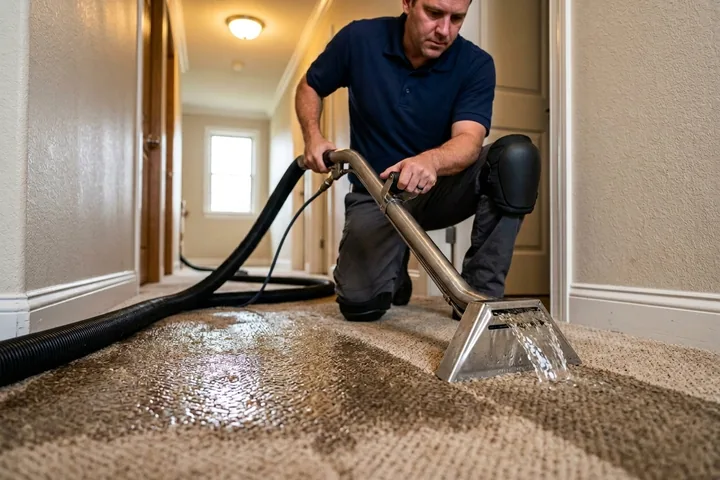
Once the scope is mapped, we extract standing water with truck-mounted and portable extraction units, portable equipment matters in elevator buildings where hose runs from a parking garage to a 12th-floor unit aren’t practical with a truck mount alone. Drying follows the IICRC S500 standard: we calculate the psychrometric conditions in each affected space, place industrial desiccant or refrigerant dehumidifiers accordingly, and monitor moisture readings daily until all structural materials reach their dry standard. Every reading is logged and timestamped, which matters when you’re coordinating with a building’s property manager, an HOA board, and two or three separate insurance adjusters at once.
For contents, furniture, cabinetry, personal belongings, we document, photograph, and either dry in place or move to a staging area depending on the severity of saturation and the layout of the unit.
Fort Lee Insurance & HOA Coordination
Water losses in Fort Lee’s condominium towers almost always involve layered coverage: the unit owner’s HO-6 policy, the building’s master policy (which typically covers common areas and the building envelope), and sometimes a neighbor’s policy if their unit was the source. Sorting out which carrier covers which scope of damage is one of the more time-consuming parts of the job, and it’s where disorganized documentation creates real delays.
We provide a complete written scope, moisture logs, and photo documentation formatted for carrier review. We bill most major insurance carriers directly. If the building’s HOA requires pre-approval for work in common areas or has a preferred vendor list for certain trades, we communicate with the property management office before work begins, not after.
Reaching Fort Lee from Kenilworth
From our Kenilworth base, the most direct route to Fort Lee runs north on the Garden State Parkway to I-95 east, crossing into Bergen County and reaching the 07024 ZIP code in under an hour under normal conditions. Because we operate 24/7, we can dispatch at hours when that corridor moves freely. For addresses deep in Coytesville or up on The Hill, we note that local streets can be narrow and parking is tight, on a first call, letting us know the building’s service entrance or parking garage access point saves time on arrival.
Local Note
In Fort Lee’s prewar buildings, particularly the older stock in Coytesville, plaster-and-lath wall systems absorb and hold water very differently than modern drywall. Plaster is dense enough that surface readings can look acceptable while the lath and framing behind it remain wet. We use penetrating probes rather than surface-only sensors in those structures, and we build extra drying time into the schedule because plaster releases moisture slowly and unevenly. Rushing the drying phase in those buildings is the most common reason a water loss turns into a mold remediation job six weeks later.
If you’re dealing with water damage right now, whether it’s a burst supply line in a high-rise tower or a flooded basement in one of The Hill’s older two-families, call The Restoration Group at (855) 650-7422. We’ll assess the damage, walk you through the documentation process, and get drying equipment in place before the situation gets worse.
Serving Fort Lee from our Fair Lawn headquarters — ★ 4.8 · 160 Google reviews
“The folks at TRG were professional, punctual, and pleasant to deal with. They did a great job addressing our issue and performed appropriate follow up to ensure our satisfaction.” — Jw, August 2026Read our reviews on Google →
Water Cleanup in Fort Lee: Service Coverage
Frequently Asked Questions
How fast can you arrive for water cleanup in Fort Lee?
How quickly can The Restoration Group reach a high-rise in Fort Lee for an emergency water cleanup?
In a Fort Lee condo building, whose insurance covers the water damage when a pipe in one unit floods the unit below?
Are the older homes in Coytesville and The Hill harder to dry out after a water loss?
What equipment do you use for water extraction in Fort Lee's high-rise buildings?
Does Fort Lee's steep Palisades terrain affect how storm-related flooding enters buildings?
Water Cleanup response in Fort Lee
Most Fort Lee calls see a technician on-site within 60 minutes from our Fair Lawn headquarters.