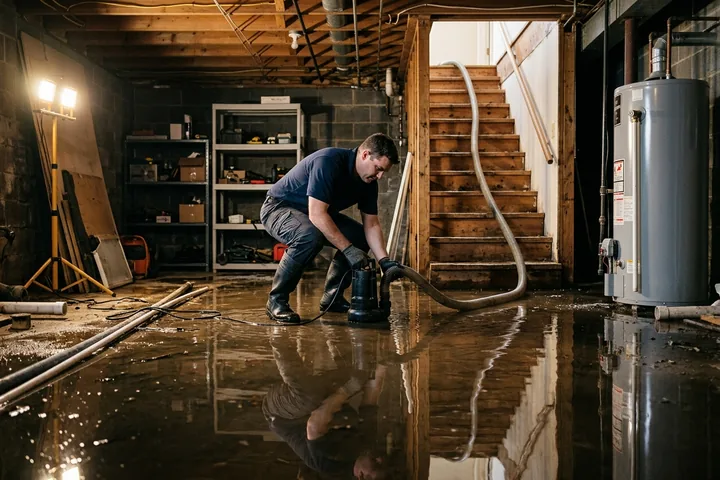
Basement Flood Cleanup in Hackensack
24/7 basement flood cleanup in Hackensack, NJ. IICRC-certified, insurance billing accepted. Call (855) 650-7422.
Our IICRC-certified technicians are dispatched from our Fair Lawn, NJ headquarters and are typically on-site in Hackensack within 60 minutes of your call.
When the Hackensack River swells after a heavy storm and tidal backpressure pushes through aging storm drains, basements across the Fairmount and Southside neighborhoods can take on water faster than a sump pump can keep up. That combination, tidal influence, clay-heavy soils that shed water instead of absorbing it, and a housing stock full of prewar foundations, makes basement flooding in Hackensack a different problem than a simple appliance leak. The Restoration Group responds 24/7 and can be reached at (855) 650-7422 the moment you realize the floor is wet.
Why Hackensack Properties See Basement Flood Cleanup Issues
Hackensack’s geography does most of the damage before the rain even stops. The eastern edge of the city runs along the Hackensack River, and tidal influence means that even moderate rainfall can back up storm infrastructure when the tide is running high. Low-lying blocks near Foschini Park and along the Prospect Avenue corridor are especially vulnerable, water that has nowhere to drain finds the nearest basement wall instead.
The housing stock compounds the problem. Two- and three-family prewar homes throughout Fairmount and the Southside were built with block or brick foundations that were never designed to be fully waterproof. Mortar joints crack over decades, and efflorescence, that chalky white mineral staining on basement walls, is usually the first sign that water has been migrating through masonry long before a visible flood event. Galvanized supply lines and cast-iron drains common in homes built before the 1960s corrode from the inside out, and a pipe that looks intact from the street can fail without warning during a cold snap or a pressure surge.
The Prospect Avenue high-rise corridor adds a commercial and multi-unit dimension. A single supply-line failure in a stacked building doesn’t stay on one floor, water follows gravity through penetrations, elevator shafts, and utility chases until it pools in the lowest mechanical space. That kind of loss requires coordinated drying across multiple units simultaneously.
Our Basement Flood Cleanup Process in Hackensack
The first step on any flooded basement is measurement, not extraction. Moisture meters and thermal imaging cameras show where water has traveled behind block walls or under slab edges, areas that look dry to the eye but will grow mold within days if left untreated. Standing water is extracted with truck-mounted or portable units depending on access, and then the slower work of structural drying begins.
For Hackensack’s older masonry construction, drying timelines run longer than they would in a newer home with poured concrete and modern drywall. Block walls are porous and hold moisture at depth; we position desiccant or refrigerant dehumidifiers and axial air movers to drive evaporation from the wall surface inward, monitoring daily with calibrated instruments until readings reach the IICRC S500 standard for acceptable moisture levels. No work is signed off until the numbers confirm it, not just until the basement feels dry.
If sewage or tidal backflow is involved, the cleanup scope expands. Category 3 water (sewage-contaminated or flood-sourced water) requires removal of all porous materials that contacted it, drywall, insulation, carpet, and antimicrobial treatment of structural surfaces before any drying equipment is placed. We document every affected material and photograph conditions throughout, which matters when an insurance claim is filed.
Reaching Hackensack from Kenilworth
The Restoration Group is based in Kenilworth, NJ, and Hackensack is a direct run up the Garden State Parkway or Route 9 to I-80, routes that our crews travel around the clock. Because our hours are 24/7, a call at 2 a.m. after a nor’easter pushes water into a Southside basement gets the same response as a daytime call. We do not quote specific arrival times in minutes because traffic on the Parkway corridor varies, but we dispatch immediately on every emergency call.
Hackensack Insurance Coordination
Most standard homeowner policies cover sudden and accidental water intrusion, a burst pipe, a failed sump pump, a washing machine supply line, but exclude gradual seepage or flood events unless the homeowner carries a separate NFIP or private flood policy. In Hackensack, where tidal flooding is a documented risk, the distinction between a storm-drain backup and a river flood event can affect which policy responds.
We document losses thoroughly from the moment we arrive: photographs, moisture readings, affected material inventories, and scope narratives. That documentation is what adjusters use to authorize work, and having it organized from day one shortens the cycle. We work with most major carriers and can communicate directly with your adjuster so you are not translating between a contractor and an insurance office while your basement is still wet.
Local Note
In Hackensack’s prewar two- and three-family homes, particularly the wood-frame stock throughout Fairmount, subfloor assemblies often sit directly on wood sleepers laid over a concrete slab or bare soil. When a basement floods, water wicks up through the sleepers into the subfloor above before it is ever visible from the first-floor living space. Homeowners sometimes call us focused on the basement and are surprised to learn the floor above needs attention too. Checking the underside of the first-floor assembly with a moisture meter is a standard part of every inspection we do in this building type, skipping it is how a dry-looking basement produces a mold problem three weeks later.
If your basement took on water, whether from a storm, a pipe, or a drain backup, call The Restoration Group at (855) 650-7422. We serve Hackensack ZIP codes 07601 and 07602 and respond around the clock so that a wet basement tonight does not become a mold problem next week.
Serving Hackensack from our Fair Lawn headquarters — ★ 4.8 · 160 Google reviews
“Prompt and professional work. Kept in contact thru out the process which was very important to me.” — F., July 2026Read our reviews on Google →
Basement Flood Cleanup in Hackensack: Service Coverage
Frequently Asked Questions
How fast can you arrive for basement flood cleanup in Hackensack?
Are basements in Hackensack's Fairmount and Southside neighborhoods more prone to flooding than other parts of Bergen County?
How does tidal influence from the Hackensack River affect a basement flood cleanup job?
What should a Prospect Avenue high-rise resident or property manager do if a pipe burst floods a lower-level mechanical room?
How long does basement drying typically take in Hackensack's older masonry homes?
Does my homeowner's policy cover basement flooding in Hackensack, or do I need a separate flood policy?
Will my homeowners insurance cover basement flood cleanup in Hackensack?
Basement Flood Cleanup response in Hackensack
Most Hackensack calls see a technician on-site within 60 minutes from our Fair Lawn headquarters.