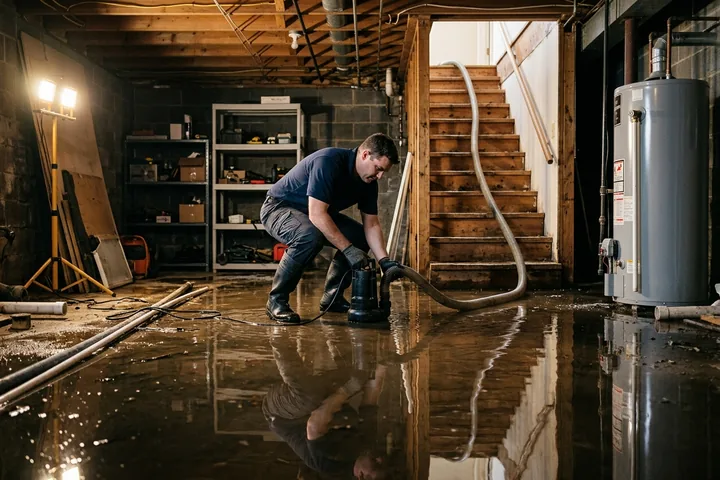
Basement Flood Cleanup in Highland Park
24/7 basement flood cleanup in Highland Park, NJ. IICRC-certified, insurance billing accepted. Call (855) 650-7422.
Our IICRC-certified technicians are dispatched from our Fair Lawn, NJ headquarters and are typically on-site in Highland Park within 60 minutes of your call.
When the Raritan River backs up and rain-soaked ground has nowhere left to drain, Highland Park basements take the hit first. The borough’s position along the river’s northern bank, combined with a dense grid of pre-war homes that were never designed with modern waterproofing in mind, means a single heavy storm can push inches of water through foundation walls, floor drains, and aging sewer laterals before a homeowner has time to move the water heater. The Restoration Group’s team is IICRC Certified (Firm #210213) and available around the clock to respond to flooded basements throughout the 08904 ZIP code.
Why Highland Park Basements Flood the Way They Do
The Raritan River defines Highland Park’s southern edge, and that geography has consequences. During Tropical Storm Ida in 2021, the low-lying stretches along River Road and the grounds of Donaldson Park were submerged, but the flooding didn’t stop at the riverbank. Groundwater saturation spread inland, overwhelming the hydrostatic pressure that older foundation walls were never engineered to resist. Homes in Livingston Manor and the Triangle neighborhood, many built between the 1910s and 1940s, sit on poured-concrete or stone-rubble foundations that are porous by today’s standards. Water doesn’t announce itself through a dramatic breach; it seeps through mortar joints, wicks up through the slab, and pools quietly behind finished walls.
The plumbing compounds the problem. Original cast-iron drain lines common in these colonials, bungalows, and two-family homes corrode from the inside out over decades. When a lateral cracks or root intrusion causes a partial blockage, a heavy rain event can reverse-flow sewage back through floor drains, a category of loss that requires a different cleanup protocol than clean water alone. On the Raritan Avenue corridor, commercial properties face a related but distinct risk: aging sprinkler systems and high-volume plumbing in restaurant kitchens can fail under pressure surges, sending water cascading into below-grade storage and prep areas.
Our Basement Flood Cleanup Process in Highland Park
The first thing that matters after a basement flood is an honest assessment of what you’re dealing with, water source, contamination category, and what’s already hidden inside the structure. A finished basement in a 1930s colonial can look like a simple wet-carpet situation on the surface while the lath and plaster behind the paneling holds moisture for weeks. We use thermal imaging and calibrated moisture meters to find those pockets before they become mold colonies.
From there, the process follows a clear sequence:
- Water extraction, truck-mounted and portable extractors remove standing water from concrete floors, carpet, and subfloor assemblies.
- Structural drying, industrial desiccant dehumidifiers and high-velocity air movers are positioned to dry the space to IICRC S500 standards, not just until it feels dry to the touch.
- Contamination treatment, if the source involves sewage backup or river intrusion, affected materials are treated with EPA-registered antimicrobials and, where necessary, removed entirely.
- Documentation, moisture readings, photos, and drying logs are compiled throughout for your insurance carrier.
In older Highland Park homes, we pay particular attention to the transition zones: where finished drywall meets an original stone foundation, where a dropped ceiling hides original floor joists, where a sump pit was retrofitted into a slab that wasn’t designed for one. Those are the spots that look fine and aren’t.
Reaching Highland Park from Our Team
The Restoration Group operates 24/7, and Highland Park is one of our active service locations, which keeps drive time short. From our base in Kenilworth, the most direct route runs east on Route 28 to the Garden State Parkway and north to Route 1, then into the borough via the Landing Lane Bridge or Raritan Avenue, a straightforward run that avoids the congestion that builds around the Rutgers University campus on the New Brunswick side of the river. For addresses in North Highland Park or near Donaldson Park, we can stage equipment efficiently without navigating the tighter residential blocks closer to downtown.
Highland Park Insurance Coordination
Most standard homeowners policies cover sudden and accidental water losses, a burst pipe, an appliance failure, a drain backup if you carry the rider. What they typically don’t cover is gradual seepage or flood damage from a rising river, which falls under NFIP (National Flood Insurance Program) policies. Given Highland Park’s documented flood history along the Raritan corridor, a meaningful number of borough homeowners carry both. We document losses in the format carriers expect: moisture mapping, category classification, itemized scope of work. Being a licensed NJ Home Improvement Contractor means our documentation holds up when adjusters review it.
Local Note
In Highland Park’s pre-war two-family homes, common throughout the Meadow and Triangle neighborhoods, the basement is often shared between units or accessed through a hatch in the first-floor unit’s kitchen. That layout creates a coordination challenge during cleanup: both tenants and the property owner may need to be present for access, and drying equipment placed in a shared basement affects both units’ living spaces. When we work these properties, we communicate directly with everyone involved and set up equipment placement that keeps egress clear and minimizes disruption to occupied floors above.
If your basement is holding water right now, call (855) 650-7422. We’ll walk you through what to do before we arrive and get a crew moving toward Highland Park immediately.
Serving Highland Park from our Fair Lawn headquarters — ★ 4.8 · 160 Google reviews
“The folks at TRG were professional, punctual, and pleasant to deal with. They did a great job addressing our issue and performed appropriate follow up to ensure our satisfaction.” — Jw, August 2026Read our reviews on Google →
Basement Flood Cleanup in Highland Park: Service Coverage
Frequently Asked Questions
How fast can you arrive for basement flood cleanup in Highland Park?
How quickly can your team reach a flooded basement in the Livingston Manor or Triangle neighborhood?
My Highland Park basement flooded during a heavy rain — is that covered by homeowners insurance or do I need a flood policy?
Are homes near Donaldson Park and River Road at higher risk for basement flooding than the rest of Highland Park?
What's different about drying out a finished basement in a 1920s or 1930s Highland Park colonial compared to a newer home?
Can a basement flood in Highland Park lead to a sewage backup, and how is that cleaned up differently?
Basement Flood Cleanup response in Highland Park
Most Highland Park calls see a technician on-site within 60 minutes from our Fair Lawn headquarters.