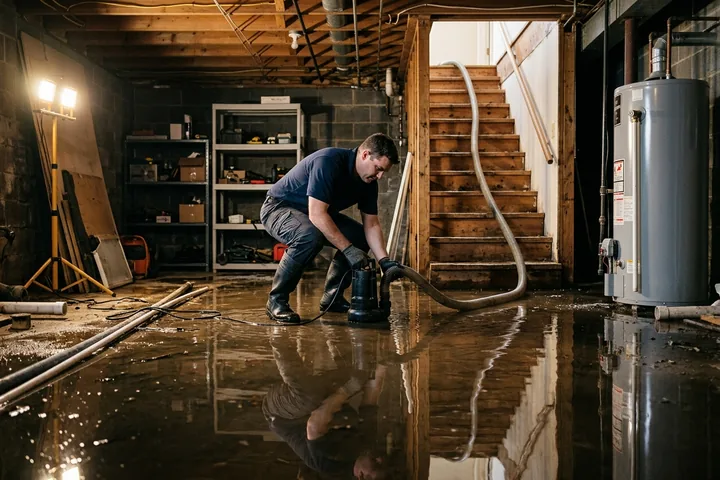
Basement Flood Cleanup in Hillside
24/7 basement flood cleanup in Hillside, NJ. IICRC-certified, insurance billing accepted. Call (855) 650-7422.
Our IICRC-certified technicians are dispatched from our Fair Lawn, NJ headquarters and are typically on-site in Hillside within 60 minutes of your call.
When the Elizabeth River backs up during a hard summer storm, basements across Hillside’s eastern neighborhoods don’t just get wet, they fill fast. The township’s dense grid of 1920s-era two-families and postwar capes was built before modern waterproofing standards existed, and many of those homes carry the original galvanized supply lines and cast-iron drains that fail quietly until they don’t. If you’re standing in a flooded basement in ZIP code 07205 right now, call (855) 650-7422. The Restoration Group dispatches around the clock from Kenilworth and can reach Hillside for emergency extraction any time of day or night.
Why Hillside Basements Flood the Way They Do
Hillside is a township where the infrastructure and the housing stock are doing a lot of heavy lifting. Most of the residential blocks, from the colonials near Hillside Center to the side-by-sides in Saybrook and Winans, were constructed between the 1920s and 1950s. That means original cast-iron drain laterals that have had decades to corrode, offset, or root-intrude, and galvanized supply lines that can pinhole without warning.
The Elizabeth River cuts across the town’s eastern edge, and the low-lying ground on that side of the township drains slowly. During Tropical Storm Ida in 2021, that combination of river overflow and overwhelmed municipal sewer capacity pushed water directly into basements through floor drains and sewer cleanouts, not just through foundation walls. That pattern repeats on a smaller scale every time a fast-moving storm drops more rain than the system can handle.
Sump-pump failures are a consistent driver of basement losses here. Many Hillside homes have pumps that were installed years ago and haven’t been serviced since. When a summer squall hits and the power flickers, a pump without a battery backup becomes useless at exactly the wrong moment.
The Conant Street industrial corridor and the Route 22 commercial strip add a different category of loss: sprinkler-discharge events, roof failures, and overnight pipe breaks in warehouse and retail spaces that need the same extraction and drying discipline as a residential basement, just at larger scale.
Our Basement Flood Cleanup Process in Hillside
Every flooded basement is a moisture problem that extends well beyond what’s visible. Water wicks into concrete block, travels under slab, and saturates the framing of finished basement walls long before the surface feels wet to the touch. Here’s how we work through it:
Extraction first. Truck-mounted and portable extraction units remove standing water from the floor, including water trapped in carpet padding, under floating floors, and in the low points of uneven slabs common in older Hillside construction.
Moisture mapping. Thermal imaging and calibrated moisture meters locate water that has migrated behind walls, under subfloor, and into the base of framing, the places that cause mold colonization within 24 to 72 hours if left untreated.
Structural drying. High-capacity LGR dehumidifiers and directed airflow equipment dry the space to IICRC S500 standards. In homes with the original plaster-and-lath construction found throughout older Hillside blocks, drying timelines run longer than in modern drywall construction because plaster holds and releases moisture more slowly.
Antimicrobial treatment. Sewer-backup events, common here when the municipal system surcharges, introduce Category 3 contamination. Affected materials are treated or removed according to the contamination category, not just dried in place.
Documentation. Moisture readings, photos, and equipment logs are compiled throughout the job to support your insurance claim.
Reaching Hillside from Kenilworth
The Restoration Group’s base in Kenilworth puts Hillside within a short drive via Route 22 or Springfield Avenue depending on traffic. Because we operate 24/7, a call at 2 a.m. during a storm gets the same response as a call on a Tuesday afternoon. Crews familiar with the Coe’s Corner and Conant Street areas know that parking and access on the denser residential blocks can require some coordination, we account for that on dispatch rather than figuring it out on arrival.
Hillside Insurance Coordination
Most standard homeowners policies cover sudden and accidental water losses, a burst pipe, an appliance failure, a sump pump overflow if you carry the rider. Sewer backup coverage is a separate endorsement, and given how often municipal surcharging affects Hillside basements during heavy rain, it’s worth confirming whether your policy includes it before you need it.
We document the loss thoroughly, moisture readings, photos of affected materials, equipment placement records, and work directly with your adjuster. As a licensed NJ Home Improvement Contractor and IICRC Certified Firm (#210213), our documentation meets the standards carriers expect.
Local Note
In Hillside’s older two-family homes, the basement is often shared between units or serves as utility space for both floors. When a sewer backup or pipe failure floods that shared space, the moisture load on the floor assembly above, the first floor of the occupied unit, is substantial. We pay particular attention to the subfloor and joist bays directly above a flooded basement in these structures, because that framing can stay wet long after the basement itself reads dry on the surface. It’s a detail that matters in a township where two-family construction is the norm rather than the exception.
If water has reached your Hillside basement, don’t wait to see whether it dries on its own. Call (855) 650-7422, we’re available any hour, and getting extraction started quickly is the single biggest factor in limiting what comes next.
Serving Hillside from our Fair Lawn headquarters — ★ 4.8 · 160 Google reviews
“Prompt and professional work. Kept in contact thru out the process which was very important to me.” — F., July 2026Read our reviews on Google →
Basement Flood Cleanup in Hillside: Service Coverage
Frequently Asked Questions
How fast can you arrive for basement flood cleanup in Hillside?
How quickly can The Restoration Group reach a flooded basement in the Saybrook or Winans areas of Hillside?
Hillside had serious sewer backups during Tropical Storm Ida — does that type of flooding require different cleanup than a burst pipe?
My Hillside home was built in the 1940s and has plaster walls in the basement — does that affect the drying process?
Does my homeowners policy cover the kind of basement flooding common in Hillside's low-lying neighborhoods near the Elizabeth River?
Are there permit or inspection requirements in Hillside for basement flood repairs that involve replacing drywall or flooring?
Will my homeowners insurance cover basement flood cleanup in Hillside?
Basement Flood Cleanup response in Hillside
Most Hillside calls see a technician on-site within 60 minutes from our Fair Lawn headquarters.