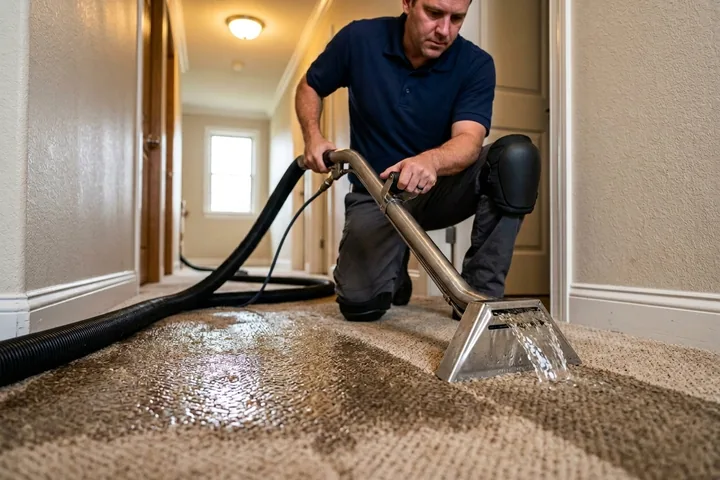
Water Cleanup in New Brunswick
24/7 water cleanup in New Brunswick, NJ. IICRC-certified, insurance billing accepted. Call (855) 650-7422.
Our IICRC-certified technicians are dispatched from our Fair Lawn, NJ headquarters and are typically on-site in New Brunswick within 60 minutes of your call.
The Raritan River has flooded Boyd Park’s low-lying riverfront more than once, Tropical Storm Ida in 2021 pushed water into streets and basements across New Brunswick’s southern edge, but the city’s most common water emergencies have nothing to do with the river. They happen inside: a corroded supply line giving out in a century-old rowhouse near Rutgers Village, a cast-iron drain backing up in a Robeson Village apartment, a commercial sprinkler tripping overnight on George Street. When water is moving through your property, the clock matters more than the cause.
Why New Brunswick Properties See Water Damage Differently
New Brunswick’s building stock spans almost every era of American construction, and that range creates a distinct set of water risks. The dense rowhouses and multifamily buildings that fill the blocks near Rutgers University were built when galvanized steel and cast-iron were standard, both corrode from the inside out, and both fail without much warning. A supply line that looks intact at the shutoff can be paper-thin at a joint hidden inside a wall cavity.
Downtown’s high-rise development and the institutional footprint around Robert Wood Johnson University Hospital introduce a different exposure: large-volume losses from commercial sprinkler systems, chilled-water lines, and HVAC condensate. A single sprinkler head activation on an upper floor can migrate through multiple units before anyone notices. The George Street corridor’s restaurants and retail spaces add overnight risk, a dishwasher line or walk-in cooler drain that fails at 2 a.m. can saturate a subfloor for hours before staff arrive.
Student rental turnover in the ZIP codes closest to campus, 08901 in particular, means deferred maintenance is common. Landlords managing high unit counts sometimes miss slow leaks until a tenant reports visible staining or a ceiling starts to sag.
Our Water Cleanup Process in New Brunswick
The process begins with containment, not extraction. Before equipment goes in, the source has to be confirmed stopped, a detail that sounds obvious but gets skipped when crews are rushing. Once water is no longer moving, we use thermal imaging and calibrated moisture meters to map the full extent of saturation, including areas that look dry at the surface. In older New Brunswick construction, that step is especially important: plaster over wood lath holds moisture differently than modern drywall, and readings at the face of a wall can understate what’s happening inside.
Extraction comes next, truck-mounted or portable units depending on access, followed by the placement of commercial-grade air movers and desiccant or refrigerant dehumidifiers sized to the affected area. Drying is monitored daily against the IICRC S500 standard, with moisture logs that document progress for your insurance carrier. Affected materials that cannot dry in place, saturated subfloor sections, soaked insulation, compromised drywall, are removed before they become a mold substrate.
As an IICRC Certified Firm (#210213) and NJ Licensed Home Improvement Contractor, we can carry the work from emergency extraction through structural drying and into reconstruction without handing the project off.
Reaching New Brunswick from Kenilworth
The Restoration Group operates out of Kenilworth, NJ, and New Brunswick sits roughly 20 miles to the southwest, accessible via the Garden State Parkway to Route 1, or through Route 27 depending on traffic and the specific address. We answer calls 24 hours a day, seven days a week. Whether the loss is in a Downtown high-rise, a Rutgers Village apartment building, or a single-family home in the Edgebrook area, dispatch goes out immediately.
For commercial properties on or near the Rutgers campus or the hospital corridor, we coordinate with property management or facilities staff on access, those buildings often have after-hours security protocols that need a call ahead.
New Brunswick Insurance Coordination
Most water losses in New Brunswick run through homeowners or commercial property policies, and the documentation your adjuster needs starts at the moment of arrival, not after drying is complete. We photograph affected areas before extraction begins, log moisture readings at each monitoring point, and produce a written scope that maps to standard line items carriers recognize. That paper trail matters whether you’re a homeowner in the Fifth Ward or a property manager handling multiple units near the Highland Park border.
We bill carriers directly where the policy allows, which reduces the out-of-pocket burden during an already stressful event.
Local Note
In New Brunswick’s older multifamily stock, particularly the three- and four-story walkups built in the early 1900s near the Rutgers campus, water from an upper-floor event almost always travels further than it appears. These buildings were framed with full-dimension lumber and finished with plaster on wood lath, and the floor assemblies have decades of gaps, penetrations, and settled framing that channel water horizontally as well as down. It is common to find saturation in a first-floor unit when the source was two floors above. If you’re a landlord or property manager dealing with a loss in that building type, plan for moisture mapping across multiple floors before assuming the damage is contained to one unit.
Call The Restoration Group at (855) 650-7422 any time, day or night, and we’ll dispatch to your New Brunswick address, assess the full scope of the water damage, and start the drying process before secondary damage sets in.
Serving New Brunswick from our Fair Lawn headquarters — ★ 4.8 · 160 Google reviews
“(Translated by Google) Excellent work. The staff were responsible, friendly, and above all, very clean. I was very satisfied and I recommend them 100%. (Original) Excelente trabajo.el personal responsables,amables y sobre todo muy limpios para trabajar .quedé satisfecha y lo recomiendo al 💯.” — Dessy, September 2026Read our reviews on Google →
Water Cleanup in New Brunswick: Service Coverage
Frequently Asked Questions
How fast can you arrive for water cleanup in New Brunswick?
How quickly can The Restoration Group reach a water emergency in New Brunswick?
Are older apartment buildings near Rutgers University more vulnerable to widespread water damage from a single leak?
Does New Brunswick's mix of student rentals and older housing stock affect how water cleanup is documented for insurance?
What happens if a commercial sprinkler activates overnight on George Street or in a Downtown New Brunswick building?
How long does the drying process typically take in New Brunswick's older plaster-and-lath construction?
Water Cleanup response in New Brunswick
Most New Brunswick calls see a technician on-site within 60 minutes from our Fair Lawn headquarters.