Basement Flood Cleanup in Parsippany
24/7 basement flood cleanup in Parsippany, NJ. IICRC-certified, insurance billing accepted. Call (855) 650-7422.
Our IICRC-certified technicians are dispatched from our Fair Lawn, NJ headquarters and are typically on-site in Parsippany within 60 minutes of your call.
When the Whippany River backs up or a nor’easter drops three inches overnight, Parsippany basements take the hit first. The township’s mix of postwar ranches and split-levels, many built in the 1950s and ’60s on low-lying lots near Lake Hiawatha and Lake Parsippany, were designed before today’s drainage expectations, and their finished lower levels can go from dry to ankle-deep in a matter of hours. The Restoration Group responds 24/7 to basement flood cleanup calls across Parsippany, bringing IICRC-certified drying protocols and direct insurance billing to every job.
Why Parsippany Properties See Basement Flooding So Often
Parsippany-Troy Hills sits at the confluence of several drainage systems, the Whippany River, Rockaway River, and Troy Brook all thread through low sections of the township. During Hurricane Ida in 2021, Lake Hiawatha neighborhoods experienced some of the most severe residential flooding in Morris County, and the area has a long memory of similar events going back to Floyd and Irene. That history isn’t just local lore; it reflects a genuine topographic reality that puts basements in the 07054 and 07005 ZIP codes at elevated risk every time a slow-moving storm stalls over northern New Jersey.
Beyond storm surge, the older lake-tract homes carry another liability: aging supply plumbing and cast-iron drain lines. A 60-year-old cast-iron stack can corrode from the inside out without showing a single exterior crack, then fail suddenly on a finished basement ceiling. In the Victorian cottages of the Mount Tabor Historic District, knob-and-tube-era plumbing has sometimes been patched rather than replaced, leaving supply lines that are genuinely unpredictable. Neither storm water nor a burst pipe gives you much warning.
Our Basement Flood Cleanup Process in Parsippany
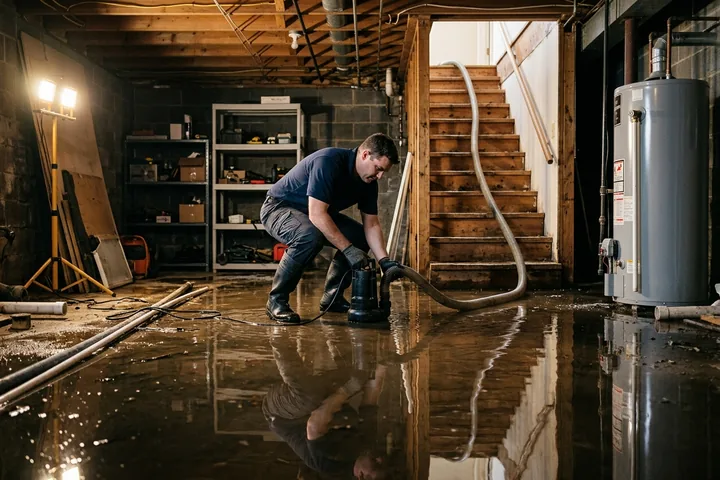
The first step on any flooded basement is containment, stopping the water source if it’s still active, then removing standing water with truck-mounted extraction equipment before it migrates further into wall cavities and subfloor assemblies. In Parsippany’s split-levels and raised ranches, water often travels horizontally under the slab before it becomes visible, which means moisture mapping with thermal imaging and calibrated meters is essential before any drying equipment is placed.
Once extraction is complete, we establish a drying chamber using commercial-grade LGR dehumidifiers and high-velocity air movers sized to the actual cubic footage of the space, not a one-size estimate. Readings are logged daily against the IICRC S500 standard so there’s a documented drying record your adjuster can review. Affected drywall, insulation, and flooring are removed to the extent necessary to reach the wet substrate; we photograph and document everything before any material comes out.
For basements with finished ceilings below first-floor bathrooms or laundry, a common configuration in the Troy Hills and Rainbow Lakes neighborhoods, we use cavity drying equipment to dry wall assemblies in place when the structure allows, which reduces tear-out and rebuild cost.
Reaching Parsippany from Kenilworth
The Restoration Group’s base in Kenilworth puts Parsippany within straightforward reach via the Garden State Parkway to I-287 northbound. Because we operate around the clock, a call at 2 a.m. from the Lake Parsippany area or the Waterview commercial corridor gets the same dispatch priority as a midday call. For commercial losses, sprinkler discharges, roof-leak intrusions into finished office suites along Route 46, we coordinate after-hours building access with property managers before our crew arrives so there’s no time lost at a locked lobby.
Parsippany Insurance Coordination
Most standard homeowner policies cover sudden and accidental water losses, a burst pipe, a failed sump pump during a storm, but the documentation requirements vary by carrier. We photograph affected materials before removal, generate moisture logs that meet adjuster expectations, and bill most major carriers directly. If your policy includes a sump pump rider or a separate flood endorsement through the National Flood Insurance Program, we can work alongside both claims simultaneously. Homeowners in the Lake Hiawatha area who filed NFIP claims after Ida are already familiar with the separate adjuster process; we’ve structured our documentation to support both tracks.
Local Note
In Mount Tabor, the tight Victorian cottage lots and narrow lanes mean a service vehicle can’t always park directly in front of the affected property. We carry extra hose runs specifically for these situations so extraction equipment staged on the street can still reach a basement at the back of a deep lot. If you’re in that neighborhood and concerned about access, mention it when you call, it’s a detail worth flagging before the crew arrives rather than after.
If standing water is in your basement right now, or you’re looking at buckled flooring and a damp smell that appeared after last week’s rain, call The Restoration Group at (855) 650-7422. We serve Parsippany and the surrounding Morris County area 24 hours a day, and we’ll walk you through next steps before we even pull out of the driveway.
Serving Parsippany from our Fair Lawn headquarters — ★ 4.8 · 160 Google reviews
“They were very professional, and took care of all the water in my ceiling. It was alot of work, but they were very good at what they did.” — Lisa, September 2026Read our reviews on Google →
Basement Flood Cleanup in Parsippany: Service Coverage
Frequently Asked Questions
How fast can you arrive for basement flood cleanup in Parsippany?
Are homes near Lake Hiawatha at higher risk of repeated basement flooding, and does that affect the cleanup approach?
How does Parsippany's older housing stock — ranches and split-levels from the 1950s and '60s — affect basement drying timelines?
Can you handle a basement flood at a commercial property in the Waterview corridor or along Route 46?
What ZIP codes in Parsippany do you serve, and does location within the township affect response time?
How does the IICRC S500 standard apply to basement flood cleanup, and why does it matter for my insurance claim?
Basement Flood Cleanup response in Parsippany
Most Parsippany calls see a technician on-site within 60 minutes from our Fair Lawn headquarters.