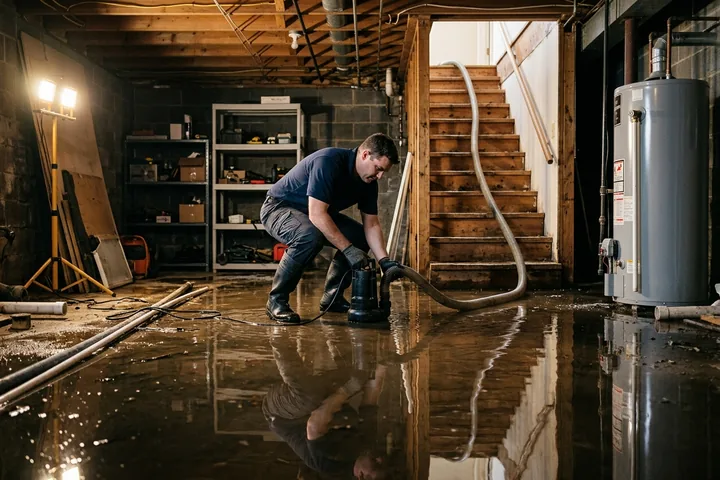
Basement Flood Cleanup in Paterson
24/7 basement flood cleanup in Paterson, NJ. IICRC-certified, insurance billing accepted. Call (855) 650-7422.
Our IICRC-certified technicians are dispatched from our Fair Lawn, NJ headquarters and are typically on-site in Paterson within 60 minutes of your call.
When the Passaic River swells after a heavy storm, the low-lying blocks near Paterson’s downtown and Riverside section don’t just get wet, they flood fast, and the water that pushes into basements carries sediment, sewage backflow, and whatever else the river picks up along the way. If you’re dealing with standing water in your basement right now, call The Restoration Group at (855) 650-7422. We’re available 24/7 and dispatch from Kenilworth, NJ, reaching Paterson neighborhoods around the clock.
Why Paterson Properties See Basement Flood Problems
Paterson’s relationship with flooding is structural, not just seasonal. The city sits directly on the Passaic River, and its topography funnels stormwater toward the lowest-lying blocks with very little natural drainage buffer. The events of Hurricane Irene in 2011 and then Ida in 2021 put this on full display, streets near the Great Falls National Historical Park and the downtown corridor were submerged for days, and basements in the surrounding blocks took on water that overwhelmed even functioning sump pumps.
Beyond river flooding, the housing stock itself creates vulnerability. Much of Paterson was built during the silk-mill era of the late 19th and early 20th centuries, dense brick rowhouses, two- and three-family frame structures, and converted industrial buildings that were never designed with modern waterproofing in mind. In neighborhoods like Sandy Hill and the Eastside, it’s common to find cast-iron drain lines that are decades past their service life, clay-tile lateral connections that crack under soil movement, and basement walls made of rubble stone or unreinforced brick that wick groundwater through the mortar joints. These aren’t cosmetic problems, they’re the reason a single heavy rain can turn a dry basement into a foot of standing water within hours.
Rental density adds another layer. Paterson has a large stock of occupied multi-family rentals where basement utility spaces are shared, unventilated, and rarely inspected. Slow leaks go unreported for months, and by the time a tenant notices, mold has already colonized the framing behind the walls.
Our Basement Flood Cleanup Process in Paterson
Every basement flood is different, but the sequence of decisions matters, especially in older Paterson construction where what you see on the surface rarely tells the full story.
We start with moisture mapping using thermal imaging and calibrated meters. In a rubble-stone or brick foundation wall, the surface can feel dry to the touch while moisture is migrating through the masonry several inches deep. Getting that reading right determines how long drying will actually take and prevents a callback weeks later when mold shows up behind a finished wall.
Standing water is extracted with truck-mounted and portable units, then we set drying equipment, industrial air movers and desiccant or refrigerant dehumidifiers, positioned for the specific geometry of the space. Low-ceiling Paterson basements with concrete block walls and minimal airflow require a different equipment layout than an open-plan finished basement. We document daily psychrometric readings so there’s a drying log for your insurance carrier.
If sewage was involved in the backup, which is common when municipal lines surcharge during heavy rain on Paterson’s combined sewer system, affected materials are handled as a Category 3 loss. That means contaminated porous materials come out, affected surfaces are treated with EPA-registered antimicrobials, and the area is cleared before any rebuild begins. We’re an IICRC Certified Firm (#210213) and follow the S500 standard for water damage and the S520 for mold, so the documentation holds up with adjusters and code inspectors.
Reaching Paterson from Kenilworth
Our Kenilworth headquarters puts us on Route 22 East to the Garden State Parkway North, connecting to I-80 West into Paterson, a route that holds up reasonably well even during off-peak hours. For calls in the southern ZIP codes like 07503 and 07504, covering South Paterson and areas near Hinchliffe Stadium, we can also route via Route 21 North along the Passaic River corridor. For the Lakeview and Hillcrest sections in the northern part of the city, I-80 to Route 19 is typically the cleaner approach. We’re available 24 hours a day, seven days a week, so we’re dispatching whether the call comes in at noon or 3 a.m.
Paterson Insurance Coordination
Most standard homeowner policies distinguish between sudden water damage (a burst pipe, an appliance failure) and flood damage caused by surface water or river overflow. In Paterson, where the Passaic has a documented history of overbank flooding, many properties in the flood-prone zones carry separate NFIP (National Flood Insurance Program) policies, and those claims follow a different documentation process than a standard HO claim.
We photograph and document losses in the format adjusters expect, produce moisture logs and scope-of-work reports, and communicate directly with your carrier so you’re not translating between a restoration crew and an insurance desk on your own. If your building is a multi-family rental, we can also coordinate with the property owner and the tenant separately to keep the claim and the communication clean.
Local Note
In Paterson’s older brick multi-family buildings, particularly the three-story walkups common in Sandy Hill and parts of the Eastside, basement walls are often built with lime-mortar joints rather than modern Portland cement. Lime mortar is softer and more permeable, which means it absorbs and releases moisture more slowly than the brick itself. When we’re drying these structures, standard drying timelines based on drywall or concrete block don’t apply. We extend the monitoring period and adjust dehumidifier placement to account for the slower moisture release from the mortar, rather than pulling equipment the moment the brick surface reads dry. Skipping that step is how mold shows up three weeks after a crew packs out.
If your basement has taken on water, whether from the Passaic backing up, a failed sump, a cracked foundation wall, or a sewage backup on a combined sewer line, call (855) 650-7422. We’ll assess the damage, explain what needs to happen, and get the drying process started the same day.
Serving Paterson from our Fair Lawn headquarters — ★ 4.8 · 160 Google reviews
“Teams were very prompt and respectful.. company responded quickly and kept in touch” — Peggy, August 2026Read our reviews on Google →
Basement Flood Cleanup in Paterson: Service Coverage
Frequently Asked Questions
How fast can you arrive for basement flood cleanup in Paterson?
How quickly can The Restoration Group reach a flooded basement in Paterson's Sandy Hill or Eastside neighborhoods?
Paterson's combined sewer system sometimes backs up during heavy rain. Does that change how you handle the cleanup?
My Paterson home was built in the early 1900s and has a rubble-stone foundation. Does that affect drying time?
Will my flood insurance cover basement cleanup if the Passaic River caused the damage?
Is mold likely after a basement flood in one of Paterson's older multi-family buildings?
Basement Flood Cleanup response in Paterson
Most Paterson calls see a technician on-site within 60 minutes from our Fair Lawn headquarters.