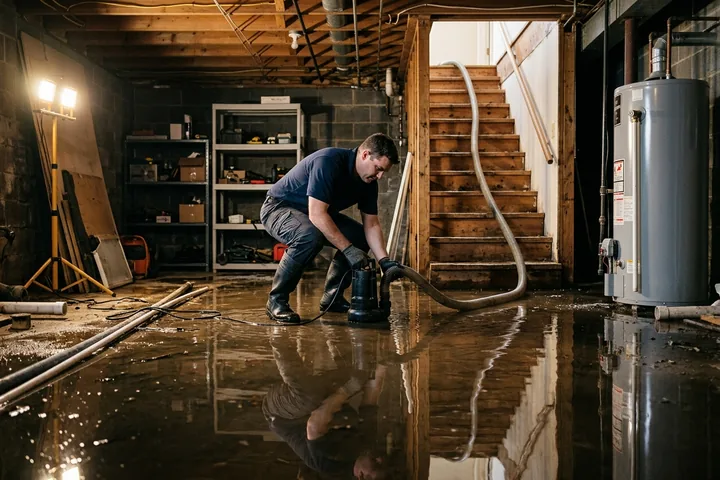
Basement Flood Cleanup in Roselle
24/7 basement flood cleanup in Roselle, NJ. IICRC-certified, insurance billing accepted. Call (855) 650-7422.
Our IICRC-certified technicians are dispatched from our Fair Lawn, NJ headquarters and are typically on-site in Roselle within 60 minutes of your call.
When the Elizabeth River backs up during a summer storm and low-lying blocks near Warinanco Park go under, Roselle basements fill faster than sump pumps can cycle. The borough’s dense grid of early-1900s through 1950s colonials and postwar capes, many with finished lower levels and decades-old cast-iron waste lines, turns a two-inch rainfall event into standing water against drywall before most homeowners realize the pump has failed. The Restoration Group responds 24/7 from Kenilworth to extract that water, dry the structure, and document the loss before secondary damage sets in.
Why Roselle Properties See Basement Flooding So Often
Roselle’s housing stock is one of the oldest in Union County. Homes throughout the 07203 ZIP code were built on tight lots with minimal setback, meaning surface water has few places to go when the ground saturates. Original galvanized supply lines and cast-iron drain stacks in these houses are at or past their service life, a corroded cleanout fitting or a joint that shifts during frost heave is often what turns a heavy rain into a sewer backup rather than a simple surface flood.
The Elizabeth River corridor along the eastern edge of town, where Warinanco Park meets residential streets, is particularly vulnerable. Tropical remnants like Ida in 2021 pushed combined sewer systems past capacity, sending backflow into basements across East Roselle and the blocks south of the park. That type of loss, a Category 3 sewage event, requires a different response than a burst supply line. The water carries pathogens, and porous materials that contact it cannot simply be dried; they have to be removed.
The Chestnut Street corridor sees its own pattern: commercial tenants and overnight retail spaces where a roof drain clogs or a supply line fails after hours. Water migrates through the floor system into basement storage or mechanical rooms before anyone arrives in the morning.
Our Basement Flood Cleanup Process in Roselle
Every job starts with moisture mapping. Before a single piece of equipment is placed, a technician walks the basement with a thermal camera and pin-type meters to find where water has traveled, behind finished wall panels, under slab-on-grade sections, into the base of stair framing. In Roselle’s older homes, this step matters more than usual because plaster-and-lath walls absorb water differently than modern drywall. The surface can read close to dry while the wood lath behind it stays saturated, and a drying plan that ignores that will fail the final clearance reading.
Once the scope is clear, extraction comes first, truck-mounted units for standing water, then weighted extraction tools pressed against carpet and pad. Contaminated materials (sewage-affected drywall, insulation, flooring) are bagged and removed before drying equipment is ever staged. Structural drying follows the IICRC S500 standard: calibrated air movers and desiccant or refrigerant dehumidifiers positioned to create directed airflow through wall cavities and across concrete. Daily moisture readings track progress and drive equipment adjustments until the structure reaches its dry standard.
As an IICRC Certified Firm (#210213) and NJ Licensed Home Improvement Contractor, every phase of the work is documented, photographs, moisture logs, equipment placement records, in a format that translates directly into an insurance claim file.
Reaching Roselle from Kenilworth
The Restoration Group is based in Kenilworth, directly adjacent to Roselle along the shared border near the Roselle Park line. Routes via Chestnut Street or St. Georges Avenue put a crew into most Roselle neighborhoods quickly, and because we operate around the clock, a call at 2 a.m. when a sump pump alarm goes off gets the same response as a call at noon. For addresses near Fifth Avenue or deeper into East Roselle, the approach from the Kenilworth side avoids the congestion that builds on the St. Georges corridor during commute hours.
Local Note
Roselle’s finished basements from the 1940s and 1950s often used a thin coat of hydraulic cement directly over the block foundation wall before paneling was installed, no true vapor barrier, no drainage mat. When those walls take on water, the cement coat traps moisture between the block and the panel framing. Drying equipment positioned only in the open basement space won’t reach it. Technicians working in this housing stock need to open the wall cavity, removing the lower course of paneling, to get airflow against the block face. Skipping that step is the most common reason a basement in this part of Union County fails a re-inspection after drying.
If your home is showing efflorescence streaks or a white mineral crust on the lower block courses, that’s a sign water has been moving through the wall repeatedly, not just during the most recent event. It’s worth noting to the technician before work begins.
When water reaches your basement in Roselle, whether it’s a sump failure during a summer storm, a sewer backup near the Warinanco Park corridor, or an overnight pipe break, call The Restoration Group at (855) 650-7422. We’ll assess the loss, explain what needs to happen, and get equipment in place before the damage compounds.
Serving Roselle from our Fair Lawn headquarters — ★ 4.8 · 160 Google reviews
“Prompt and professional work. Kept in contact thru out the process which was very important to me.” — F., July 2026Read our reviews on Google →
Basement Flood Cleanup in Roselle: Service Coverage
Frequently Asked Questions
How fast can you arrive for basement flood cleanup in Roselle?
Are homes near Warinanco Park at higher risk for sewage backup during heavy rain?
How quickly can The Restoration Group reach East Roselle or the Fifth Avenue area after I call?
My Roselle home was built in the 1940s and has a finished basement with wood paneling. Does that change how drying works?
Will my homeowner's insurance cover basement flood cleanup in the 07203 ZIP code, and how does the claims process work?
How long does basement flood cleanup typically take in Roselle's older housing stock?
Basement Flood Cleanup response in Roselle
Most Roselle calls see a technician on-site within 60 minutes from our Fair Lawn headquarters.