Water Cleanup in Staten Island
24/7 water cleanup in Staten Island, NY. IICRC-certified, insurance billing accepted. Call (855) 650-7422.
Our IICRC-certified technicians are dispatched from our Kenilworth, NJ headquarters and are typically on-site in Staten Island within 60 minutes of your call.
When a pipe lets go behind a kitchen wall in a Port Richmond row house or a nor’easter pushes water under the back door of a New Dorp split-level, the clock starts immediately. Mold can begin colonizing wet framing within 24 to 48 hours, and in Staten Island’s older housing stock, where plaster, horsehair insulation, and cast-iron plumbing coexist in the same wall cavity, water travels in ways that a moisture meter at the surface won’t reveal. The Restoration Group operates 24/7 and keeps crews based on the borough, so a call to (855) 650-7422 reaches people who know what they’re walking into before they open the door.
Why Staten Island Properties See Water Damage Differently
The borough’s geography does a lot of the work here. The East Shore, South Beach, Midland Beach, Oakwood Beach, sits at low elevation with a water table that rises fast during heavy rain. Hurricane Sandy in 2012 left entire blocks of those neighborhoods with feet of standing water inside finished basements, and Tropical Storm Ida in 2021 demonstrated that the flooding risk isn’t confined to the shore: low-lying South Shore streets saw flash flooding that overwhelmed storm drains within hours of the rainfall peak.
Away from the water, the housing stock creates its own set of problems. The postwar Cape Cods and split-levels that dominate neighborhoods like Great Kills and New Dorp were built with partial basements and crawlspaces that collect groundwater during prolonged wet stretches. The aging cast-iron supply lines and drain stacks in pre-1960s homes throughout the borough are prone to pinhole leaks and sudden joint failures, losses that can run undetected behind plaster walls for days before a ceiling sag or a musty smell prompts the call. On the commercial side, the Hylan Boulevard corridor sees recurring roof-leak and sprinkler-discharge claims, particularly in flat-roofed retail buildings where drainage scuppers clog with debris.
Our Water Cleanup Process in Staten Island
Every job starts with a thorough inspection using thermal imaging and calibrated moisture meters, not just a visual walk-through. In Staten Island homes, that step matters more than it might elsewhere, because water in a plaster-and-lath wall behaves differently than water in modern drywall. Plaster can read dry at the surface while the lath behind it stays saturated; skip that step and you’re sealing in the moisture that feeds mold.
From there, the process follows the IICRC S500 standard for water damage restoration:
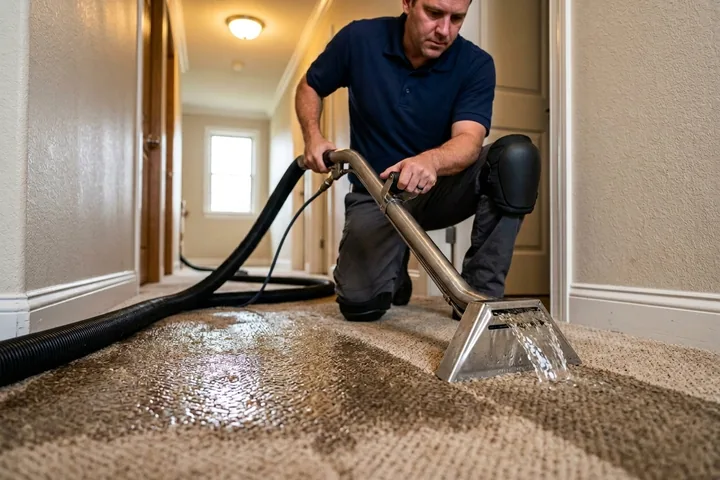
- Standing water extraction using truck-mounted and portable units, including submersible pumps for basement flooding
- Structural drying with industrial air movers and refrigerant dehumidifiers positioned to create directed airflow through wall cavities and under flooring
- Daily moisture monitoring with documented readings so drying progress is trackable and defensible for insurance purposes
- Controlled demolition when wet materials, saturated subfloor, swollen baseboard, soaked insulation, cannot be dried in place without creating a secondary mold risk
- Antimicrobial treatment of affected surfaces before any reconstruction begins
For homes in flood-prone ZIP codes like 10306 (South Beach, New Dorp) or 10304 (St. George, Stapleton), we also assess whether floodwater carried contaminants that require Category 3 handling protocols, a distinction that changes both the safety procedures and the scope of what needs to come out.
Reaching Staten Island from Kenilworth
The Restoration Group’s Kenilworth, NJ base puts crews close to the Goethals Bridge, which feeds directly onto the Staten Island Expressway. From there, the South Shore is accessible via the Richmond Parkway, and the North Shore neighborhoods around St. George and Port Richmond are reachable without crossing the island. We dispatch 24/7, so a call at 2 a.m. after a sump pump failure gets the same response as a call at noon.
Staten Island Insurance Coordination
Most standard homeowners policies cover sudden and accidental water damage, a burst pipe, an appliance supply line failure, an ice dam backup, but exclude gradual leaks and flood damage. In Staten Island, that distinction matters enormously. Homes in FEMA-designated flood zones along the East Shore are often required to carry separate NFIP flood policies, and those claims follow a different documentation and adjuster process than a standard HO claim.
We photograph and document affected materials before anything is removed, produce moisture logs that meet carrier requirements, and can communicate directly with your adjuster to support the claim. We don’t work for the insurance company, we work for you, but thorough documentation is the single biggest factor in whether a claim pays out fully or gets disputed.
Local Note
In Staten Island’s older frame homes, particularly the early-1900s stock in St. George and Port Richmond, plaster walls are applied over wood lath rather than gypsum board. When water gets into those assemblies, the plaster itself may feel firm and look intact while the lath and the framing behind it are holding significant moisture. Drying times for these wall systems run longer than for drywall, and the airflow strategy has to account for the fact that the plaster acts as a partial vapor barrier. Crews that aren’t familiar with this construction type sometimes declare a job dry too early; we set expectations accordingly and extend monitoring until readings are stable across the full assembly depth.
If you’re dealing with standing water, a soaked basement, or the aftermath of a roof leak anywhere on the borough, call (855) 650-7422. We’ll walk you through what to expect before we arrive and get a crew moving the same day.
Serving Staten Island from our Kenilworth headquarters — ★ 4.8 · 160 Google reviews
“(Translated by Google) Excellent work. The staff were responsible, friendly, and above all, very clean. I was very satisfied and I recommend them 100%. (Original) Excelente trabajo.el personal responsables,amables y sobre todo muy limpios para trabajar .quedé satisfecha y lo recomiendo al 💯.” — Dessy, September 2026Read our reviews on Google →
Water Cleanup in Staten Island: Service Coverage
Frequently Asked Questions
How fast can you arrive for water cleanup in Staten Island?
Are homes in South Beach and the East Shore more likely to need Category 3 flood cleanup protocols?
How does Staten Island's older housing stock affect drying timelines?
My home in ZIP code 10306 is in a FEMA flood zone — does that change how the insurance claim works?
What's the difference between water extraction and structural drying, and do I need both?
Can you respond to water emergencies in Great Kills or Tottenville, at the far end of the South Shore?
Water Cleanup response in Staten Island
Most Staten Island calls see a technician on-site within 60 minutes from our Kenilworth headquarters.