Water Cleanup in Wayne
24/7 water cleanup in Wayne, NJ. IICRC-certified, insurance billing accepted. Call (855) 650-7422.
Our IICRC-certified technicians are dispatched from our Fair Lawn, NJ headquarters and are typically on-site in Wayne within 60 minutes of your call.
The Passaic and Pompton Rivers don’t give much warning. When they rise, as they did during Irene in 2011 and again with Ida in 2021, neighborhoods like Hoffman Grove and Mountain View can go from damp to several feet of standing water in hours. But river flooding is only part of Wayne’s water damage picture. The lake communities at Packanack Lake and Pines Lake sit on midcentury ranches and split-levels with finished basements just feet from the waterline, and the region’s aging sump-dependent colonials from the 1950s and ’60s fail quietly, a cracked discharge line or a pump that trips during a nor’easter can soak a finished basement before anyone notices the smell.
Why Wayne Properties See Recurring Water Damage
Wayne’s geography works against its homeowners in a few specific ways. The township sits at the confluence of two flood-prone river systems, and large portions of the 07470 zip code fall within FEMA-designated special flood hazard areas. That means water intrusion here isn’t a freak event, it’s a recurring seasonal risk, particularly in spring snowmelt and during late-summer tropical systems.
Beyond the rivers, the lake communities add a second layer of exposure. Homes near Pines Lake and Packanack Lake were largely built in the 1950s through early 1970s, often with block or poured-concrete foundations that weren’t designed with modern waterproofing membranes. Finished lower levels, rec rooms, home offices, in-law suites, are common, and they’re the first spaces to take on water when a sump fails or a window well backs up. The plumbing in these homes is aging too: galvanized supply lines and cast-iron drain stacks that corrode from the inside out, sometimes rupturing without any visible exterior warning.
Commercial properties along the Route 23 and Route 46 corridors face a different set of risks, roof-drain backups, sprinkler-head failures, and HVAC condensate line overflows that can saturate drop-ceiling tiles and subfloor assemblies across large retail footprints.
Our Water Cleanup Process in Wayne
Water damage moves faster than most people expect. Within the first 24 hours, saturated drywall begins to soften, wood subfloor panels start to swell at the seams, and, depending on the moisture load, microbial activity can begin establishing itself in wall cavities. Speed and sequencing matter.
When a crew arrives, the first priority is stopping active intrusion if it hasn’t been addressed, then assessing the full moisture boundary using thermal imaging and calibrated moisture meters. In Wayne’s older housing stock, this step takes longer than it does in newer construction: plaster-and-lath walls common in pre-1970s colonials and capes read differently on a moisture meter than standard drywall, and water migrates laterally through plaster much farther from the source before it becomes visible.
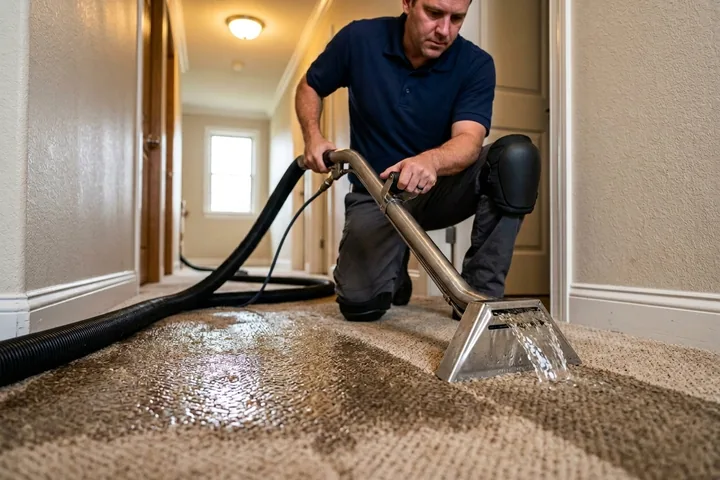
Extraction comes next, truck-mounted and portable units pulling standing water from hard surfaces and subfloor assemblies. After extraction, the drying phase begins: commercial-grade desiccant and refrigerant dehumidifiers, high-velocity air movers positioned to create the directed airflow patterns called for under the IICRC S500 standard. Moisture readings are logged at each visit so drying progress is documented, a record that matters both for structural verification and for insurance claim support.
Affected materials that can’t be dried in place, saturated insulation, compromised drywall sections, swollen engineered flooring, are removed and disposed of properly before reconstruction begins.
Reaching Wayne from Kenilworth
The Restoration Group operates 24/7 out of Kenilworth, NJ. The fastest routing to most of Wayne runs north on the Garden State Parkway to I-287 West, putting crews in the central parts of town efficiently. The Preakness and Mountain View sections are accessible via Route 23 North. For addresses near the river corridors in Hoffman Grove, the approach varies depending on road conditions, during active flood events, certain low-lying routes along the Pompton are impassable, and crews familiar with the area know to route around them rather than lose time at a barricade.
Wayne Insurance Coordination
Most standard homeowner policies in New Jersey cover sudden and accidental water damage, a burst pipe, an appliance failure, an ice-dam backup, but exclude gradual seepage and, critically, rising floodwater. In Wayne, where river flooding is a documented recurring event, the distinction matters. Homeowners in the Hoffman Grove and Mountain View flood zones who carry separate NFIP flood policies are in a different claims process than those filing under a standard HO-3.
The Restoration Group is an NJ Licensed Home Improvement Contractor and works directly with adjusters from most major carriers. We document affected areas with photographs, moisture logs, and scope reports in the format adjusters expect, which reduces back-and-forth and keeps the claim moving. We can also communicate directly with your adjuster so you’re not translating between two technical conversations at once.
Local Note
In Wayne’s lake communities, particularly around Packanack Lake and Pines Lake, finished basements in midcentury split-levels often have a structural quirk worth knowing: the lower level sits partially below grade with a concrete slab that was poured directly on soil without a vapor barrier, a standard practice in that era. After a flood event, that slab retains moisture from below even after surface water is extracted, and a drying plan that doesn’t account for ground-moisture vapor transmission will show stalled readings for days. Crews need to recognize that pattern and adjust equipment placement accordingly, positioning desiccant units to address vapor drive upward through the slab, not just lateral evaporation from walls.
If your home or business in Wayne has taken on water, whether from the river, a failed sump, a burst pipe, or a roof leak, call The Restoration Group at (855) 650-7422. We’re available around the clock, and we know what water damage looks like in this part of Passaic County.
Serving Wayne from our Fair Lawn headquarters — ★ 4.8 · 160 Google reviews
“(Translated by Google) Excellent work. The staff were responsible, friendly, and above all, very clean. I was very satisfied and I recommend them 100%. (Original) Excelente trabajo.el personal responsables,amables y sobre todo muy limpios para trabajar .quedé satisfecha y lo recomiendo al 💯.” — Dessy, September 2026Read our reviews on Google →
Water Cleanup in Wayne: Service Coverage
Frequently Asked Questions
How fast can you arrive for water cleanup in Wayne?
Are homes near Packanack Lake and Pines Lake more vulnerable to basement flooding than other parts of Wayne?
How does river flooding in Wayne's Hoffman Grove and Mountain View areas affect the cleanup process compared to a standard pipe burst?
Does Wayne's location in a FEMA flood zone affect what my insurance covers for water cleanup?
What does water cleanup actually look like inside a 1960s Wayne colonial with plaster walls?
Can you respond to water emergencies in Wayne overnight or on weekends?
Water Cleanup response in Wayne
Most Wayne calls see a technician on-site within 60 minutes from our Fair Lawn headquarters.