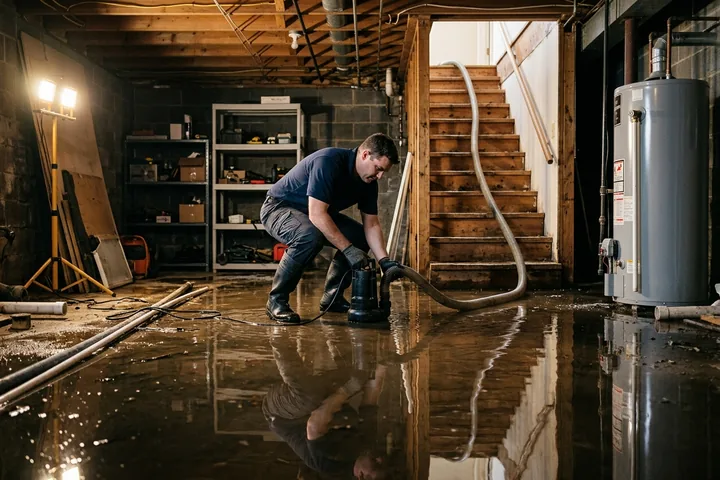
Basement Flood Cleanup in Fort Lee
24/7 basement flood cleanup in Fort Lee, NJ. IICRC-certified, insurance billing accepted. Call (855) 650-7422.
Our IICRC-certified technicians are dispatched from our Fair Lawn, NJ headquarters and are typically on-site in Fort Lee within 60 minutes of your call.
When the Palisades cliffs funnel a hard rain down toward Fort Lee’s older streets, basements in Coytesville and The Hill can go from dry to ankle-deep in less than an hour. The steep-grade drainage that makes this borough visually dramatic is the same force that overwhelms window wells, floor drains, and aging sump pits, and once water is inside, the clock starts immediately. The Restoration Group responds 24/7 to basement flood cleanup calls across Fort Lee (07024), bringing industrial extraction and drying equipment to properties that range from prewar two-families to the dense high-rise towers lining the Palisades.
Why Fort Lee Properties See Basement Flood Cleanup Issues
Fort Lee’s geography is the root cause of most storm-related basement losses. The borough sits atop the Palisades escarpment, and when rainfall exceeds what the municipal storm system can carry, runoff accelerates downhill through residential streets rather than dispersing gradually across flat terrain. Tropical Storm Ida in 2021 illustrated this pattern across all of Bergen County, communities on elevated, rocky ground saw rapid surface flooding that overwhelmed basement waterproofing systems that had held for decades.
Beyond storm events, the building stock itself creates vulnerability. Coytesville and The Hill contain a significant share of prewar and mid-century homes built on rubble-stone or poured-concrete foundations that were never designed with modern drainage membranes. These foundations wick groundwater laterally during prolonged wet periods, producing slow seepage that is easy to dismiss until finished materials are already saturated. Meanwhile, the high-rise towers near the George Washington Bridge and the Hudson Lights mixed-use complex face a different problem: a single supply-line failure or appliance leak on an upper floor can migrate through concrete slabs and appear as standing water in a sub-grade mechanical room or parking level, sometimes floors below the actual source.
Our Basement Flood Cleanup Process in Fort Lee
The first priority on arrival is source control, if water is still entering, we identify whether it is groundwater intrusion, a failed sump pump, a broken supply line, or storm-driven backflow. Each source requires a different containment step before extraction begins.
Once the inflow is stopped, truck-mounted and portable extractors remove standing water. In Fort Lee’s older homes, this phase often reveals a secondary problem: water has wicked into rubble-stone foundation walls or migrated beneath slab-on-grade floors where standard surface extraction cannot reach it. We use thermal imaging cameras and calibrated moisture meters to map the full extent of saturation, including areas that appear dry to the eye but are holding moisture inside wall cavities or under flooring.
Structural drying follows, using high-capacity air movers and refrigerant dehumidifiers placed according to the IICRC S500 standard for water damage restoration. Drying logs are recorded daily, which matters when an insurance adjuster or a co-op board requests documentation of the drying timeline. We do not close out a job until readings confirm materials have returned to acceptable moisture levels, not just until the floor looks dry.
Fort Lee Insurance & HOA Coordination
Fort Lee’s condominium and co-op towers add a coordination layer that single-family basement jobs do not require. When a unit owner’s basement storage area or a building’s sub-grade mechanical space is affected, the question of which policy responds, the unit owner’s HO-6 or the building’s master policy, depends on the source of the loss and the governing documents. We document the loss origin carefully because that distinction drives the entire claim.
For high-rise buildings near the Main Street corridor, building managers often require that restoration contractors carry specific insurance minimums and submit certificates of insurance before work begins. The Restoration Group is a licensed NJ Home Improvement Contractor through the NJ Division of Consumer Affairs and an IICRC Certified Firm (#210213), which satisfies most building management requirements without delay. We work directly with adjusters and provide the photo documentation, moisture logs, and scope of work that carriers need to process a claim efficiently.
Local Note
In Fort Lee’s prewar homes, particularly the older stock in Coytesville, basement walls are frequently rubble-stone construction pointed with lime mortar rather than modern Portland cement. When these walls take on water, the mortar absorbs and retains moisture long after the stone face reads dry on a pin-type meter. We use non-invasive impedance meters against the wall surface to detect residual moisture inside the mortar joints, which prevents a premature close-out that would leave conditions favorable for mold growth behind finished framing.
If you are dealing with standing water or saturated materials in your Fort Lee basement, call (855) 650-7422 any time, day or night. We will assess the source, extract the water, and dry the structure completely so that one weather event does not turn into a mold problem or a structural issue that follows you for years.
Serving Fort Lee from our Fair Lawn headquarters — ★ 4.8 · 160 Google reviews
“The folks at TRG were professional, punctual, and pleasant to deal with. They did a great job addressing our issue and performed appropriate follow up to ensure our satisfaction.” — Jw, August 2026Read our reviews on Google →
Basement Flood Cleanup in Fort Lee: Service Coverage
Frequently Asked Questions
How fast can you arrive for basement flood cleanup in Fort Lee?
How quickly can The Restoration Group reach a basement flood emergency in Coytesville or The Hill?
Fort Lee has a lot of high-rise condos near the GWB — does basement flood cleanup work differently in those buildings?
My Fort Lee basement flooded during a heavy storm — is this covered by homeowners insurance?
What makes basement flooding in Fort Lee's older prewar homes harder to dry than a newer construction home?
How long does basement flood cleanup typically take in a Fort Lee property?
Basement Flood Cleanup response in Fort Lee
Most Fort Lee calls see a technician on-site within 60 minutes from our Fair Lawn headquarters.