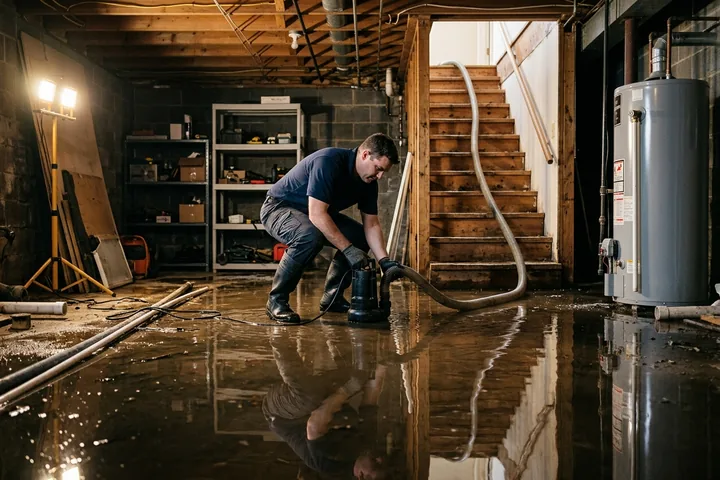
Basement Flood Cleanup in Hoboken
24/7 basement flood cleanup in Hoboken, NJ. IICRC-certified, insurance billing accepted. Call (855) 650-7422.
Our IICRC-certified technicians are dispatched from our Fair Lawn, NJ headquarters and are typically on-site in Hoboken within 60 minutes of your call.
Hoboken’s basement flood problem isn’t just about heavy rain, it’s about geography. The city sits on what was once tidal marsh along the Hudson, and that low-lying foundation means water has nowhere to go when the combined sewer system backs up. Residents of Downtown Hoboken and Southwest Hoboken know this firsthand: after Ida in 2021, basement units and below-grade spaces filled with sewage-laced water within hours of the storm’s peak. When that happens, the clock starts immediately, not just for your belongings, but for the structure itself.
Why Hoboken Properties Flood Differently Than Most
The ZIP code 07030 covers one of the most flood-vulnerable urban footprints in New Jersey. Hoboken’s housing stock is dominated by 19th-century brownstones and brick rowhomes, most of which were built before modern waterproofing standards existed. Below-grade units, garden apartments, finished basements, utility rooms, sit directly against unreinforced masonry foundations that wick groundwater laterally, not just from above. After a heavy rain event, moisture can appear in a basement wall hours after the surface water has receded, because it’s traveling through the brick itself.
The city’s combined sewer system compounds the risk. When storm volume overwhelms capacity, the overflow doesn’t just pool on the street, it pushes back through floor drains and utility connections into the lowest point of the building. That means basement flood water in Hoboken is frequently a Category 3 loss (sewage-contaminated), not the cleaner Category 1 or 2 water you’d see from a burst supply line. The cleanup protocol is meaningfully different: affected materials must be treated as contaminated, and personal protective equipment requirements for the crew are stricter.
Aging plumbing adds another layer. Many of the rowhomes between Uptown and the Waterfront share party-wall drain stacks that were installed decades ago. A failure in one unit can push water into adjacent spaces, and in a multi-family building, that can mean three or four separate units affected by a single pipe event.
Our Basement Flood Cleanup Process in Hoboken
The first step on any job is water classification, we need to know whether we’re dealing with groundwater intrusion, a pipe burst, or sewer backup before any equipment goes in. That determination drives everything else: what protective gear the crew wears, which materials can be dried in place versus removed, and how we document the loss for your insurance carrier.
Once the source is identified and stopped, extraction comes next. In Hoboken’s below-grade spaces, that often means truck-mounted extraction units staged on the street, with hose runs down stairwells, not the easiest access geometry, but one we’re accustomed to in dense urban rowhouse blocks. After bulk water is removed, we use thermal imaging cameras to find moisture hidden inside masonry walls and under flooring. In buildings where the original plaster and lath are still intact, readings at the surface can look dry while the substrate behind them holds significant moisture, a reading that would pass a quick check but fail a thorough one.
Drying equipment, industrial dehumidifiers and air movers, is then positioned to move air through the affected cavity. Because Hoboken basements are often low-ceiling, brick-walled spaces with limited airflow, drying timelines can run longer than they would in a newer home with framed walls and open ductwork. We monitor daily with calibrated moisture meters and adjust equipment placement until readings return to baseline.
All work is performed by our IICRC Certified Firm (#210213) crew and documented with photos, moisture logs, and a drying report, the same paperwork your insurance adjuster will ask for.
Hoboken Insurance and HOA Coordination
Sewer backup losses are among the most frequently disputed water damage claims in New Jersey, and Hoboken properties generate a disproportionate share of them. Standard homeowner policies often exclude sewer backup unless a rider is in place, something many residents discover for the first time after a storm event. We document the loss thoroughly regardless of coverage status, because that documentation matters whether you’re filing a claim, pursuing a landlord, or disputing a denial.
For multi-unit buildings, common throughout Hoboken’s rowhouse blocks, we’re experienced in coordinating with building owners and property managers when a single event affects multiple units. We can scope each affected space separately and produce individual reports where the carrier or HOA requires them.
Local Note
In Hoboken’s older brownstones, particularly those on the blocks closest to the former rail yards near Hoboken Terminal and along the Southwest Hoboken flats, basement floors are sometimes original bluestone or brick-set pavers over a sand bed, not poured concrete. Water extraction in these spaces requires a different approach: the pavers themselves can be lifted and dried separately, and the sand substrate beneath often needs to be partially excavated and replaced if it has absorbed sewage-contaminated water. It’s a detail that matters for both the remediation outcome and the scope you submit to your carrier.
If your basement has flooded and you’re in Hoboken, call The Restoration Group at (855) 650-7422. We respond around the clock, and we know what below-grade water damage looks like in this city’s specific building stock, from the brick foundations near Castle Point to the newer waterfront construction along Pier A Park.
Serving Hoboken from our Fair Lawn headquarters — ★ 4.8 · 160 Google reviews
“Teams were very prompt and respectful.. company responded quickly and kept in touch” — Peggy, August 2026Read our reviews on Google →
Basement Flood Cleanup in Hoboken: Service Coverage
Frequently Asked Questions
How fast can you arrive for basement flood cleanup in Hoboken?
How quickly can The Restoration Group reach a flooded basement in Hoboken?
After a sewer backup in Southwest Hoboken, is my basement considered contaminated even if the water looks clear?
My Hoboken brownstone has original plaster walls in the basement. Does that change the drying process?
Does Hoboken's combined sewer system affect whether my insurance claim will be covered?
My building near the Waterfront has multiple units affected by one pipe failure. Can you scope each unit separately?
Basement Flood Cleanup response in Hoboken
Most Hoboken calls see a technician on-site within 60 minutes from our Fair Lawn headquarters.