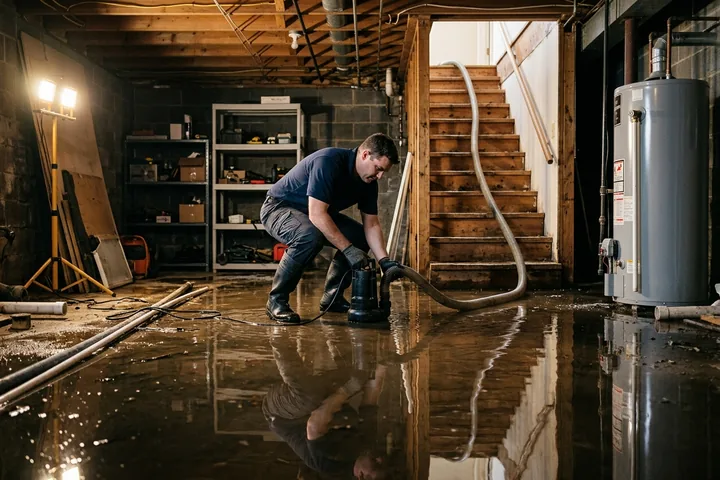
Basement Flood Cleanup in Jersey City
24/7 basement flood cleanup in Jersey City, NJ. IICRC-certified, insurance billing accepted. Call (855) 650-7422.
Our IICRC-certified technicians are dispatched from our Fair Lawn, NJ headquarters and are typically on-site in Jersey City within 60 minutes of your call.
When Ida’s rainfall hit Jersey City in September 2021, basements from Bergen-Lafayette to Journal Square filled in hours — not because of roof leaks or burst pipes, but because the city’s combined sewer system simply couldn’t keep pace. That’s the particular challenge of basement flooding here: the water often arrives from below, through floor drains and cracked slab joints, carrying whatever the municipal sewer holds. The Restoration Group responds 24/7 and brings the documentation discipline that Jersey City’s mix of century-old rowhouses and modern condo towers both demand.
Why Jersey City Basements Flood Differently Than Most
Jersey City sits on low-lying ground between the Hudson River and Newark Bay, and significant portions of the city — particularly the older residential blocks in The Heights and Greenville — were developed before modern storm-sewer separation was standard. When heavy rain overwhelms the combined system, sewage-laced water backs up through floor drains. That’s a categorically different problem than a burst supply line: it’s Category 3 water under IICRC standards, meaning porous materials that contact it — wood framing, concrete block, drywall, insulation — require removal rather than drying in place.
The waterfront story is different but equally complicated. At Newport and along the Exchange Place corridor, high-rise buildings stack dozens of residential units above shared mechanical spaces. A single riser failure or appliance supply-line burst in a lower unit can wick into concrete decking and travel laterally before anyone notices. Building management in these towers needs unit-by-unit moisture mapping and written drying logs — not just a dry basement — because the condo association’s insurer will ask for them.
Then there’s the housing stock itself. Brownstones and frame rowhouses built between the 1890s and 1920s are common across ZIP codes 07304 and 07306. Their rubble-stone or brick foundations were never designed to be waterproof; they rely on exterior drainage that degrades over decades. Once water finds a path through the mortar joints, it tends to find it again.
Our Basement Flood Cleanup Process in Jersey City
The first thing that changes the process here is source classification. Before any equipment goes in, we identify whether the water is clean supply-line overflow, gray water from a drain backup, or black water from a sewer event. That determination controls everything downstream: what PPE the crew wears, which materials can be dried versus removed, and how we document the loss for your carrier.
For sewer-backup events — the most common call we get from older Jersey City neighborhoods — the sequence runs: containment and safety assessment, standing water extraction, removal of contaminated porous materials, antimicrobial treatment of structural surfaces, and then controlled drying of what remains. We use thermal imaging cameras to find moisture that has migrated behind plaster or block walls before it becomes a mold problem. Mold colonization can begin within 24 to 48 hours in a wet basement; the goal is to get structural moisture readings trending down well before that window closes.
For high-rise units, we add a documentation layer: room-by-room moisture readings recorded by unit number, timestamped photos of affected assemblies, and a written drying log formatted for the building’s insurance adjuster. Condo boards in Jersey City have learned — often the hard way — that an undocumented dry-out creates disputes when a neighboring unit reports damage weeks later.
Jersey City Insurance and HOA Coordination
Sewer backup coverage is a rider, not a standard feature of most homeowner policies — and many Jersey City homeowners don’t realize they don’t have it until they’re standing in two inches of contaminated water. We document the loss thoroughly regardless, because the paperwork you generate now determines what your adjuster can approve later. We photograph affected materials before removal, record moisture readings at every inspection point, and provide a written scope that carriers and public adjusters can work from directly.
For condo owners in buildings managed by an HOA, the question of whose policy responds — the unit owner’s or the master policy — depends on where the water originated and what the association’s bylaws say. We’ve worked through enough of these situations to know that getting the building manager involved early, and keeping documentation unit-specific, prevents the coverage disputes that drag on for months.
Reaching Jersey City from Kenilworth
From our Kenilworth base, the most direct route into Jersey City runs via the New Jersey Turnpike to Routes 1 and 9, entering the city through the southern neighborhoods before working north. The Heights and Journal Square are accessible via Routes 139 and 1/9 through the Holland Tunnel approach corridor. Because we operate 24/7, we’re not fighting the Lincoln or Holland Tunnel backup that defines daytime response times for Manhattan-based crews — overnight and weekend calls into Jersey City move significantly faster.
Local Note
In Jersey City’s older rowhouse blocks — particularly in Bergen-Lafayette and parts of Greenville — basement walls are often a combination of original rubble-stone foundation and later brick infill, sometimes with a thin parge coat of mortar that reads visually intact but has lost its bond. Moisture meters used on these surfaces can give misleadingly low readings because the sensor is contacting the dry parge layer, not the saturated stone behind it. We use both pin-type and non-invasive sensors in combination, and in some cases thermal imaging, to get an accurate picture of what’s actually wet. A basement that looks dry on the surface after extraction can still have saturated foundation walls that will grow mold and damage finished framing if not addressed.
If your basement took on water — from a storm drain backup, a sewer event, or a supply-line failure — call The Restoration Group at (855) 650-7422. We’re available around the clock, and we bring the documentation Jersey City properties require.
Basement Flood Cleanup in Jersey City: Service Coverage
Frequently Asked Questions
How fast can you arrive for basement flood cleanup in Jersey City?
How quickly can The Restoration Group reach a flooded basement in The Heights or Bergen-Lafayette?
Jersey City had major sewer backups during Ida — does that change how basement flood cleanup is handled compared to a regular pipe burst?
I own a condo in a Newport high-rise and the flood originated in a unit above mine — whose insurance handles it, and how does documentation work?
How long does basement flood cleanup typically take in Jersey City's older brownstone and rowhouse stock?
Does sewer backup coverage apply to basement flooding in Jersey City, and what documentation do I need for a claim?
Basement Flood Cleanup response in Jersey City
Most Jersey City calls see a technician on-site within 60 minutes from our Fair Lawn headquarters.