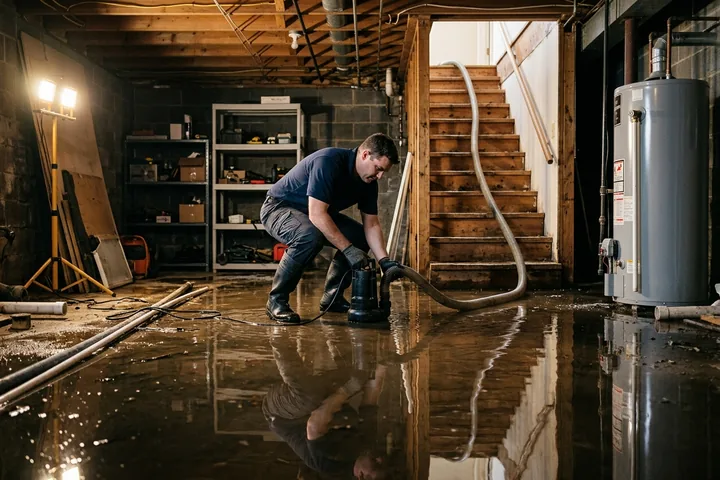
Basement Flood Cleanup in New Brunswick
24/7 basement flood cleanup in New Brunswick, NJ. IICRC-certified, insurance billing accepted. Call (855) 650-7422.
Our IICRC-certified technicians are dispatched from our Fair Lawn, NJ headquarters and are typically on-site in New Brunswick within 60 minutes of your call.
The Raritan River has always defined New Brunswick’s southern edge, and after Tropical Storm Ida pushed floodwater into low-lying riverfront blocks near Boyd Park in 2021, the city’s vulnerability to basement flooding became impossible to ignore. But the Raritan is only part of the story. From the aging rowhouses near Rutgers Village to the postwar multifamily stock in Edgebrook, New Brunswick basements flood for a long list of reasons, and when they do, the window for preventing secondary damage is measured in hours, not days. The Restoration Group responds 24/7 from Kenilworth to help property owners stop the loss before it compounds.
Why New Brunswick Basements Flood More Than You’d Expect
New Brunswick’s housing stock tells the story before a single pipe breaks. Much of the residential fabric in the 08901 and 08903 ZIP codes was built in the early twentieth century, when cast-iron drain lines and galvanized supply pipes were standard. Those materials are now well past their design life. Cast iron corrodes from the inside out, and the first sign of failure is often a slow seep that saturates a basement floor over weeks before it becomes an obvious flood.
The city’s density compounds the problem. Rowhouses and multifamily buildings share party walls and common drain stacks, so a failed line in one unit can push water into an adjacent basement with no warning. Near Rutgers University, student rental turnover means deferred maintenance is common, appliance hose connections, sump pump batteries, and water heater pressure relief valves go uninspected for years at a stretch. When they fail, they fail completely.
Soil and topography matter too. The low-lying blocks between downtown and the Raritan carry a high water table, especially after prolonged rain. Hydrostatic pressure against foundation walls, many of them unreinforced block or rubble stone, can push groundwater through cracks that were invisible during dry months. This is a different mechanism than a burst pipe, and it requires a different response.
Our Basement Flood Cleanup Process in New Brunswick
Every basement flood cleanup starts with a moisture assessment, not a mop. Before any water is moved, the crew maps the full extent of saturation using thermal imaging and calibrated moisture meters. In New Brunswick’s older construction, this step is especially important: plaster walls and original hardwood subfloors can read dry at the surface while holding significant moisture behind the finish layer. Missing that hidden saturation is how mold colonies establish themselves within 48 to 72 hours of a water event.
Once the scope is confirmed, standing water is extracted using truck-mounted and portable extraction units. Affected materials, insulation, drywall, base trim, are removed to the flood cut line to expose framing and allow airflow. Industrial desiccant and refrigerant dehumidifiers, paired with high-velocity air movers, are positioned to dry the structural cavity, not just the visible surface. Drying is monitored daily against the IICRC S500 standard until readings return to pre-loss baselines.
Throughout the process, documentation is built in parallel: moisture logs, photo records, and a written scope of loss that your insurance carrier can use directly. As an IICRC Certified Firm (#210213) and NJ Licensed Home Improvement Contractor, the work meets the documentation standards most carriers require before approving a claim.
Reaching New Brunswick from Kenilworth
Kenilworth sits roughly 20 miles from New Brunswick via the Garden State Parkway to Route 1, a route that stays accessible around the clock. For properties near the George Street business district or the hospital corridor around Robert Wood Johnson University Hospital, the approach via Route 18 or Albany Street keeps the crew off the most congested downtown blocks. For residential addresses in Edgebrook or along the Highland Park border, Route 27 through Edison is often the cleaner path depending on traffic conditions.
Because the crew is dispatched 24/7, response happens on your timeline, not the next business morning.
New Brunswick Insurance Coordination
Basement flood claims in New Brunswick split into two categories that carriers treat very differently: sudden and accidental losses (burst pipe, appliance failure) versus gradual seepage or groundwater intrusion. The distinction matters because standard homeowner policies typically cover the former and exclude the latter. Documentation gathered at the start of the job, including the failure point, the water’s entry path, and the timeline of visible damage, is what supports a covered claim and keeps your adjuster from reclassifying the loss.
For commercial properties along the George Street corridor or institutional buildings near the university, the documentation requirements are higher and the scope of loss often involves multiple tenants or shared systems. The Restoration Group prepares line-item estimates formatted for commercial carrier review.
Local Note
In New Brunswick’s Fifth Ward and Rutgers Village, many basement floors are original poured concrete from the 1920s and 1930s, low-grade mix, often without a vapor barrier beneath it. After a flood event, that slab absorbs water like a sponge and releases it slowly back into the air long after the visible standing water is gone. Crews that skip daily moisture readings on these slabs and pull equipment too early leave behind elevated humidity levels that drive mold growth in the framing above. Drying a 1920s New Brunswick basement correctly takes longer than drying a modern poured slab, and the monitoring schedule has to reflect that, not a standard regional average.
If your basement has flooded and you are in New Brunswick or the surrounding area, call The Restoration Group at (855) 650-7422. The crew is available around the clock, and the sooner extraction begins, the narrower the window for secondary damage stays.
Serving New Brunswick from our Fair Lawn headquarters — ★ 4.8 · 160 Google reviews
“(Translated by Google) Excellent work. The staff were responsible, friendly, and above all, very clean. I was very satisfied and I recommend them 100%. (Original) Excelente trabajo.el personal responsables,amables y sobre todo muy limpios para trabajar .quedé satisfecha y lo recomiendo al 💯.” — Dessy, September 2026Read our reviews on Google →
Basement Flood Cleanup in New Brunswick: Service Coverage
Frequently Asked Questions
How fast can you arrive for basement flood cleanup in New Brunswick?
Are basements in New Brunswick's older rowhouse neighborhoods more prone to recurring flood damage?
How does the Raritan River's flood history affect basement cleanup decisions in low-lying parts of New Brunswick?
Will my insurance cover basement flooding in New Brunswick, and how does the cause affect my claim?
How long does basement flood drying typically take in New Brunswick's early-1900s construction?
Do commercial properties near the George Street corridor or downtown New Brunswick require different documentation for a flood claim?
Basement Flood Cleanup response in New Brunswick
Most New Brunswick calls see a technician on-site within 60 minutes from our Fair Lawn headquarters.