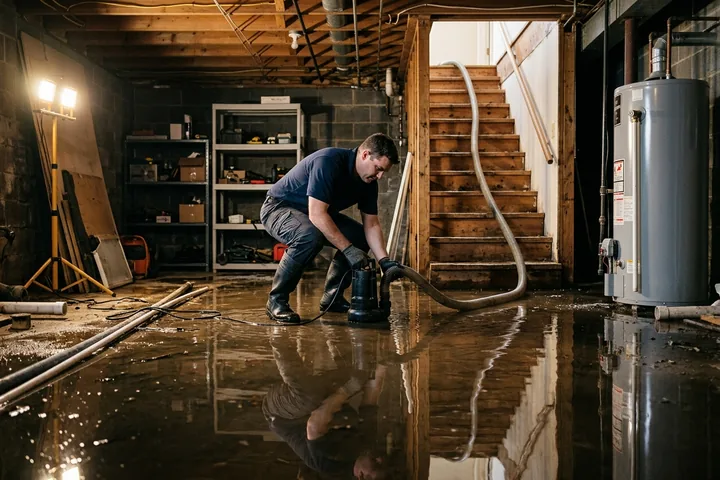
Basement Flood Cleanup in Staten Island
24/7 basement flood cleanup in Staten Island, NY. IICRC-certified, insurance billing accepted. Call (855) 650-7422.
Our IICRC-certified technicians are dispatched from our Kenilworth, NJ headquarters and are typically on-site in Staten Island within 60 minutes of your call.
When the East Shore floods, and after Sandy in 2012 and Ida in 2021, Staten Island knows it will flood again, the water doesn’t stop at the front door. It finds the basement. Whether you’re dealing with a storm surge that crept under a South Beach split-level or a cast-iron drain that finally gave out in a Port Richmond row house, standing water in a basement moves fast: soaking into framing, wicking up drywall, and giving mold a foothold within 24 to 48 hours. The Restoration Group operates around the clock, and with a crew base on Staten Island, we can get equipment on-site before that window closes.
Why Staten Island Basements Flood More Than You’d Expect
The borough’s geography sets up a perfect storm for basement water intrusion. Much of the South Shore sits on low-lying, poorly draining fill, the same soil conditions that made Oakwood Beach and Midland Beach so catastrophically vulnerable during Sandy. Even on a routine nor’easter, groundwater rises fast enough to push through foundation walls that are decades past their waterproofing life.
The housing stock makes it worse. The postwar Cape Cods and split-levels that fill neighborhoods like Great Kills and New Dorp were built in the 1950s and 1960s with poured concrete or concrete block foundations, materials that develop hairline cracks over time and let water migrate laterally through the wall, not just up through the floor drain. Older frame homes near St. George, some dating to the early 1900s, often have rubble-stone foundations with no meaningful moisture barrier at all.
Then there’s the plumbing. Aging cast-iron supply and drain lines throughout the borough are at the end of their service life. A pipe that holds through summer can split when January temperatures drop and the ground shifts. When that happens in a finished basement, you’re dealing with both category-2 or category-3 contaminated water and structural materials that have been absorbing moisture for hours before anyone noticed.
Our Basement Flood Cleanup Process in Staten Island
Every job starts with a thorough moisture assessment, not just the visible puddle, but what’s hiding behind the walls and under the floor. In Staten Island’s older homes, that means probing concrete block cavities and checking beneath any floating laminate or tile that may have trapped water underneath. We use thermal imaging cameras alongside penetrating moisture meters because surface readings alone will miss saturation in block cores and subflooring.
Once we understand the full scope, we extract standing water with truck-mounted and portable units, then establish a drying system calibrated to the space. Basements are notoriously slow to dry because they have limited air exchange and often sit below the dew point of the ambient air. We use industrial desiccant or refrigerant dehumidifiers, whichever the conditions call for, and position high-velocity air movers to pull moisture out of wall cavities, not just off surfaces.
Materials that can’t be saved, saturated fiberglass insulation, compromised drywall below the flood line, buckled subfloor panels, are removed and documented before disposal. Documentation matters for your insurance claim, and we photograph and log affected materials at every stage.
Reaching Staten Island from Our Crew Base
Our Kenilworth, NJ headquarters is a short drive from the Goethals Bridge, and we maintain a crew presence on the island itself, which means we’re not routing every call through New Jersey traffic. For addresses in ZIP codes like 10306 (covering Great Kills and New Dorp) or 10312 (Tottenville and the South Shore), crews can mobilize directly without adding bridge time to an already urgent situation. We answer calls 24 hours a day, every day of the year, because a sump pump failure at 2 a.m. doesn’t wait for business hours.
Insurance Coordination for Staten Island Flood Claims
Basement flood claims on Staten Island often involve a coverage question right at the start: is this a sewer backup, a groundwater event, or a plumbing failure? The answer determines which policy, homeowners, flood (NFIP or private), or an endorsement, applies. We document the loss in a format that supports your adjuster’s investigation, including moisture mapping, photo logs, and a written scope of damage. We bill carriers directly and work with adjusters regularly, so the paperwork doesn’t fall entirely on you during an already stressful situation.
Local Note
In the postwar split-levels common throughout Great Kills and New Dorp, the half-basement design means the finished lower level is partially below grade and partially above it, which changes how water behaves during a flood event. Water often enters through the below-grade wall section but runs toward the above-grade exterior wall before pooling, which means the wettest materials aren’t always where the water entered. Crews who haven’t worked this housing type before sometimes miss saturation in the above-grade wall base. It’s a pattern worth knowing before you start tearing out the wrong wall.
If your basement is holding water right now, call (855) 650-7422. We’ll assess the damage, explain what needs to happen, and get drying equipment in place, so a bad day doesn’t turn into a mold problem that follows you for months.
Serving Staten Island from our Kenilworth headquarters — ★ 4.8 · 160 Google reviews
“(Translated by Google) Excellent work. The staff were responsible, friendly, and above all, very clean. I was very satisfied and I recommend them 100%. (Original) Excelente trabajo.el personal responsables,amables y sobre todo muy limpios para trabajar .quedé satisfecha y lo recomiendo al 💯.” — Dessy, September 2026Read our reviews on Google →
Basement Flood Cleanup in Staten Island: Service Coverage
Frequently Asked Questions
How fast can you arrive for basement flood cleanup in Staten Island?
Are South Shore homes in Staten Island at higher risk for recurring basement flooding?
How quickly can you reach a flooded basement in the 10306 or 10312 ZIP codes?
Does the age of my Staten Island home affect how long basement drying takes?
What's the difference between a flood insurance claim and a homeowners claim for a Staten Island basement flood?
Do you remove and dispose of flood-damaged materials, or just dry what's there?
Basement Flood Cleanup response in Staten Island
Most Staten Island calls see a technician on-site within 60 minutes from our Kenilworth headquarters.