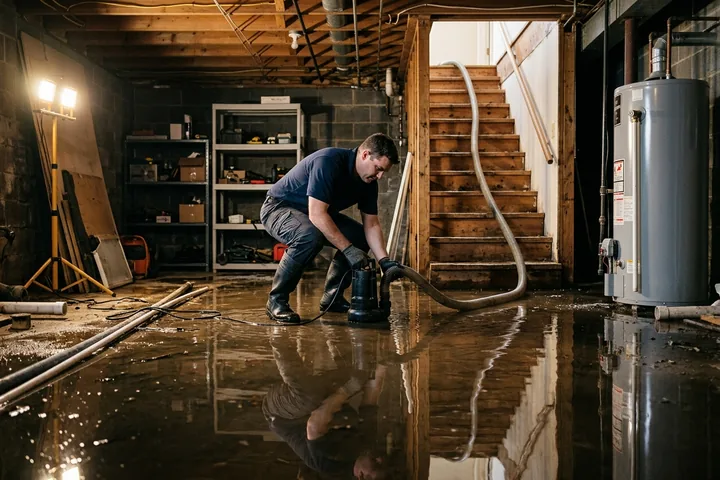
Basement Flood Cleanup in Summit
24/7 basement flood cleanup in Summit, NJ. IICRC-certified, insurance billing accepted. Call (855) 650-7422.
Our IICRC-certified technicians are dispatched from our Fair Lawn, NJ headquarters and are typically on-site in Summit within 60 minutes of your call.
Summit’s steep topography is one of its most distinctive features — and one of its most consequential for homeowners with finished basements. Unlike the river towns downhill along the Passaic, Summit’s elevation keeps it out of most regional flood maps, but that same hillside geography concentrates stormwater into lower levels with surprising force. When a summer cloudburst hits the Franklin School area or a clay sewer lateral backs up under a century-old street tree in the Northside, water doesn’t trickle into a basement — it arrives fast, and it finds every crack in a 1910 stone foundation before you’ve had a chance to move a single piece of furniture.
Why Summit Basements Flood the Way They Do
The housing stock in 07901 tells the story. Most of Summit’s residential blocks were built between the 1890s and the 1930s, when deep, fully excavated basements were standard — often finished with plaster walls, hardwood floors, and millwork that matches the rooms above. Those basements were built to last, but not to withstand the drainage loads that come with today’s impervious surfaces and aging infrastructure.
Three failure patterns show up repeatedly in Summit:
Stormwater intrusion through foundation walls. Steep lots along the Brayton School area and the hillside streets above Springfield Avenue channel runoff directly against foundation walls. Original drainage systems — clay tile, hand-laid stone — were sized for a different era. When they fail or clog, hydrostatic pressure pushes water through mortar joints that look solid until they’re not.
Sewer lateral backups. Summit’s tree canopy is one of its great assets; the root systems under those trees are not. Clay sewer laterals installed before World War II are routinely compromised by root intrusion, and a single heavy rain event can overwhelm the system and send sewage-contaminated water back through floor drains. This is a Category 3 contamination situation — it requires a different response than a clean water pipe burst.
Burst supply and radiator lines in older wings. During hard freeze events, uninsulated plumbing in older additions and attic-fed radiator systems can fail inside walls. By the time water appears in the basement, it has often traveled through plaster and lath on multiple floors.
Our Basement Flood Cleanup Process in Summit
The process starts with a thorough moisture assessment before any equipment is placed. In Summit’s older homes, surface readings lie — a plaster wall can feel dry to the touch while the lath behind it holds significant moisture. Thermal imaging and penetrating moisture meters give a complete picture of where water has traveled, which matters enormously when you’re dealing with original hardwood floors and built-in millwork that can’t simply be replaced from a lumber yard.
Water source classification comes next. Clean water from a burst supply line is handled differently than a backed-up sewer lateral. Category 3 losses require EPA-compliant containment, appropriate PPE, and antimicrobial treatment protocols — steps that protect both the occupants and the crew.
Extraction, structural drying, and monitoring follow a plan calibrated to the specific materials in the space. Plaster releases moisture more slowly than modern drywall, and original hardwood flooring requires controlled drying conditions to avoid cupping and delamination. Drying equipment is positioned based on the room geometry, not a generic template, and moisture readings are logged at each visit so the drying curve is documented — something insurance adjusters and homeowners both need to see.
Final clearance is confirmed with the same instruments used at the start, not by visual inspection alone.
Getting to Summit from Kenilworth
The Restoration Group operates out of Kenilworth, which puts Summit roughly 20–25 minutes away via Route 22 to Springfield Avenue — a direct corridor into the heart of Summit’s residential neighborhoods. Because we’re available around the clock, a call at 2 a.m. when a pipe bursts near the Summit train station gets the same response as a call on a Tuesday afternoon. Crews stage equipment before leaving, so arrival means work starts immediately.
Insurance Documentation for Summit Losses
Basement flood claims in Summit frequently involve high-value contents — antique furniture, built-in cabinetry, original hardwood, period lighting. Thorough photo documentation, moisture logs, and itemized scope reports matter more here than in a newer construction market. The Restoration Group provides the documentation carriers need to evaluate the full scope of the loss, and we work directly with adjusters so the claim process doesn’t fall on the homeowner to manage alone.
Local Note
In Summit’s older homes — particularly on the hillside blocks between Downtown Summit and the New Providence border — finished basements often have original plaster on poured concrete or stone walls rather than modern framing. When water intrudes, that plaster can absorb and hold moisture for days without showing obvious surface damage. Homeowners who dry the floor and run a box fan sometimes think the problem is solved, only to find mold colonizing behind the baseboard a few weeks later. Moisture mapping that goes beyond the visible wet area is the only reliable way to confirm a basement is actually dry in this housing stock.
If your basement in Summit has taken on water — whether from a backed-up drain, a burst pipe, or stormwater pushing through the foundation — call The Restoration Group at (855) 650-7422. We’ll assess the full extent of the loss, protect what’s in the space, and dry it to a documented standard.
Basement Flood Cleanup in Summit: Service Coverage
Frequently Asked Questions
How fast can you arrive for basement flood cleanup in Summit?
Are Summit's older finished basements harder to dry than modern ones?
My Summit basement flooded from a backed-up floor drain after heavy rain — is that treated differently than a pipe burst?
How quickly can The Restoration Group reach the Northside or Downtown Summit after a call?
Summit's tree roots have cracked my clay sewer lateral before — does that affect how you handle the cleanup inside the house?
What does insurance documentation look like for a basement flood claim in a high-value Summit home?
Basement Flood Cleanup response in Summit
Most Summit calls see a technician on-site within 60 minutes from our Fair Lawn headquarters.